
What Is a Nerve Root Block and How Does It Help Back Pain in UAE?
Does sitting all day cause herniated discs?
Not directly. Studies show a modest association between prolonged sitting and back pain, but sitting alone is not proven to cause disc herniation. A combination of low activity, poor conditioning, sudden loading and individual factors is more likely.
Is disc degeneration at 25 normal?
Imaging studies show that some disc degeneration is present in a considerable proportion of young adults with no symptoms, around 37 percent at age 20 in one major review. It is not necessarily a sign of a problem.
How often should I get up from my desk?
A common recommendation is every 30 to 45 minutes, even for a minute or two. The exact interval matters less than breaking up long unbroken periods of sitting.
Will a standing desk fix my back pain?
It may help some people by encouraging posture changes, but standing still for long periods is not ideal either. Alternating positions and moving regularly works better than any single setup.
Can young people have disc surgery?
Yes, when indicated, though most disc problems in younger adults improve without surgery. Surgery is considered when there is persistent nerve pain, progressive weakness or severe symptoms that have not improved with non-surgical treatment.
Should I get an MRI if my back hurts at work?
Usually not at first. Most back pain improves with time and movement, and imaging often shows changes unrelated to symptoms. An MRI is reasonable if there are nerve symptoms, weakness, red flags or persistent pain.
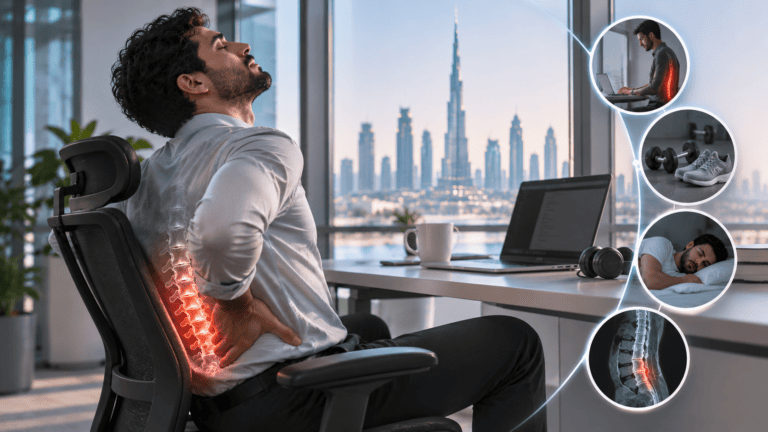
A familiar scene in many Dubai offices: a colleague in their late twenties or early thirties, perfectly fit by every other measure, leaning on one hip because sitting hurts. Ask around and several others have a similar story. It feels as though disc problems are arriving earlier than they used to.
Is that true, and if so, why? The honest answer is a mix of “yes, probably in some respects”, “not exactly in the way people fear”, and “much of it is manageable.” This article separates what is well supported from what is assumed.
Are disc problems really starting earlier?
There is genuine evidence that musculoskeletal pain is very common among younger workers in the UAE. A study of 507 young technology workers reported that roughly three-quarters had work-related musculoskeletal symptoms, with low back pain the most frequent complaint at around 48 percent. A separate study of Dubai school students found back pain in about 65 percent of 184 participants. These are cross-sectional studies, meaning they capture how common symptoms are at one point in time. They do not prove that desk work causes disc disease, and they cannot tell us whether rates are higher than a generation ago.
What we can say with confidence is that back pain is common in young adults, and that sedentary work is a recognised contributor to it. Whether that equals early disc degeneration is a separate question, and it deserves a careful answer.
Does sitting actually damage discs?
The evidence is more nuanced than headlines suggest. A systematic review by Chen and colleagues in 2009 examining sitting at work and low back pain concluded that evidence for a clear causal link between sitting itself and back pain was limited. Later analyses, such as a 2021 meta-analysis by Prince and colleagues, found a small association between prolonged sitting and low back pain, with an odds ratio of around 1.19, meaning roughly a 19 percent higher odds. That is a modest effect, not a dramatic one.
So the careful summary is this:
- Sitting for long periods is associated with more back pain, but the effect is small to moderate
- Sitting is not uniquely harmful; static posture of any kind for hours can stress the spine
- Other factors, including fitness, sleep, stress, smoking and job satisfaction, matter at least as much
In other words, the problem is less “sitting” than “sitting for hours, without moving, while otherwise inactive.”
What about disc changes on scans?
Here is where expectations often go wrong. Many young people are told after an MRI that they have disc degeneration, bulges or protrusions, and conclude that their spine is “ageing too fast.” The data suggest otherwise.
A large review of imaging studies in people without back pain, led by Brinjikji and published in the American Journal of Neuroradiology in 2015, found that disc degeneration was present in about 37 percent of people aged 20 who had no symptoms, disc bulges in around 30 percent, disc protrusions in about 29 percent and annular fissures in roughly 19 percent. By age 50 these rates were much higher.
These findings matter because they show that some degree of disc change is a normal feature of the spine, even in young adults, and often causes no trouble. Disc changes on a scan, in other words, are not the same thing as a disc problem. A scan can look alarming in a person who feels fine, and look unremarkable in someone in significant pain. This is the central reason a Spine Imaging Doctor in Dubai will never treat a scan report in isolation.
So why might more young people be noticing symptoms?
Several things probably contribute, and none of them need disc “failure” to explain.
Long, unbroken sitting
Desk workers can sit for several hours at a time, with the lumbar spine flexed or slumped and the hip flexors shortened. The discs tolerate varied loading better than constant loading.
Low overall activity
Many people sit all day, commute by car, and then rest in the evening. Deconditioned muscles around the spine provide less support, and the discs and joints take more strain.
Screens and posture
Laptops encourage a forward head and rounded upper back. The neck and upper back are particularly affected, and the load travels down the spine. ### Sudden bursts of activity
A sedentary week followed by a heavy gym session, or a weekend of moving furniture, is a common recipe for a disc injury. Discs prefer consistent loading to occasional spikes. Dr. Sherief Elsayed, Consultant Spine Surgeon in Dubai, notes that a disc prolapse can even occur while bending at the dishwasher, particularly if the disc was already close to giving way, and that good bending and lifting technique reduces the risk.
Stress and sleep
Mental strain, long working hours and poor sleep raise the sensitivity of the pain system. People under stress often notice back pain more.
Awareness and imaging
Easy access to scans means more young people are discovering incidental changes, and some then worry or seek treatment. More diagnosis does not always mean more disease.
What does a disc problem actually feel like?
Many people have vague back stiffness at a desk. A true disc herniation tends to have a more specific pattern:
- Pain in the lower back, often with pain travelling down one leg (sciatica) or into an arm if the disc is in the neck
- Pins and needles, numbness or weakness in the limb
- Pain that worsens with sitting, bending, coughing or sneezing
- Relief in certain positions, such as standing or walking
A Slipped Disc Doctor in Dubai can explain how these discs are assessed and treated. Most herniations improve over weeks to months with conservative treatment, because the body can reabsorb the herniated material.
What can desk workers do?
The strongest evidence supports a handful of simple habits.
- Break up sitting. Stand, walk or change position every 30 to 45 minutes. Short breaks work better than a single long one.
- Move more overall. Walking, swimming and strength training are good for spinal health. Swimming in particular engages the core without loading the spine.
- Set up your workstation sensibly. Screen at eye level, feet flat, hips and knees at roughly right angles, and lumbar support if you need it.
- Strengthen your core and hips. Muscles that control the trunk share load with the discs. A Core Strengthening Spine Doctor in Dubai can give you a practical starting point.
- Learn to bend and lift well. Hinge at the hips and knees, keep the load close, and avoid twisting while lifting.
- Avoid smoking. Smoking is associated with poorer disc health and slower healing.
- Build up exercise gradually. Sudden jumps in intensity are a frequent cause of injury.
- Look after sleep and stress. Both influence how the body perceives and recovers from pain.
Standing desks and ergonomic chairs can help some people, but evidence that any particular piece of equipment prevents back pain is limited. Regular movement matters more than the furniture.
When should you see a specialist?
Most episodes settle with time and movement. Consider assessment if:
- Pain has continued for more than four to six weeks
- Pain radiates into the leg or arm with tingling or numbness
- You notice weakness, such as a foot dragging
- Symptoms are interfering with sleep, work or daily life
- You are unsure whether your scan result matters
Seek urgent care for numbness between the legs, difficulty passing urine, or loss of bladder or bowel control, as these can indicate compression of the nerves at the base of the spine.
Treatment usually starts with non-surgical care, including physiotherapy, medication and guided exercise. A Spine Care Doctor in the UAE can describe the range of options, and a Desk-Related Back Pain Doctor in Dubai can place that in the wider picture of back problems.
The balanced conclusion
Disc problems in young Dubai desk workers are a real concern in terms of symptoms, and back pain is common in this group. But the evidence does not show that desks are quietly destroying young spines. Disc changes are common in healthy young people, sitting has a small to moderate effect, and the greatest protection comes from regular movement, strength and sensible habits. If symptoms persist or concern you, a proper assessment, rather than a scan alone, is the way to find out what is going on.
Table of Contents
Recent Articles
Why Dubai Desk Workers Are Getting Disc Problems at a Younger Age
What Is a Nerve Root Block and How Does It Help Back Pain in UAE? Does sitting all day cause herniated discs? Not directly. Studies show a modest association between

What Is a Nerve Root Block and How Does It Help Back Pain in UAE?
What Is a Nerve Root Block and How Does It Help Back Pain in UAE? Is a nerve root block painful? Most people describe pressure and a brief sharp sting

Why Long Flights From Dubai Can Trigger Sciatica and Back Pain
Why Long Flights From Dubai Can Trigger Sciatica and Back Pain Can sitting on a plane cause a slipped disc? A long flight does not usually cause a disc to