
Why the Right Spine Diagnosis Matters More Than Surgery in UAE
Why do doctors sometimes disagree about my diagnosis?
Spine symptoms can overlap, and scans often show findings unrelated to pain. Different clinicians may weigh the history, examination and imaging differently. A second opinion helps clarify, particularly before surgery.
Can an MRI be normal when I am in pain?
Yes. Pain can come from muscles, joints or nerves in ways that scans may not show. A normal MRI can be reassuring because it suggests no serious structural problem, though it does not mean the pain is imaginary.
Can an abnormal MRI be unimportant?
Yes. Disc bulges and degeneration are common in people without pain, so an abnormal finding does not always explain symptoms. The key is whether the finding matches your clinical picture.
How do I know if my symptoms come from the spine or the hip?
Hip problems often cause groin pain and pain in the front of the thigh to the knee, and may limit hip rotation. Sciatica usually runs down the back or outer side of the leg, often below the knee. Examination and sometimes an X-ray separate the two.
Is a diagnostic injection useful?
Sometimes. If numbing a specific joint or nerve temporarily removes the pain, it supports that structure as the source. It is a clue to be combined with the rest of the assessment.
What if I have been told I need surgery but I am unsure?
Ask the surgeon how the scan matches your symptoms, what the alternatives are, and what happens without surgery. Seek a second opinion if the explanation does not feel complete.
Ask most people what a spine surgeon does and they will say “operates.” That is only part of the truth. The most consequential thing a spine surgeon does is decide what is wrong, and just as often what is not wrong. Operations are tools. A diagnosis is the map that tells you whether the tool is needed.
This article explains why getting the diagnosis right is worth more than any technique, how a careful assessment works, and what can go wrong when the order is reversed.
Why is diagnosis more important than the operation?
An excellent operation on the wrong problem is a failed operation. If the pain is coming from a hip, a joint at the back of the spine, a nerve in the leg or the muscles, then fixing a disc that merely looks abnormal on a scan will not help. The surgery may have been technically perfect, yet the patient is no better, and sometimes worse.
Dr. Sherief Elsayed, Consultant Spine Surgeon in Dubai, puts it plainly: pain is a symptom, not a diagnosis. The aim is to find the source, not to treat the picture on the screen. A good diagnosis also protects people from surgery they do not need, which, in his words, is half of his job.
Why can’t a scan give the answer by itself?
Scans show structure, not pain. And the spine changes with age in ways that are common and often harmless.
A major review of imaging in people without back pain, led by Brinjikji and published in the American Journal of Neuroradiology in 2015, found that disc degeneration was present in about 37 percent of 20-year-olds with no symptoms, bulging discs in about 30 percent, and that these figures climbed steadily with age. In older adults, most had some degeneration without any pain.
This means three things:
- A scan can show something that looks serious but is not the cause of your symptoms
- A scan can look unremarkable in someone with real pain
- The same finding may be significant in one person and irrelevant in another
This is the heart of why a Consultant Spine Specialist in Dubai insists that an MRI report alone is not enough to decide on treatment. The images need to be interpreted alongside the patient’s story and examination.
What does a proper diagnosis involve?
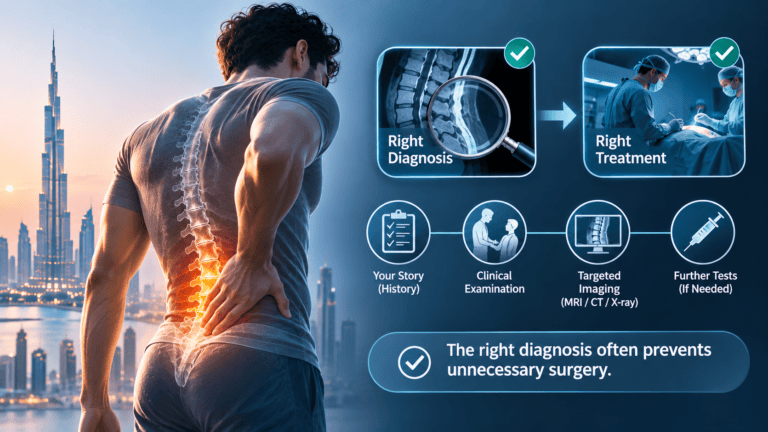
A careful assessment typically has four parts.
1. The history
The way you describe your symptoms contains much of the answer. A good clinician asks about:
- Where the pain is, and where it travels
- What brings it on and what eases it
- Whether you feel numbness, tingling or weakness
- How far you can walk, and what stops you
- Bladder, bowel and sexual function
- Previous injuries, operations and illnesses
- What treatment you have tried
Patterns matter. A patient who can walk about five minutes, needs to rest, finds that bending forward helps and can walk uphill more easily than on the flat is describing a classic picture of spinal stenosis, not a problem of blood vessels. Those distinctions come from asking the right questions.
2. The examination
Examination checks posture, movement, strength, sensation, reflexes and the hips. Findings can reveal which nerve is affected before any scan. For example, pain travelling into the thumb side of the hand suggests the C6 nerve in the neck, while pain along the outside of the foot suggests S1 in the lower back. A stiff hip with groin pain points to a joint problem rather than sciatica.
3. Imaging, used with purpose
MRI, CT and X-rays answer specific questions. They are used to confirm or refute a suspected cause, not to go looking for anything that might be there. The scan should explain the symptoms; if it does not, that matters.
4. Further tests where needed
Blood tests, nerve conduction studies, bone density scans or diagnostic injections can clarify uncertain cases. For example, a targeted injection that removes pain temporarily can confirm that a particular joint or nerve is the source.
What happens when the diagnosis is missed?
The consequences are real, and they run in several directions.
- Unnecessary surgery. Someone is offered a fusion for a degenerate disc that is not the pain generator, and ends up with the same pain plus the risks of an operation. A fusion is something you cannot undo.
- Delayed treatment. Leg pain labelled as sciatica turns out to be a hip problem, and months pass. In one illustrative case, a patient with severe leg pain saw six doctors over eight months before the true cause, a hip condition, was identified.
- Missed red flags. Rare but serious problems, such as infection, tumour or cauda equina syndrome, need prompt recognition. Pain can be mistaken for something routine.
- Wrong non-surgical treatment. Physiotherapy or injections aimed at the wrong target waste time and money.
Many conditions mimic each other. The question of whether leg pain comes from the spine or the circulation, or whether sciatica is actually something else, is a regular challenge. A Leg Pain Spine Doctor in Dubai sees how varied the causes of leg pain can be.
When is surgery the right answer?
When the diagnosis is clear and matches the symptoms, surgery can be very effective. Dr. Sherief Elsayed describes a short set of checks:
- Is there true nerve pain?
- Is it limiting your walking or function?
- Is there any weakness?
- Do the physical findings fit the story?
- Do the images explain the symptoms?
- What has been tried so far, and how did you respond?
If most of these point the same way, an operation may be reasonable. Progressive weakness makes surgery more urgent, because the longer a nerve is compressed, the less likely it is to recover fully. If the scan does not match the symptoms, surgery is usually the wrong answer.
Examples where surgery is clearly appropriate include compression of the spinal cord, progressive neurological loss, cauda equina syndrome, certain fractures and tumours threatening the spinal cord. The detail of these urgent situations is handled by a Spinal Tumour Specialist in Dubai and is described in cauda equina syndrome as a spine emergency.
Why do second opinions help?
A second opinion is a way of testing the diagnosis. Because spine problems are often ambiguous, a fresh look can confirm the plan, refine it, or change direction. It is particularly valuable when:
- An operation has been recommended for back pain alone
- The proposed surgery involves fusion across several levels
- You have been given a frightening prediction, such as “you’ll need surgery eventually”
- The explanation does not match your symptoms
- You have seen multiple clinicians with different views
A thoughtful surgeon will welcome this. Bring the scan images as well as the reports, and a list of what you have tried. The questions worth asking are outlined in questions to bring to a first spine appointment.
What about patients in the UAE specifically?
The UAE has world-class imaging and hospital infrastructure, which is a strength. It also means easy access to scans, multiple specialists and sometimes fragmented records. Patients commonly see several doctors across different facilities and countries. Some practical points help:
- Keep a single folder of reports and images, ideally digital
- Write down what each doctor said, and the reasons
- Bring everything to your appointment
- Mention previous treatments, including those abroad
- Ask each doctor to explain how the diagnosis fits your symptoms
This reduces repetition and the risk that important information is lost between clinics.
How does Dr. Sherief Elsayed’s approach put this into practice?
His philosophy can be summarised in a few principles: treat the person, not the scan; use conservative care first unless there are red flags; look beyond imaging to find the root cause; personalise the plan; and make sure the patient understands and shares the decision. Practically, this means:
- Spending time on the history and examination
- Reviewing the images himself rather than relying only on the report
- Explaining the diagnosis in plain language
- Discussing all options, including no surgery
- Referring on when the problem lies outside the spine
If you are unsure about a diagnosis or a recommended operation, you can book a visit with a Second Opinion Spine Surgeon in Dubai and bring your records for review.
The key message
Surgery is a means, not a goal. The most valuable outcome of a spine consultation is often an accurate explanation of what is happening, followed by a plan that fits it. Sometimes that plan includes an operation. Very often it does not. Either way, it starts with the diagnosis.
Table of Contents
Recent Articles
Why the Right Spine Diagnosis Matters More Than Surgery in UAE
Why the Right Spine Diagnosis Matters More Than Surgery in UAE Why do doctors sometimes disagree about my diagnosis? Spine symptoms can overlap, and scans often show findings unrelated to

How to Sleep With Lower Back Pain, A UAE Spine Surgeon Advises
How to Sleep With Lower Back Pain, A UAE Spine Surgeon Advises What is the best sleeping position for lower back pain? There is no single best position. Side-lying with
Why Dubai Desk Workers Are Getting Disc Problems at a Younger Age
What Is a Nerve Root Block and How Does It Help Back Pain in UAE? Does sitting all day cause herniated discs? Not directly. Studies show a modest association between