
The Right Way to Bend to Avoid a Disc Prolapse, UAE Surgeon Shows
Is it too late to change my bending technique if I already have some back pain?
No, adopting correct technique at any point provides ongoing benefit by reducing further mechanical stress on the spine, and is a core component of both treatment for existing back pain and prevention of future episodes or progression.
How can I practise correct bending technique if I am not sure I am doing it right?
A physiotherapist can provide hands-on assessment and correction of your specific bending and lifting movement patterns, similar to the direct, real-time correction demonstrated in this article, ensuring the technique is being applied correctly to your individual body mechanics.
Does correct bending technique matter even for very light objects?
Yes, as this article explains, the mechanical stress on the disc is driven primarily by spinal position during the movement rather than solely by the weight of the object being lifted, meaning correct technique remains relevant even for very light everyday tasks.
Can poor bending technique alone cause a disc prolapse, even without any specific heavy lifting incident?
Yes, particularly in a disc that has already accumulated significant annular damage through cumulative loading history, a relatively minor bending movement performed with poor technique can be the final trigger for a clinically apparent prolapse, even though the underlying damage developed gradually over an extended period beforehand.
Should I use a back brace or support belt when bending and lifting regularly?
This depends on the specific clinical situation and should be discussed with your treating physiotherapist or doctor. For most people, focusing on correct underlying technique provides more sustainable, long-term benefit than relying on external supports for routine daily activities.
At what age should someone start paying attention to bending technique for spinal health?
There is no specific age threshold. Given the cumulative nature of disc loading and degeneration discussed throughout this article, adopting correct technique as early and consistently as possible provides the greatest long-term protective benefit.
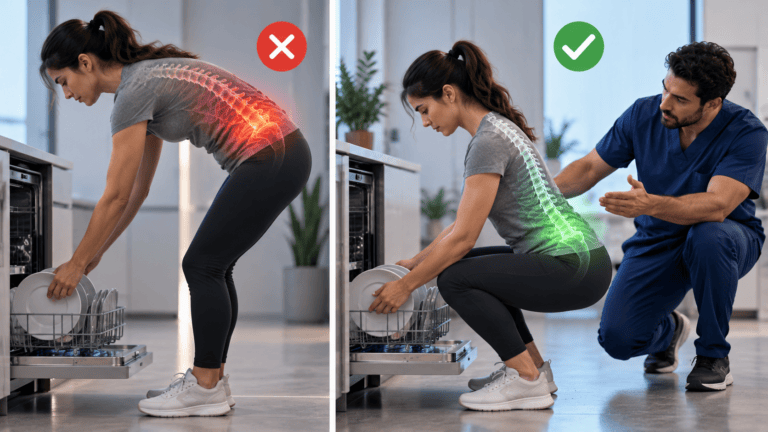
There is a moment, captured directly during a patient teaching session, that illustrates one of the most consequential and most commonly ignored pieces of practical spinal health advice: the specific way a person bends down to pick something up genuinely determines their risk of disc injury, and it applies just as much to reaching into a dishwasher as it does to lifting weights in a gym.
Dr. Sherief Elsayed, Consultant Spine Surgeon in Dubai, demonstrates the correct technique directly with a patient and explains precisely why the difference matters.
The Correction, Captured in Real Time
Dr. Sherief Elsayed’s instruction to the patient is immediate and direct: “Don’t bend like that in front of me. Okay. Keep your back straight. Bend your hips and knees. That’s it. Good. Up. Very good.”
This brief, real-time correction captures the essential biomechanical instruction at the heart of safe bending and lifting technique: maintaining a neutral, straight spine while allowing the movement to occur primarily through the hip and knee joints, rather than through spinal flexion.
Why the Initial Bending Pattern Was a Problem
The patient’s initial movement, the one that prompted Dr. Sherief Elsayed’s immediate correction, represents a very common and instinctive bending pattern: flexing forward through the spine itself, rounding the back, rather than hinging at the hips with the knees bending to lower the body.
The biomechanics of spinal flexion under load:
When the spine flexes forward significantly, particularly under any additional load such as lifting an object, the mechanical stress on the intervertebral discs increases substantially compared to a neutral spine position. As covered in detail in the earlier article Can Deadlifting Cause a Slipped Disc? Dr. Sherief Elsayed Warns Athletes in Dubai, this occurs because spinal flexion shifts the compressive load anteriorly onto the disc, increasing pressure specifically on the posterior aspect of the annulus fibrosus, precisely the region most commonly implicated in disc herniation.
Why This Applies Far Beyond the Gym
Dr. Sherief Elsayed makes a specific and important clarification about who this advice applies to: “It’s not because she’s in the gym lifting something heavy. It can happen bending at the dishwasher.”
This is a genuinely important public health message, because there is a common misconception that disc injury is primarily a concern for athletes, weightlifters, or manual labourers handling genuinely heavy loads. In reality, the mechanical principle at play, increased posterior disc pressure during spinal flexion, applies to any bending movement, regardless of how much weight, if any, is being lifted.
Why everyday bending carries genuine risk:
Repetitive, cumulative loading of the spine in flexion, even from relatively light everyday tasks performed with poor technique, contributes to the same kind of annular micro-damage discussed in the earlier deadlifting article. Loading a dishwasher, picking up a child’s toy from the floor, reaching into a low cupboard, or countless other routine daily activities, all involve exactly the same spinal flexion pattern that, repeated with poor technique many times over months and years, contributes cumulatively to disc degeneration and increases the risk of an eventual herniation event, sometimes triggered by what feels like a completely trivial, minor bending movement.
The Critical Timing Point: “Especially If the Disc Is About to Prolapse Anyway”
Dr. Sherief Elsayed adds a specific and clinically important nuance: “That’s especially true if the disc is about to prolapse anyway.”
This observation reflects an important clinical reality that connects directly to the underlying pathology of disc herniation, as discussed extensively in earlier articles in this series. Disc herniation is rarely a sudden, isolated event occurring in an otherwise perfectly healthy disc. It typically represents the final step in a progressive process of annular weakening, the accumulation of micro tears within the annulus fibrosus over an extended period, as described in the deadlifting article’s discussion of the staged pathological progression from micro tears through to full prolapse.
For a disc that has already accumulated significant annular damage through this progressive process, whether from previous heavy lifting, prolonged poor postural habits, or simply age-related degeneration, even a relatively minor additional loading event, performed with poor technique, can be the final mechanical insult that pushes the compromised disc from a state of significant weakening into an actual, clinically apparent prolapse. This is precisely why patients sometimes describe their disc herniation as having occurred during a seemingly trivial activity, such as bending to pick up a pen, when in reality the disc had already been significantly compromised over an extended period beforehand, and the trivial-seeming event was simply the final straw.
The Correct Technique, Explained
Dr. Sherief Elsayed’s specific instructions, “keep your back straight, bend your hips and knees,” describe what is generally referred to as hip-hinge or squat-pattern lifting technique, in contrast to the spine-flexion pattern that the patient initially demonstrated.
The key elements of correct technique:
Maintaining spinal neutrality: The natural curves of the spine, including the lumbar lordosis, should be maintained throughout the movement rather than being flattened or reversed through excessive forward bending. This keeps the compressive load distributed more evenly across the vertebral bodies and discs rather than concentrating stress on the posterior annulus.
Hip and knee flexion as the primary movement source: Rather than bending forward through the spine to reach a lower object, the movement should be generated primarily through flexion at the hip and knee joints, effectively squatting down while keeping the torso relatively upright and the spine in its neutral position.
Keeping the load close to the body: When lifting any object, keeping it as close to the torso as possible throughout the movement significantly reduces the mechanical leverage, and therefore the compressive force, placed on the lumbar spine compared to lifting with the arms extended away from the body.
Controlled, deliberate movement: Sudden, jerky, or rapid bending and lifting movements generate higher peak forces on spinal structures compared to slow, controlled movement through the same range of motion.
Why This Advice Applies Universally, Not Just to Patients Already Experiencing Symptoms
While Dr. Sherief Elsayed’s direct correction in this scenario was given to a specific patient during a teaching moment, likely someone already managing or at risk of a spinal condition, the underlying principle of correct bending technique is universal advice that benefits everyone, regardless of current spinal health status.
For patients with known disc pathology, correct technique reduces the ongoing mechanical stress on an already compromised disc. A Disc Herniation Specialist in Dubai will incorporate this guidance directly into rehabilitation planning.: Correct technique reduces the ongoing mechanical stress on an already compromised disc, reducing the risk of progression to a more significant herniation or, for patients recovering from previous disc surgery, reducing the risk of the recurrence discussed extensively in earlier articles in this series.
For patients without current symptoms: Adopting correct bending and lifting technique as a consistent habit reduces the cumulative annular loading that contributes to disc degeneration over the course of a lifetime, representing genuine preventive spinal health practice rather than simply symptom management.
Practical Application in Daily Life
Given Dr. Sherief Elsayed’s specific mention of the dishwasher as an everyday example, this advice deserves practical translation. A Spinal Health Doctor in Dubai can provide hands-on technique correction for these routine daily movements. as an everyday example, this advice deserves practical translation into the kinds of routine activities most people perform daily without giving spinal mechanics any particular thought.
Common everyday activities where this technique applies:
Loading and unloading a dishwasher or washing machine, picking up children or pets, retrieving items from low shelves or the floor, gardening tasks involving bending toward ground level, making a bed, and countless other routine household and occupational tasks all involve exactly the same fundamental bending mechanics that Dr. Sherief Elsayed is addressing.
A Back Pain Specialist in Dubai advising patients on activity modification and injury prevention will consistently emphasise this same principle: correct bending technique is not a specialised skill reserved for the gym, but a fundamental movement pattern that should be applied consistently across every bending and lifting task encountered throughout daily life.
UAE-Specific Considerations
Given the significant population in the UAE managing back pain and disc-related conditions, discussed extensively throughout this blog series, and the wide range of occupational and domestic settings where bending and lifting tasks occur daily, physiotherapy and rehabilitation programmes across Dubai commonly incorporate exactly this kind of practical, hands-on technique correction as a core, ongoing component of both treatment and long-term prevention strategy.
Expert Summary
Correct bending technique, maintaining a straight, neutral spine while generating movement primarily through the hips and knees, meaningfully reduces the mechanical stress placed on the intervertebral discs during any bending or lifting task, whether in the gym or at the kitchen sink. This principle applies universally, not only to heavy lifting, and carries particular importance for anyone whose discs have already accumulated significant annular damage through previous loading history, where even a seemingly trivial bending movement performed with poor technique can be the final mechanical trigger for a clinically significant disc prolapse.
Table of Contents
Recent Articles

Why Eight People Were Needed for One Spine Surgery in Dubai
Why Eight People Were Needed for One Spine Surgery in Dubai Does every spinal surgery require exactly eight team members? No, as Dr. Sherief Elsayed explains directly, the specific team
Three Spine Surgery Myths a Dubai Surgeon Wants You to Forget
Three Spine Surgery Myths a Dubai Surgeon Wants You to Forget Is it really safe to walk on the same day as spine surgery? Yes, for the majority of modern
Why Osteoporosis Is Called the Silent Disease in the UAE
Why Osteoporosis Is Called the Silent Disease in the UAE If osteoporosis doesn’t cause pain, how would I know if I needed a DEXA scan? Given the entirely silent nature