
Why Osteoporosis Is Called the Silent Disease in the UAE
If osteoporosis doesn't cause pain, how would I know if I needed a DEXA scan?
Given the entirely silent nature of the condition, screening decisions are typically based on established risk factors including age, sex, menopausal status, family history, and other relevant medical history, rather than waiting for symptoms that will not appear until a fracture has occurred. Discuss your individual risk factors with your doctor.
How often should DEXA scanning be repeated?
This depends on individual risk factors and any previous scan results. Your doctor can advise on an appropriate screening interval based on your specific clinical situation.
Can osteoporosis be reversed once it is diagnosed?
While established bone loss cannot always be fully reversed, appropriate treatment, including medication where indicated, adequate vitamin D and calcium as discussed in earlier articles, and weight-bearing exercise, can meaningfully improve bone density and significantly reduce future fracture risk.
Is osteoporosis only a concern for older women?
While postmenopausal women carry a particularly elevated risk due to the hormonal changes discussed in earlier articles, osteoporosis can affect men and younger individuals as well, particularly in the presence of specific risk factors such as prolonged steroid use or other relevant medical conditions.
What is the difference between osteopenia and osteoporosis?
Both represent reduced bone density compared to normal, with osteopenia representing a lesser degree of reduction (T-score between -1.0 and -2.5) and osteoporosis representing a more significant reduction (T-score of -2.5 or below), the specific diagnostic threshold discussed in this article.
Does a normal calcium blood test mean I don't need to worry about my bone health?
No, as this article explains directly, a normal calcium blood test does not exclude osteoporosis, given the body’s compensatory mechanisms that maintain normal blood calcium even in the presence of significant bone calcium depletion. DEXA scanning, not blood testing, is the appropriate way to directly assess bone density.
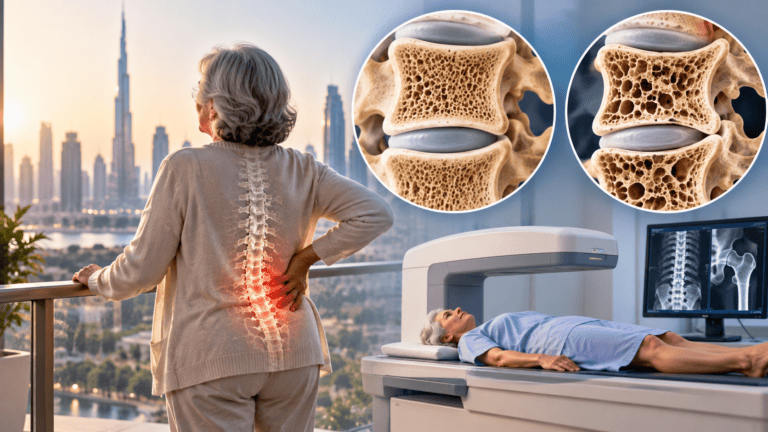
Osteoporosis has earned its clinical reputation as “the silent disease” for a very specific and clinically important reason: it produces no warning symptoms of its own, offers no early clue that would prompt a patient to seek assessment, and can progress for years, or even decades, entirely undetected, until it reveals itself suddenly and dramatically through a fracture. Understanding exactly why this condition remains so invisible until that point, and precisely how it should actually be detected, is essential knowledge for anyone concerned about their long-term bone health.
Dr. Sherief Elsayed, Consultant Spine Surgeon in Dubai, walks through the key facts that explain both the danger and the detection of this genuinely silent condition.
Osteoporosis Is Not Painful, By Itself
Dr. Sherief Elsayed establishes the foundational fact directly: “Osteoporosis is not a painful condition.”
This is the single most important starting point for understanding why osteoporosis is so frequently under-diagnosed until a serious complication has already occurred. Unlike many medical conditions that announce their presence through some form of discomfort, prompting the affected person to seek medical attention, osteoporosis itself generates no pain, no discomfort, and genuinely no subjective warning sign whatsoever during its progressive development.
What Osteoporosis Actually Is
Dr. Sherief Elsayed provides a precise, clinically accurate definition: “Osteoporosis is normal bone, just not enough of it.”
This description is worth pausing on, because it directly addresses a common misconception. Osteoporosis is not a disease of abnormal, defective, or diseased bone tissue. The bone that is present in osteoporosis is structurally normal bone, with its usual composition and mineralisation. The problem is purely quantitative: there is simply less of it than there should be, a genuine reduction in overall bone mass and, correspondingly, bone strength, compared to what is needed to reliably withstand normal, everyday mechanical loads and stresses.
This distinction, between osteoporosis (reduced quantity of normal bone) and osteomalacia (normal quantity but poorly mineralised, soft bone, as discussed in the earlier article on vitamin D deficiency), is clinically important, and it explains precisely why osteoporosis progresses silently: the bone that remains continues to function essentially normally in its structural role, right up until there is genuinely insufficient bone mass remaining to withstand a given mechanical load, at which point a fracture occurs, often with minimal or no significant preceding trauma.
When Osteoporosis Finally Becomes Painful
Dr. Sherief Elsayed identifies the specific point at which this silent condition finally becomes symptomatic: “It only becomes painful if you end up with a fractured spine or fractured hip, for example.”
This is precisely why osteoporosis is so frequently first diagnosed only after a fragility fracture has already occurred, a fracture resulting from a fall or minor trauma that would not be expected to cause a fracture in bone of normal strength and density. As discussed in the earlier article on women’s bone density in their thirties, and directly relevant here, a fracture of the spine or hip is frequently the very first clinical sign that osteoporosis was present, meaning the underlying condition had already progressed silently, and significantly, for a substantial period beforehand, entirely without the affected person’s knowledge.
Why a Standard Blood Test Cannot Detect Osteoporosis
One of the most genuinely important, and most commonly misunderstood, points Dr. Sherief Elsayed makes concerns exactly why a routine blood test is not an effective way to screen for or detect osteoporosis: “A calcium blood test is almost always normal in osteoporosis.”
This finding, that blood calcium levels remain normal even in patients with significant, established osteoporosis, initially seems counterintuitive, but it is directly explained by the body’s tightly regulated calcium homeostasis system, described in detail in the earlier article on vitamin D and calcium metabolism.
The physiological explanation:
Dr. Sherief Elsayed explains the mechanism directly: “We need calcium in all of our body systems, notably our nervous system and our heart to help keep it pumping. So if the body detects that your calcium levels are dipping, it’ll leach it from the bone right away to get them up in the blood.”
This is precisely the same compensatory mechanism discussed in detail in the earlier article on vitamin D deficiency and bone health: because maintaining normal blood calcium levels is so critically important for essential, immediately life-sustaining functions, including nerve signalling and cardiac muscle contraction, the body prioritises this blood calcium homeostasis above almost everything else, including the long-term structural integrity of the skeleton itself. The moment blood calcium levels begin to fall below their tightly regulated normal range, the body responds by mobilising calcium from bone stores to restore normal blood levels, essentially sacrificing skeletal calcium reserves to protect these more immediately critical physiological functions.
Why this makes blood calcium testing useless for osteoporosis detection:
Because of this powerful, continuous compensatory mechanism, a patient can have significantly depleted bone calcium stores, meaning genuinely established osteoporosis, while their blood calcium level remains entirely within the normal reference range, precisely because the body has been actively and continuously drawing on those bone stores to maintain blood calcium homeostasis throughout the entire period during which the osteoporosis was silently developing. Dr. Sherief Elsayed’s direct conclusion follows logically: “So a blood test is not a good test to look for osteoporosis.”
The Correct Test: DEXA Scanning
Having established why blood testing is ineffective, Dr. Sherief Elsayed identifies the actual, appropriate diagnostic tool: “This is a DEXA scanner. It gives us a very accurate measure of your bone density, your T-score.”
DEXA, which stands for dual-energy X-ray absorptiometry, is a specific imaging technique that directly measures bone mineral density at key skeletal sites, most commonly the hip and lumbar spine, by measuring the differential absorption of two distinct X-ray energy levels as they pass through bone tissue, allowing precise calculation of the mineral content, and therefore the density, of the bone being scanned. This directly and accurately measures the actual physical quantity of bone present, rather than relying on any indirect blood marker, providing exactly the kind of direct, accurate assessment that blood testing fundamentally cannot offer for this specific condition.
Understanding the T-score:
The T-score, the specific measurement Dr. Sherief Elsayed references, compares an individual patient’s bone density to the average peak bone density of a healthy young adult of the same sex, expressed in standard deviations above or below that reference average. A T-score of -1.0 or above is considered normal. A T-score between -1.0 and -2.5 indicates osteopenia, a lesser degree of bone density reduction that represents increased risk but does not yet meet the diagnostic threshold for osteoporosis itself. A T-score of -2.5 or below meets the formal diagnostic criteria for osteoporosis.
Why DEXA Scanning Is Genuinely Safe: Addressing Radiation Concerns
A common hesitation patients express about undergoing DEXA scanning relates to radiation exposure, and Dr. Sherief Elsayed addresses this directly and reassuringly: “Very, very low radiation. In fact, less than a flight from London to Dubai. Both very low.”
This comparison provides genuinely useful, relatable context. Commercial air travel exposes passengers to a small amount of additional cosmic radiation, at higher altitude, compared to typical ground-level background exposure, an amount that is widely and correctly understood to be very low and of negligible individual health consequence for the occasional traveller. By directly comparing the radiation dose of a DEXA scan to this specific, familiar, and reassuring reference point, Dr. Sherief Elsayed provides patients with an accurate and genuinely reassuring sense of scale regarding this specific diagnostic test’s very low radiation exposure.
Why This Matters So Significantly for Spine Health
The connection between osteoporosis and spinal health, extensively discussed throughout this blog series, is direct and clinically significant. Osteoporotic vertebral compression fractures, as covered in the earlier articles on bone density and vitamin D deficiency, represent one of the most common and clinically significant consequences of undetected, silently progressing osteoporosis, frequently presenting with sudden, severe back pain following what may seem like a minor or even unremarkable precipitating event. A Spine Fusion Surgeon in Dubai will factor bone density directly into any surgical planning involving instrumentation.
A Spinal Health Doctor in Dubai assessing a patient, particularly an older patient or one with other relevant risk factors, presenting with new, unexplained back pain, should always specifically consider osteoporotic vertebral fracture within the differential diagnosis, and appropriately arrange DEXA scanning as part of a comprehensive assessment where clinically indicated, rather than relying on blood testing that, as this article explains clearly, will not provide the relevant diagnostic information.
Who Should Consider DEXA Screening
Given the entirely silent nature of osteoporosis before a fracture occurs, proactive screening in appropriate at-risk populations is genuinely important rather than waiting for symptoms that, by definition, will not appear until a fracture has already occurred. A Back Pain Doctor in Dubai can arrange DEXA scanning where clinically indicated.
Populations who should generally consider DEXA screening:
Postmenopausal women, given the accelerated bone loss following the decline in oestrogen discussed in the earlier article on women’s bone density; older adults generally, particularly those with additional risk factors including a family history of osteoporosis or fragility fracture; patients with prolonged corticosteroid use; patients with vitamin D deficiency or other conditions affecting calcium and bone metabolism as discussed in earlier articles in this series; and any patient who has already sustained a fragility fracture, given the significantly increased risk of further fractures this represents.
UAE-Specific Context
Given the substantial population-wide vitamin D deficiency prevalent across the UAE, discussed extensively in earlier articles in this series, and its direct relevance to bone health, proactive DEXA screening in appropriate at-risk populations across Dubai represents a genuinely important preventive health measure, allowing osteoporosis to be identified and appropriately managed well before it reveals itself through the kind of serious, potentially life-altering fracture that Dr. Sherief Elsayed describes as the disease’s characteristic, but entirely avoidable, silent presentation. A Consultant Spine Surgeon in Dubai considers proactive DEXA screening a genuinely important preventive health measure.
Expert Summary
Osteoporosis earns its description as the silent disease because it is a purely quantitative reduction in otherwise normal bone, producing no pain or symptoms of its own until a fracture, frequently affecting the spine or hip, finally occurs. Blood calcium testing is fundamentally ineffective for detecting this condition, because the body’s powerful calcium homeostasis mechanisms maintain normal blood calcium levels by actively drawing on bone stores throughout the entire silent progression of the disease. DEXA scanning, providing a direct, accurate, and genuinely very low radiation measurement of actual bone density, represents the correct and appropriate diagnostic tool, allowing this otherwise entirely silent condition to be identified and treated before it reveals itself through a potentially serious fracture.
Table of Contents
Recent Articles

Why Eight People Were Needed for One Spine Surgery in Dubai
Why Eight People Were Needed for One Spine Surgery in Dubai Does every spinal surgery require exactly eight team members? No, as Dr. Sherief Elsayed explains directly, the specific team
Three Spine Surgery Myths a Dubai Surgeon Wants You to Forget
Three Spine Surgery Myths a Dubai Surgeon Wants You to Forget Is it really safe to walk on the same day as spine surgery? Yes, for the majority of modern
Why Osteoporosis Is Called the Silent Disease in the UAE
Why Osteoporosis Is Called the Silent Disease in the UAE If osteoporosis doesn’t cause pain, how would I know if I needed a DEXA scan? Given the entirely silent nature