
Can Deadlifting Cause a Slipped Disc? Dr. Sherief Elsayed Warns Athletes in Dubai
Can I continue deadlifting after a disc prolapse?
In many cases, yes, but not immediately and not without guidance. Following appropriate rehabilitation, most patients with disc herniations can return to lifting. The timeline depends on the severity of the herniation, whether surgery was required, and how rehabilitation has progressed. A physiotherapist experienced in working with strength athletes should guide the return to lifting programme, coordinating with a Sports Spine Surgeon in Dubai for imaging review and surgical assessment if needed.
Is the sumo deadlift safer for the lower back than conventional?
The sumo stance reduces the forward lean of the torso and therefore reduces the moment arm at the lumbar spine. For athletes with existing lumbar sensitivity, the sumo variant may be better tolerated. However, technique matters more than stance variation, and a poorly executed sumo deadlift is not inherently safer than a well-executed conventional one.
Should I wear a belt when deadlifting?
A lifting belt increases intra-abdominal pressure and provides proprioceptive feedback, which can enhance trunk stability under heavy loads. It is a useful tool for maximum effort lifts but should not be used as a substitute for developing core strength and bracing technique. Athletes who rely entirely on a belt for spinal support at moderate loads are masking a technique deficiency.
How do I know if my back pain after deadlifting is normal muscle soreness or something more serious?
Normal post-training muscle soreness is diffuse, symmetric, typically worse 24 to 48 hours after training, and improves with light movement. Pain that is sharp, asymmetric, radiates into a limb, worsens with sitting, or persists beyond 72 hours with no improvement warrants clinical assessment.
What weight is safe to deadlift if I have a disc bulge?
This depends on the size and location of the bulge, the specific disc level involved, and your current symptoms. A blanket weight limit cannot be given without a clinical assessment. If you have a known disc bulge, seek assessment from a spine specialist and a physiotherapist experienced in strength training before continuing heavy lifting.
Can strengthening the core completely prevent disc injury from deadlifting?
Core strength significantly reduces spinal injury risk by maintaining neutral spine position under load. However, it cannot eliminate risk entirely, particularly when loads are excessive or technique is compromised. Core training is an important protective factor, not an absolute guarantee.
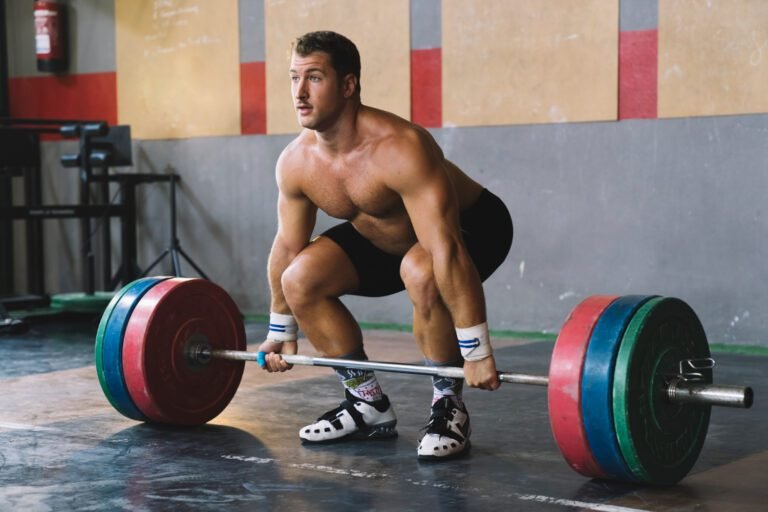
The deadlift is one of the most effective compound exercises in strength training. It builds posterior chain strength, improves athletic performance, and when performed correctly, is a highly functional movement. It is also one of the exercises most commonly associated with serious spinal injury in the gym, and for good reason. Understanding where the risk comes from, how it develops, and what separates safe from dangerous lifting is essential for any athlete in Dubai who trains regularly and wants to continue doing so without ending up in a spine clinic.
Dr. Sherief Elsayed, Consultant Spine Surgeon in Dubai, addresses high performance athletes directly on this topic. His message is nuanced: the deadlift is not inherently dangerous, but the way it is approached very often is.
Is the Deadlift Dangerous for the Spine?
The short answer, according to Dr. Sherief Elsayed, is that it depends entirely on technique and load management: “A deadlift is not inherently dangerous if you undertake it with the correct technique with a neutral spine position.”
The neutral spine is the key concept. It refers to maintaining the natural curves of the cervical, thoracic, and lumbar spine throughout the lift, avoiding both excessive rounding (flexion) of the lower back and excessive arching (hyperextension). In a neutral spine position, the compressive load of the lift is distributed evenly across the vertebral bodies, the discs, and the posterior elements. The muscles and ligaments surrounding the spine work together to maintain this position under load, acting as a dynamic stabilising system.
When the neutral spine is lost, typically when the lower back rounds under heavy load, the mechanical environment changes dramatically. The load shifts anteriorly onto the disc, compressive forces on the posterior annulus increase, and the risk of disc injury escalates.
How Common Are Back Injuries in Weightlifters?
The numbers are significant. As Dr. Sherief Elsayed notes: “The lumbar spine does account for around 30 to 40 percent of all injuries amongst weightlifters.”
This statistic reflects the cumulative load that the lumbar spine absorbs in weightlifting training. Compound lifts, deadlifts and squats in particular, generate the highest spinal loads of any exercise modality. For athletes who train multiple times per week and progressively increase their working weights, the cumulative mechanical stress on the lumbar discs is substantial over months and years.
The injury pattern in weightlifters reflects this load distribution. Lumbar disc herniation, facet joint injury, and spondylolysis (stress fracture through the pars interarticularis) are the most common spinal diagnoses in this population. Each can be career-limiting if not managed appropriately.
How Does Repetitive Loading Lead to Disc Prolapse?
Dr. Sherief Elsayed explains the mechanism clearly: “Repetitive lifting, especially exceeding what’s good for you, can cause micro tears in the disc, which will eventually lead to a disc prolapse, a proper prolapse of the disc coming out, pressing the nerve and you developing sciatica or even worse, weakness in your leg.”
This describes a well-documented pathological progression:
Stage 1: Micro tears in the annulus fibrosus The annulus fibrosus, the tough outer ring of the intervertebral disc, is composed of concentric layers of collagen fibres arranged at alternating angles. Repetitive loading, particularly in flexion, creates cyclic stress on these fibres. Over time, this stress produces small tears within the annular layers. These micro tears are often asymptomatic initially.
Stage 2: Accumulation of annular damage As micro tears accumulate, the structural integrity of the annulus is progressively compromised. The disc becomes less able to contain the nucleus pulposus, the gel-like core, under load. This stage may produce discogenic back pain, a deep, centralised aching that worsens with loading and prolonged sitting.
Stage 3: Disc herniation When the annular damage reaches a critical threshold, the nucleus pulposus can push through the weakened annulus and protrude into the spinal canal. This is a disc herniation or prolapse. If the herniated material contacts a nerve root, the result is sciatica, the sharp, burning, radiating pain that travels into the leg in the distribution of the compressed nerve.
Stage 4: Neurological compromise In severe herniations, the nerve root is not merely irritated but significantly compressed, leading to motor weakness, reduced reflexes, and sensory deficit in the affected limb. This is the clinical scenario Dr. Sherief Elsayed refers to as “even worse, weakness in your leg,” and it represents a more urgent clinical situation requiring prompt assessment. The article Does a Slipped Disc Always Need Surgery? A UAE Spine Surgeon Explains the Truth covers what happens next and when surgery becomes necessary.
What Is Correct Deadlift Technique for Spinal Protection?
Correct technique is the primary protective factor. The following principles are the foundation of safe deadlifting.
Neutral spine throughout the movement: The lumbar spine should maintain its natural lordosis (inward curve) from the setup position through the pull and the lockout. Excessive rounding at the lower back, particularly during the initial pull from the floor when forces are greatest, is the single most common technical fault that increases injury risk.
Hip hinge mechanics: The deadlift is a hip hinge, not a squat. The movement is initiated by pushing the hips back while maintaining a rigid torso, allowing the hamstrings to load eccentrically. Athletes who squat down to the bar rather than hinge often compromise their lumbar position under load.
Bar path: The bar should travel in a vertical line directly over the mid-foot. A bar that drifts away from the body during the pull creates a forward moment arm that dramatically increases lumbar extensor demand.
Bracing: Taking a deep diaphragmatic breath and creating intra-abdominal pressure before initiating the pull stiffens the trunk and protects the lumbar spine. This is sometimes called the Valsalva manoeuvre and is a standard technique in competitive lifting.
Load management: The most important but most commonly ignored principle. Progressive overload should be gradual, allowing the body’s connective tissues, including the discs and ligaments of the spine, to adapt to increasing demands. Attempting maximal or near-maximal loads without an adequate base of strength and movement quality is how acute disc injuries occur.
The Personal Record Problem
Dr. Sherief Elsayed addresses a specific and common pattern: “This video is for those high performance athletes that are trying to beat their personal record.”
The pursuit of personal records creates a specific risk environment. As athletes approach their maximal load, technique tends to degrade. What was achievable at 80 percent of maximum with good form becomes increasingly compromised at 95 or 100 percent. The mental focus on completing the lift overrides the body’s protective signals. The athlete grinds through a technically deteriorating lift, and the disc pays the price.
This is compounded by the competitive environment of many Dubai gyms and fitness communities, where athletes push each other toward heavier lifts and where admitting that a load is too heavy can feel like a failure rather than a sensible training decision.
The clinical reality is that a disc prolapse requiring surgical decompression represents months out of training at minimum, and potentially years of suboptimal performance even after recovery. No personal record is worth that.
Training Modifications That Protect the Spine Without Sacrificing Progress
Athletes who want to continue training safely around spinal risk can make targeted modifications without abandoning compound lifting.
Technique work at submaximal loads: Spending dedicated sessions working on movement quality at 60 to 70 percent of maximum builds the neuromuscular patterns that will protect the spine when heavier loads are attempted.
Romanian deadlifts: The Romanian deadlift, performed with a slight knee bend and a controlled eccentric lowering phase, keeps the bar off the floor and reduces the spinal load at the most vulnerable phase of the conventional deadlift. It is an excellent variation for athletes with existing lumbar sensitivity.
Trap bar deadlifts: The hexagonal trap bar positions the load in line with the body rather than in front of it, reducing the forward moment arm and allowing a more upright torso position. For athletes with a history of lumbar disc problems, the trap bar variant significantly reduces lumbar stress while maintaining training stimulus.
Core training: Dedicated lumbar multifidus and deep core training, separate from heavy lifting sessions, builds the stabilising system that protects the spine under load. Exercises such as bird-dogs, Pallof presses, and dead bugs specifically target the muscles that maintain neutral spine position during heavy lifting.
Recovery: Dr. Sherief Elsayed’s own DNA testing revealed that he recovers more slowly from hard exercise than average, requiring careful management of training load and rest periods. Athletes who push maximum efforts with insufficient recovery between sessions accumulate fatigue in spinal structures that increases injury risk progressively. A Spine Injury Specialist in Dubai can help identify early disc changes before they progress to full prolapse.
Warning Signs That Should Stop Training Immediately
Athletes who are pushing heavy deadlifts should know which symptoms require them to stop training and seek assessment before returning to the platform.
Stop and seek assessment if:
- Back pain during or after lifting that is significantly worse than previous training soreness
- Pain that radiates into the buttock, thigh, or below the knee
- Numbness or tingling in the leg or foot
- Weakness in a leg, foot drop, or difficulty with certain movements
- Pain that worsens when sitting and is relieved only by walking or lying down
These symptoms suggest nerve root irritation or compression that warrants clinical evaluation. Training through them risks converting a manageable disc injury into a full prolapse requiring surgical intervention.
Expert Summary
The deadlift is not the enemy of the lumbar spine. Poor technique, excessive loading without adequate preparation, and insufficient recovery are. Dr. Sherief Elsayed’s message to high performance athletes in Dubai is precise and practical: train with a neutral spine, manage your load progression intelligently, and do not sacrifice technique in the pursuit of a personal record. The cumulative damage that leads to disc prolapse is not sudden, it builds over time through micro tears, and it is preventable with the right approach. A Back Pain Specialist in Dubai can assess your spinal health and advise on training modifications if you are already experiencing symptoms.
Table of Contents
Recent Articles

Why Eight People Were Needed for One Spine Surgery in Dubai
Why Eight People Were Needed for One Spine Surgery in Dubai Does every spinal surgery require exactly eight team members? No, as Dr. Sherief Elsayed explains directly, the specific team
Three Spine Surgery Myths a Dubai Surgeon Wants You to Forget
Three Spine Surgery Myths a Dubai Surgeon Wants You to Forget Is it really safe to walk on the same day as spine surgery? Yes, for the majority of modern
Why Osteoporosis Is Called the Silent Disease in the UAE
Why Osteoporosis Is Called the Silent Disease in the UAE If osteoporosis doesn’t cause pain, how would I know if I needed a DEXA scan? Given the entirely silent nature