
What Is Cervical Kyphosis and Should You Be Worried About It?
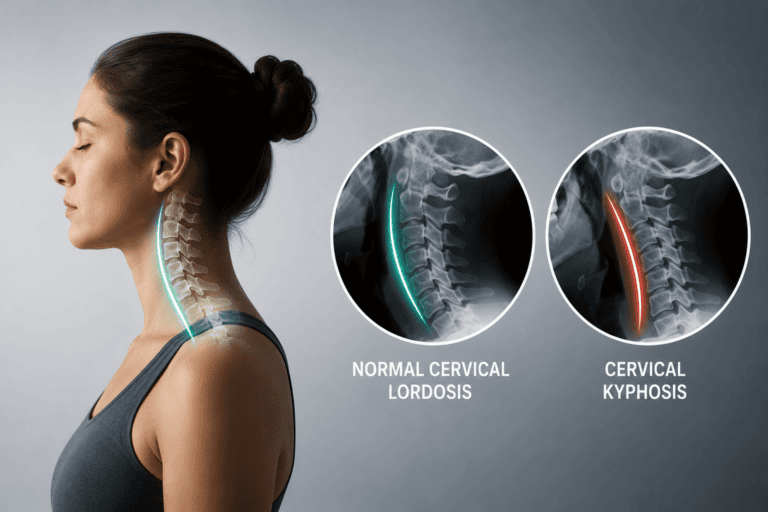
Should I be worried if my X-ray report says I have cervical kyphosis?
Not automatically. Given that around 12% of people with no symptoms whatsoever have a kyphotic cervical spine, this finding alone, without correlating symptoms, functional limitation, or progression, is not necessarily indicative of any problem requiring treatment.
Why do some radiology reports include alarming percentage figures?
These figures often arise from automated or semi-automated measurement software that compares an individual’s spinal curvature to a single reference value, without accounting for the significant natural variation in normal spinal alignment across the population. The resulting percentage can appear more alarming than the underlying clinical situation warrants.
Can cervical kyphosis cause neck pain?
It can, but the presence of kyphosis alone does not necessarily mean it is the cause of any pain a patient is experiencing. Many people with cervical kyphosis have no pain at all, while others with pain may have it from an entirely different source. A thorough clinical assessment is needed to determine whether the two are genuinely related.
How is cervical kyphosis treated if it is genuinely causing problems?
Treatment depends entirely on the underlying cause, severity, and associated symptoms. Options range from physiotherapy and postural exercises for mild, symptomatic cases to surgical correction for severe, progressive, or neurologically significant kyphosis. The specific approach is individualised.
Should I get a second opinion if I have been told I need surgery based on a kyphosis measurement?
If a surgical recommendation is based primarily on a numerical measurement without clear correlation to significant symptoms, functional limitation, or neurological findings, seeking a second opinion is entirely appropriate, following the same principles discussed in the published article on second opinions elsewhere in this series.
Is cervical lordosis loss the same thing as cervical kyphosis?
These terms are often used somewhat interchangeably in clinical practice, though technically “loss of lordosis” can describe a spectrum ranging from a simply straightened (but not reversed) curve through to a fully kyphotic (reversed) curve. The specific measurement and terminology used should always be interpreted in the context of the patient’s actual clinical presentation.
Few things generate as much unnecessary anxiety in spine patients as a radiology report filled with precise-sounding numbers describing a deviation from a theoretical ideal. A patient who reads that they have lost “131.9%” of their normal neck curve is likely to feel alarmed, even though, as will become clear, this specific figure is essentially meaningless without proper clinical context. Understanding what cervical kyphosis actually is, how common it is in people with no symptoms whatsoever, and why some of the language used in radiology reports can create alarm disproportionate to the actual clinical significance, is genuinely important for patient wellbeing.
Dr. Sherief Elsayed, Consultant Spine Surgeon in Dubai, addresses this directly and reassuringly.
What Is Normal Cervical Alignment?
Dr. Sherief Elsayed establishes the baseline: “The normal cervical spine has what we call a cervical lordosis, or a curvature backwards.”
The human spine, viewed from the side, is not a straight column. It has a series of gentle curves that alternate in direction as they pass down the body. The cervical spine (neck) and lumbar spine (lower back) both curve with their convexity facing backward, a pattern called lordosis. The thoracic spine (mid-back) curves in the opposite direction, with its convexity facing forward, called kyphosis.
This alternating pattern of curves is not incidental. It distributes mechanical load efficiently through the spinal column, absorbs the impact of walking and movement, and positions the head appropriately over the body’s centre of gravity. A normal cervical lordosis allows the head to sit balanced above the shoulders with minimal ongoing muscular effort required to hold it upright.
What Cervical Kyphosis Means
Cervical kyphosis describes a reversal of this normal curve pattern in the neck, where the cervical spine curves in the same direction as the thoracic spine (convexity forward) rather than maintaining its normal backward-curving lordosis. Instead of the neck curving gently backward, it appears to lean or curve forward on imaging.
This is what Dr. Sherief Elsayed refers to when he describes patients who “have these fancy lines drawn on them which show that their spine is in fact kyphotic or leaning forward” on their X-rays.
The Critical Statistic: 12% of Normal People Have This
The single most important piece of information in this discussion is Dr. Sherief Elsayed’s direct statement: “12% of the normal population has a kyphotic cervical spine. So if you don’t have a perfect cervical lordosis, that doesn’t mean that there’s anything wrong with you.”
This statistic reframes the entire clinical significance of a kyphotic finding on a cervical X-ray. If nearly one in eight people without any symptoms, without any pathology, and without any need for treatment, has a cervical spine that measures as kyphotic on imaging, then the presence of this finding alone cannot be considered abnormal or pathological in any meaningful clinical sense.
This mirrors a pattern that recurs throughout spine medicine and has been addressed in earlier articles in this series, including the discussion of disc degeneration being nearly universal in asymptomatic adults, covered in the article Why an MRI Report Alone Is Not Enough to Decide on Spine Treatment in the UAE. Anatomical variation is the norm, not the exception, and a significant proportion of what appears as a “finding” on imaging is simply the normal range of human anatomical diversity.
Why “131.9% Loss of Curve” Is Meaningless
Dr. Sherief Elsayed addresses a specific and genuinely important pattern in how alarming radiology figures are sometimes generated and communicated: “Reading things like 131.9% loss in your curve is completely meaningless.”
This kind of figure typically arises from a specific measurement process: the cervical lordosis angle is measured on a patient’s X-ray, this measured angle is then compared to an assumed “normal” reference value, and a percentage difference is calculated and reported.
Why this calculation is fundamentally flawed for clinical interpretation:
There is no single universal “normal” cervical lordosis value that applies to every individual. Normal cervical curvature varies considerably between individuals based on genuine anatomical variation, exactly the kind of variation that produces the 12% of the population with naturally kyphotic cervical spines that Dr. Sherief Elsayed describes.
When a percentage figure is generated by comparing an individual’s actual measurement against an arbitrary reference value that does not account for this normal variation, the resulting percentage can produce numbers that appear alarming, such as 131.9%, without any genuine clinical meaning. A percentage figure exceeding 100% for “loss” of a curve is itself a signal that the underlying calculation methodology is producing numbers that do not correspond to any physiologically meaningful concept. You cannot lose more than 100% of something in any way that is clinically interpretable; the figure is an artifact of the specific mathematical comparison being made, not a genuine measure of pathology or severity.
The broader lesson:
Precise-sounding numbers in a medical report create an impression of scientific rigour and objective severity that is not always warranted. A patient reading “131.9% loss” understandably interprets this as evidence of a serious, quantifiable problem. In reality, this figure tells the patient almost nothing about whether their neck curvature is actually causing them any problem, is a variant of normal anatomy, or requires any treatment whatsoever.
When Cervical Kyphosis Is Genuinely Clinically Significant
None of this means that cervical kyphosis is never clinically important. There are specific circumstances in which cervical kyphosis is a genuine finding requiring assessment and, in some cases, treatment.
Progressive or severe kyphosis: A significant, progressively worsening kyphotic deformity, particularly one that develops following trauma, surgery, or in the context of specific underlying conditions, can produce genuine biomechanical and neurological consequences.
Symptomatic kyphosis: Cervical kyphosis accompanied by neck pain that correlates specifically with the deformity, difficulty maintaining a horizontal gaze (a functional problem where the deformity prevents the patient from looking straight ahead without significant compensatory effort), or neurological symptoms suggesting spinal cord or nerve involvement, warrants specific clinical assessment.
Post-surgical kyphosis: Following certain cervical spine surgeries, particularly extensive posterior decompression procedures such as multilevel laminectomy without adequate stabilisation, a progressive kyphotic deformity can develop over time, sometimes requiring corrective surgery.
Kyphosis associated with myelopathy: As discussed in the earlier article on cervical myelopathy, significant cervical kyphosis can, in combination with degenerative changes, contribute to spinal cord compression and the development of myelopathic symptoms, particularly when the kyphotic deformity effectively “drapes” the spinal cord over the front of the vertebral bodies.
How Clinical Significance Is Actually Determined
Rather than relying on a percentage calculation compared to an arbitrary reference value, the genuine clinical significance of cervical kyphosis is assessed through a combination of factors.
Correlation with symptoms: Does the patient have neck pain, functional limitation, or neurological symptoms that correlate specifically with the alignment finding? As established throughout this blog series, imaging findings are only clinically meaningful when they explain the patient’s actual symptoms.
Progression over time: Is the degree of kyphosis stable when compared to previous imaging, or is it progressively worsening? A stable kyphotic curve, even if outside a theoretical “normal” range, is a very different clinical situation from one that is actively progressing.
Functional impact: Can the patient maintain a comfortable, functional horizontal gaze? Is there any difficulty with activities of daily living related to the neck position?
Neurological examination: Are there any signs suggesting the alignment is contributing to spinal cord or nerve root compromise, following the same neurological examination principles described in the article on spinal cord injury symptoms?
A Cervical Spine Doctor in Dubai assessing a patient with a reported kyphotic finding on imaging will apply exactly this kind of comprehensive clinical assessment, rather than basing any treatment decision on the numerical percentage alone.
How is Cervical Kyphosis Treated?
Cervical kyphosis can be treated either non-surgically or surgically. Cervical kyphosis treatment depends on the pressure on the spinal cord. If there is significant pressure being applied to the spinal cord, surgery may be recommended.
Non-Surgical Treatment
For mild cervical kyphosis, Dr Sherief will recommend non-surgical treatment, such as
- Simple observation.
- Medications to reduce pain and inflammation.
- Physical therapy, such as neck exercises, to provide pain relief and help restore a normal neck curve.
- Applying ice or a heat pad to relieve pain and inflammation.
Surgical Treatment
If you’re experiencing pain or neurological symptoms, like muscle weakness, tingling, or coordination issues, Dr Sherief may recommend cervical kyphosis surgery. The type of surgery recommended will depend on whether your neck has some flexibility or is rigid.
He uses several techniques to repair the cervical spine, including:
- Posterior approaches, where he enters through the back of your neck.
- Anterior approaches, where he accesses the spine near your throat.
- Combined anterior and posterior approaches.
He may also remove the disc or portions of bones, and you may have a cervical fusion or cervical disc replacement (cervical arthroplasty).
Overall, the goals for cervical spinal surgery are to:
- Restore the natural curvature of your spine
- Relieve pressure off your spinal cord and nerves
- Restabilize your spine
Why This Matters for Patient Wellbeing
There is a genuine and well-documented phenomenon, discussed in the earlier published article Why Fear-Based Spine Predictions Drive Disability in the UAE, where alarming-sounding radiological language and figures produce disproportionate anxiety, catastrophic thinking about the spine, and behaviour changes such as excessive movement avoidance, none of which are supported by the actual clinical significance of many imaging findings. A Spine Pain Doctor in Dubai provides accurate, evidence-based reassurance grounded in clinical correlation rather than isolated numbers.
A patient who has been told their curve shows a “131.9% loss” but has no symptoms, no functional limitation, and a completely normal neurological examination, is a patient who should be reassured clearly and directly that this figure does not represent a problem requiring treatment. Providing that reassurance, grounded in accurate clinical reasoning rather than dismissiveness, is an important part of good spine care.
Expert Summary
Cervical kyphosis, a forward-curving rather than the normally backward-curving cervical spine, is present in approximately 12% of the normal population with no associated symptoms or pathology. Percentage figures such as “131.9% loss of curve,” generated by comparing an individual’s measurement against an arbitrary reference value, are not clinically meaningful and should not be interpreted as indicators of severity. Genuine clinical significance is determined by correlation with symptoms, progression over time, functional impact, and neurological findings, not by a single alarming-sounding number on a radiology report.
Table of Contents
Recent Articles

Why Eight People Were Needed for One Spine Surgery in Dubai
Why Eight People Were Needed for One Spine Surgery in Dubai Does every spinal surgery require exactly eight team members? No, as Dr. Sherief Elsayed explains directly, the specific team

Three Spine Surgery Myths a Dubai Surgeon Wants You to Forget
Three Spine Surgery Myths a Dubai Surgeon Wants You to Forget Is it really safe to walk on the same day as spine surgery? Yes, for the majority of modern
Why Osteoporosis Is Called the Silent Disease in the UAE
Why Osteoporosis Is Called the Silent Disease in the UAE If osteoporosis doesn’t cause pain, how would I know if I needed a DEXA scan? Given the entirely silent nature