
What Precision Medicine Means for Pain Management in Dubai
How accurate is pharmacogenomic testing?
Pharmacogenomic testing for well-established genetic variants, including CYP2D6 metaboliser status, is highly accurate and based on well-validated laboratory techniques. The clinical interpretation and application of results, translating genetic findings into specific medication recommendations, is an area of ongoing research and refinement, though for certain well-established gene-drug interactions, the evidence base and clinical guidance is robust.
Is pharmacogenomic testing widely available in Dubai?
Yes, several specialist laboratories and clinics in Dubai and across the UAE offer pharmacogenomic testing services, reflecting the growing availability of precision medicine approaches in the region’s healthcare system.
Do I need pharmacogenomic testing before every new medication?
Not necessarily. Testing is typically most valuable for medications known to have well-established, clinically significant genetic variation in metabolism, such as certain pain medications, some psychiatric medications, and certain anticoagulants. Your doctor can advise on whether testing would be genuinely useful for your specific situation.
What should I do if I have had an unexpected or severe reaction to a medication in the past?
This kind of history is exactly the situation where pharmacogenomic testing may provide valuable insight. Discuss this history with your doctor, who can advise on whether testing would help explain the reaction and guide safer future medication choices.
Does an ultra-rapid metaboliser status mean I cannot take any opioid pain medication?
No, it specifically means that medications depending on the CYP2D6 pathway for activation (codeine, dihydrocodeine, tramadol) carry increased risk. Other opioid medications that do not rely primarily on this specific metabolic pathway remain viable options when opioid pain relief is genuinely needed, guided by appropriate clinical assessment.
How is pharmacogenomic testing different from other genetic tests?
Pharmacogenomic testing specifically focuses on genes relevant to drug metabolism and response, providing directly actionable clinical information for medication selection, distinct from genetic tests focused on disease risk prediction, ancestry, or other applications.
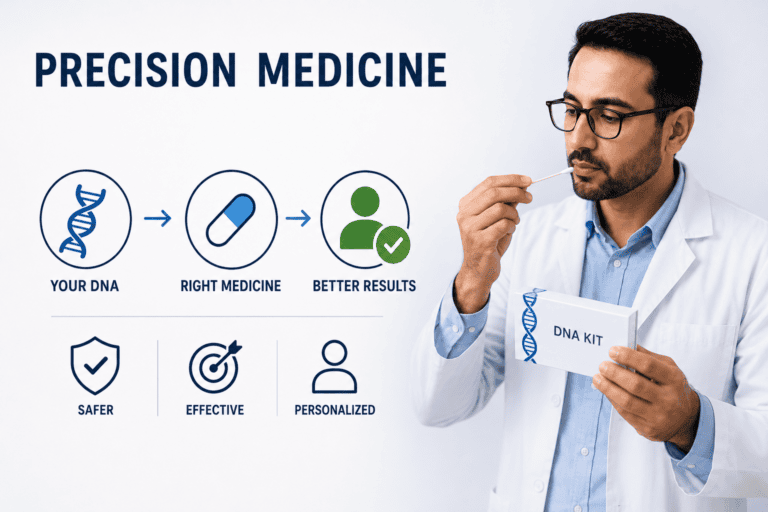
Pain medication does not affect every person in exactly the same way, and this is not simply a matter of individual pain tolerance or subjective preference. There is a genuine, measurable, and increasingly well-understood genetic basis for why certain medications work brilliantly for one patient and produce unexpected side effects or inadequate relief in another, even at identical doses. Precision medicine, the practice of using an individual’s own genetic information to guide treatment decisions, is beginning to transform how pain medication is selected, moving away from a one-size-fits-all approach toward something genuinely tailored to each patient’s biology.
Dr. Sherief Elsayed, Consultant Spine Surgeon in Dubai, illustrates this directly using his own personal genetic testing results.
The Test: Direct-to-Physician DNA Analysis
Dr. Sherief Elsayed describes the process from personal experience: “What I’m doing right now is a DNA test. I’m going to send this off to the lab, and around two to three weeks later, I’m going to have some pretty fascinating results.”
This describes a pharmacogenomic testing process, in which a sample, typically obtained through a simple cheek swab or blood sample, is sent to a specialised laboratory for genetic analysis focused specifically on genes known to influence how the body processes medications. Unlike broader genetic testing that might screen for disease risk or ancestry information, pharmacogenomic testing is specifically targeted at the genetic variants that determine drug metabolism, providing clinically actionable information about medication response.
What Is Pharmacogenomics?
Dr. Sherief Elsayed names the specific field: “These are called pharmacogenomics. This is precision medicine.”
Pharmacogenomics is the study of how an individual’s genetic makeup influences their response to medications, specifically focusing on genes that code for the enzymes responsible for metabolising, activating, or eliminating specific drugs from the body. Many medications, once ingested, must be chemically processed by the body’s enzyme systems, most commonly a family of liver enzymes known as the cytochrome P450 system, either to activate the medication into its therapeutically active form, or to break it down and eliminate it from the body once its therapeutic effect has been achieved.
Genetic variation between individuals means that these enzymes do not function identically in every person. Some people have genetic variants that produce highly efficient, fast-acting versions of a specific enzyme. Others have variants that produce slower, less efficient versions, or in some cases, versions with minimal or no functional activity at all. This genetic variation directly translates into differences in how quickly and how completely a given medication is processed by an individual’s body, which in turn affects both the medication’s effectiveness and the risk of side effects at any given dose.
The Specific Finding: Codeine, Dihydrocodeine, and Tramadol
Dr. Sherief Elsayed shares a specific and clinically significant finding from his own results: “I know, for example, that in the pain category, certain medications are not good for me. Codeine, dihydrocodeine, tramadol.”
Codeine, dihydrocodeine, and tramadol share an important pharmacological characteristic: they are all prodrugs, meaning that in their initially administered form, they have relatively weak pain-relieving effect on their own. Their meaningful analgesic (pain-relieving) activity depends on the body’s own enzyme systems converting them into a more active metabolite.
The specific enzyme involved:
This conversion process for codeine and related medications depends primarily on an enzyme called CYP2D6, part of the cytochrome P450 family. Genetic variation in the CYP2D6 gene produces a well-documented spectrum of metaboliser status across the population, ranging from poor metabolisers (who convert very little of the drug into its active form, and therefore experience minimal pain relief even at standard doses) through normal metabolisers, to ultra-rapid metabolisers.
Why Being an Ultra-Rapid Metaboliser Is Genuinely Dangerous
Dr. Sherief Elsayed explains his own specific genetic finding and its clinical significance: “The reason they’re not good for me is one of my enzymes over-metabolises them or ultra-rapidly metabolises them. So I’m exposed to the active metabolite more than another person. Increased risk of adverse effects.”
This is a genuinely important safety finding, and it illustrates precisely why pharmacogenomic testing has real clinical value rather than being simply an interesting curiosity.
The mechanism of the risk:
An ultra-rapid metaboliser converts codeine (or dihydrocodeine, or tramadol) into its active metabolite significantly faster and more completely than a normal metaboliser. Rather than providing a gradual, moderate level of the active pain-relieving compound over time, as intended by the standard dosing of these medications, an ultra-rapid metaboliser is exposed to a higher peak concentration of the active metabolite than the medication’s standard dosing was designed to produce.
Why this matters clinically:
The active metabolite of codeine and related medications is, in each case, a stronger opioid compound. Codeine itself is metabolised into morphine. An ultra-rapid metaboliser essentially receives an unpredictably higher effective dose of morphine than intended, even when taking a standard, apparently safe dose of codeine. This significantly increases the risk of opioid-related adverse effects, including respiratory depression, which in severe cases can be life-threatening.
This is not a hypothetical or purely theoretical risk. It has been documented in real clinical cases, including tragic instances involving breastfeeding mothers who were ultra-rapid CYP2D6 metabolisers being prescribed codeine, resulting in dangerously high morphine concentrations in their breast milk and subsequent infant harm, cases that directly informed current prescribing guidance around codeine use in specific populations.
What This Means for Future Prescribing
Dr. Sherief Elsayed draws the practical, forward-looking conclusion from his own results: “So if I ever do need an opiate analgesic one day, those are the ones I know to avoid.”
This is the essence of the clinical value of pharmacogenomic testing: it provides actionable, individualised guidance that can be applied proactively, before a medication is ever prescribed, rather than discovering an adverse reaction reactively after a patient has already experienced harm.
For Dr. Sherief Elsayed personally, knowing his CYP2D6 ultra-rapid metaboliser status means that if he ever requires opioid pain relief, whether following a personal injury, surgery, or any other clinical scenario, he and any treating clinician now have specific, genetically informed guidance to avoid codeine, dihydrocodeine, and tramadol specifically, and to select an alternative pain medication that does not depend on this particular metabolic pathway, avoiding the unpredictable and potentially dangerous drug exposure that these specific medications would otherwise produce for him.
Broader Applications of Pharmacogenomic Testing in Spine Care
While this specific example focuses on pain medication metabolism, pharmacogenomic testing has broader applications relevant to spine care and surgical practice generally.
Anaesthetic medications: Genetic variation affects the metabolism of several medications used during anaesthesia and peri-operative pain management, and pharmacogenomic information can guide safer medication selection for patients undergoing spinal surgery.
Anti-inflammatory medications: As discussed in the earlier article on COX-2 inhibitors, individual variation in drug metabolism can influence both the effectiveness and side effect risk of anti-inflammatory medications commonly used in spine care.
Anticoagulants: For patients requiring blood-thinning medication, whether related to spinal surgery risk factors or unrelated medical conditions, pharmacogenomic testing can guide appropriate dosing. A Spine Fusion Doctor in Dubai will factor this genetic information into peri-operative medication planning. or unrelated medical conditions, pharmacogenomic testing can guide appropriate dosing of certain anticoagulant medications known to have genetically variable metabolism.
Why This Represents a Genuine Shift in Medical Practice
Dr. Sherief Elsayed’s engagement with pharmacogenomic testing reflects the broader intellectual curiosity and engagement with emerging medical technology discussed in the earlier article Why a UAE Spine Surgeon Says Learning Beats Every Other Dopamine Hit. Precision medicine, using an individual patient’s specific genetic, molecular, or other biological characteristics to guide treatment decisions rather than applying population-average dosing and medication selection to every patient, represents a genuine shift away from the traditional one-size-fits-all model of prescribing.
A Spine Consultant in Dubai engaging with this kind of precision medicine approach reflects a broader commitment to individualised, evidence-based patient care that extends beyond the surgical technique itself into every aspect of medication management surrounding a patient’s treatment.
UAE-Specific Context
Pharmacogenomic testing is increasingly available in the UAE through specialist laboratories and clinics offering this service. A Consultant Spine Surgeon in Dubai can discuss whether this testing would be valuable for your specific situation. through specialist laboratories and clinics offering this service, reflecting the broader growth of precision medicine capabilities across the region’s healthcare system. For patients with a personal or family history of unusual medication reactions, inadequate pain relief from standard opioid medications, or unexpected side effects from standard doses, discussing pharmacogenomic testing with their treating physician may provide genuinely valuable, individualised guidance for current and future medication decisions.
Expert Summary
Pharmacogenomic testing reveals genuine, individually variable genetic differences in how the body metabolises medications, information that has direct and sometimes safety-critical implications for medication selection. Dr. Sherief Elsayed’s own results, showing ultra-rapid metabolism of codeine, dihydrocodeine, and tramadol, illustrate precisely why this individualised approach matters: standard doses of these specific medications would expose him to unpredictably high concentrations of their active opioid metabolites, increasing his risk of adverse effects. This kind of proactive, genetically informed knowledge allows both patients and their treating clinicians to make safer, more effective medication choices, representing precision medicine applied directly and practically to pain management.
Table of Contents
Recent Articles

Why Eight People Were Needed for One Spine Surgery in Dubai
Why Eight People Were Needed for One Spine Surgery in Dubai Does every spinal surgery require exactly eight team members? No, as Dr. Sherief Elsayed explains directly, the specific team

Three Spine Surgery Myths a Dubai Surgeon Wants You to Forget
Three Spine Surgery Myths a Dubai Surgeon Wants You to Forget Is it really safe to walk on the same day as spine surgery? Yes, for the majority of modern

Why Osteoporosis Is Called the Silent Disease in the UAE
Why Osteoporosis Is Called the Silent Disease in the UAE If osteoporosis doesn’t cause pain, how would I know if I needed a DEXA scan? Given the entirely silent nature