
Can Calcium Supplements Cause Kidney Stones?
If I have osteoporosis, should I take calcium supplements?
This should be discussed specifically with your doctor, who will assess your individual dietary calcium intake, vitamin D status, and overall bone health picture. Many osteoporosis management guidelines prioritise ensuring adequate vitamin D and dietary calcium sufficiency, with supplementation considered specifically when a genuine dietary or absorption gap is identified, rather than as an automatic addition for every osteoporosis diagnosis.
How much dietary calcium do I need daily?
Recommended daily calcium intake varies by age and specific population group, but generally falls within a range achievable through a varied diet including dairy or fortified alternatives, leafy greens, and other calcium-containing foods. Your doctor or a dietitian can provide guidance specific to your individual needs.
What is the link between calcium supplements and kidney stones specifically?
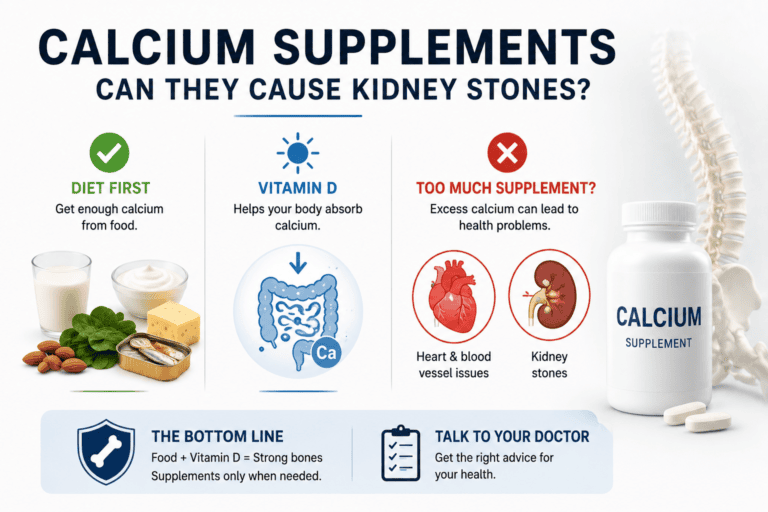
Calcium supplements, particularly when taken as concentrated doses separate from meals, can increase urinary calcium excretion more significantly than an equivalent amount of dietary calcium consumed alongside other food components, increasing the risk of calcium-based kidney stone formation in susceptible individuals.
Is calcium from food safer than calcium from supplements?
Current evidence generally suggests that dietary calcium, absorbed gradually alongside other food components, carries a more favourable safety profile compared to concentrated calcium supplementation, particularly regarding kidney stone risk and the emerging concerns around cardiovascular calcium deposition.
How do I know if I am vitamin D deficient?
A simple blood test measuring 25-hydroxyvitamin D levels provides an accurate assessment. Given the high prevalence of deficiency in the UAE, discussed in the earlier article on this topic, testing is a reasonable consideration for most residents, particularly those with limited sun exposure or other risk factors.
Should vegans definitely take calcium supplements?
Not automatically, but vegans should specifically assess whether their diet includes adequate calcium-fortified foods and other plant-based calcium sources. If dietary intake remains insufficient despite deliberate effort to include these sources, supplementation may be appropriate, ideally guided by a doctor or dietitian’s assessment.
Calcium supplements occupy an almost unquestioned position in popular health culture, frequently marketed and recommended as a straightforward way to protect bone health, particularly for those concerned about osteoporosis. Yet the assumption that more calcium, delivered through a supplement, is automatically beneficial for bone health overlooks both how the body actually absorbs and uses calcium, and the genuine risks that unnecessary supplementation can carry.
Dr. Sherief Elsayed, Consultant Spine Surgeon in Dubai, offers a direct and somewhat contrarian position on this widely used supplement category.
The Direct Position: “I Would Never Take a Calcium Supplement”
Dr. Sherief Elsayed states his personal practice unambiguously: “As a doctor, I would never take a calcium supplement. We get enough calcium from our diet.”
This position, while it may surprise patients who have been conditioned to view calcium supplementation as an unquestioned good practice for bone health, reflects a specific and clinically grounded understanding of dietary calcium sufficiency and the actual rate-limiting factor in effective calcium utilisation by the body.
Why Dietary Calcium Is Usually Sufficient
For most people eating a varied diet, adequate calcium intake is achievable through food sources alone without requiring supplementation. Dairy products, including milk, yoghurt, and cheese, are particularly rich sources of readily absorbable calcium. Beyond dairy, calcium is also present in meaningful quantities in leafy green vegetables, fortified plant-based milk alternatives, canned fish consumed with bones (such as sardines), tofu, and certain nuts and seeds.
Recommended daily calcium intake for most adults falls within a range that is genuinely achievable through a reasonably varied diet including some of these sources, without requiring additional supplementation for the majority of the population.
The Actual Bottleneck: Vitamin D, Not Calcium
Dr. Sherief Elsayed identifies the genuinely limiting factor in the calcium-bone health relationship: “What’s important is vitamin D to help our intestines absorb that calcium.”
This directly connects to the mechanism explained in detail in the earlier published article Why Living Indoors in Dubai Can Weaken Your Bones Over Time Dietary calcium, however abundant in the diet or however much is consumed through supplementation, must be actively absorbed from the digestive tract into the bloodstream before it can contribute to bone health. This absorption process depends critically on adequate vitamin D, which acts on the cells lining the small intestine to enable active calcium transport.
This is a crucial clinical distinction. For the significant proportion of the UAE population who are vitamin D deficient, as covered extensively in the earlier article, the limiting factor in achieving adequate bone-supporting calcium levels is not insufficient dietary or supplemental calcium intake, but insufficient vitamin D to actually absorb the calcium that is already present in a normal diet. Taking additional calcium supplements without correcting an underlying vitamin D deficiency does very little to solve the actual problem, because the excess supplemental calcium simply cannot be efficiently absorbed without adequate vitamin D to enable the process.
The Risk: Where Unabsorbed or Excess Calcium Goes
Dr. Sherief Elsayed identifies the specific risk associated with excessive calcium supplementation: “Too much calcium can cause it to be deposited in the cardiovascular system, causing all kinds of problems. It can cause renal stones, for example.”
This addresses a genuine and increasingly well-documented safety concern with calcium supplementation, particularly when taken in excess of what the body can effectively use and incorporate into bone.
Cardiovascular calcium deposition:
There is a growing body of research suggesting that excess calcium, particularly when delivered through supplementation rather than dietary sources, may be associated with increased deposition of calcium within blood vessel walls, a process linked to vascular calcification and, in some studies, an increased risk of cardiovascular events. This research area continues to evolve, but it represents a meaningful shift from the historical assumption that calcium supplementation carries essentially no downside risk.
Kidney stones:
Excess calcium that is absorbed into the bloodstream but not effectively utilised by bone must ultimately be filtered and eliminated by the kidneys. When calcium levels in the urine are elevated, this significantly increases the risk of calcium-based kidney stone formation, one of the most common and well-established complications specifically associated with calcium supplementation, particularly at higher doses.
This risk is distinct from dietary calcium intake, where the calcium is absorbed more gradually alongside other dietary components and is generally associated with a lower, and in some studies even protective, effect on kidney stone risk, compared to the more concentrated, rapid absorption profile of a calcium supplement taken as an isolated dose.
Who Actually Needs Calcium Supplementation?
Dr. Sherief Elsayed identifies the specific populations for whom calcium supplementation genuinely is appropriate: “Unless you’re a vegan or unless you have a medical condition that means you have a very low calcium, then you shouldn’t be taking calcium supplementation.”
Vegans and strict plant-based diets:
Individuals following a vegan diet, without dairy products as a calcium source, may have genuinely lower dietary calcium intake unless they are specifically and consistently consuming adequate quantities of calcium-fortified plant milks, tofu, calcium-set products, and other plant-based calcium sources. For this population, supplementation may be a reasonable and appropriate way to close a genuine dietary gap.
Diagnosed medical conditions causing hypocalcaemia:
Certain medical conditions, including specific hormonal disorders affecting parathyroid function, certain malabsorption conditions, and some medication effects, can cause genuinely low blood calcium levels (hypocalcaemia) that require active medical management, including calcium supplementation under appropriate medical supervision and monitoring.
Other specific clinical scenarios:
Certain other situations, such as specific stages of chronic kidney disease with particular calcium and phosphate management requirements, or particular post-surgical scenarios (such as following parathyroid surgery), may also warrant supervised calcium supplementation as part of a broader, individually tailored medical management plan.
What This Means in Practice: Vitamin D Over Calcium
The practical clinical guidance that emerges from this discussion is that for most people concerned about bone health, particularly in the UAE context where vitamin D deficiency is widespread, the priority should be addressing vitamin D status rather than reflexively adding calcium supplementation. This directly reinforces the guidance provided in the earlier articles on bone health in this series, including Why Women in Their 30s Need to Start Protecting Their Bone Density, where adequate vitamin D, alongside weight-bearing exercise, is identified as central to bone health, with dietary calcium generally sufficient without additional supplementation for most individuals.
A Spinal Health Doctor in Dubai assessing a patient’s bone health, particularly in the context of osteoporosis prevention or management, should evaluate vitamin D status specifically, alongside dietary calcium intake assessment, rather than automatically recommending calcium supplementation as a default intervention.
Why This Matters for Spine Patients Specifically
For patients managing spinal conditions, particularly those with osteoporosis-related vertebral fragility, understanding genuine determinants of bone health matters directly. A Spine Fusion Surgeon in Dubai relies on adequate bone quality for secure implant fixation in spinal surgery. or those preparing for spinal surgery involving instrumentation that depends on adequate bone quality for secure fixation, understanding the genuine determinants of bone health, appropriate vitamin D status and adequate dietary calcium, rather than indiscriminate calcium supplementation, is directly relevant to optimising surgical outcomes and long-term spinal bone health.
UAE-Specific Considerations
Given the population-wide prevalence of vitamin D deficiency in the UAE discussed extensively elsewhere in this blog series, there may be a temptation for patients or even some healthcare providers to reach for calcium supplementation as a general bone health measure, without specifically addressing the underlying vitamin D deficiency that is the actual driver of impaired calcium absorption and bone health concerns in this population. Dr. Sherief Elsayed’s guidance directly challenges this reflexive approach, emphasising testing and correcting vitamin D status as the more clinically appropriate and evidence-based intervention.
Expert Summary
For most people, dietary calcium intake is genuinely sufficient, and the actual limiting factor in bone health is adequate vitamin D to enable calcium absorption, not insufficient calcium itself. Calcium supplementation, taken without a genuine indication, carries real risks, including potential cardiovascular calcium deposition and a well-established increased risk of kidney stones. Calcium supplementation remains genuinely appropriate for specific populations, including strict vegans without adequate dietary alternatives, and individuals with diagnosed medical conditions causing low blood calcium, but should not be viewed as a default, universally beneficial intervention for general bone health, particularly when the more important underlying issue, vitamin D deficiency, remains unaddressed.
Table of Contents
Recent Articles

Why Eight People Were Needed for One Spine Surgery in Dubai
Why Eight People Were Needed for One Spine Surgery in Dubai Does every spinal surgery require exactly eight team members? No, as Dr. Sherief Elsayed explains directly, the specific team
Three Spine Surgery Myths a Dubai Surgeon Wants You to Forget
Three Spine Surgery Myths a Dubai Surgeon Wants You to Forget Is it really safe to walk on the same day as spine surgery? Yes, for the majority of modern
Why Osteoporosis Is Called the Silent Disease in the UAE
Why Osteoporosis Is Called the Silent Disease in the UAE If osteoporosis doesn’t cause pain, how would I know if I needed a DEXA scan? Given the entirely silent nature