
Why Your Spine Needs Gravity, Dr. Sherief Elsayed Explains
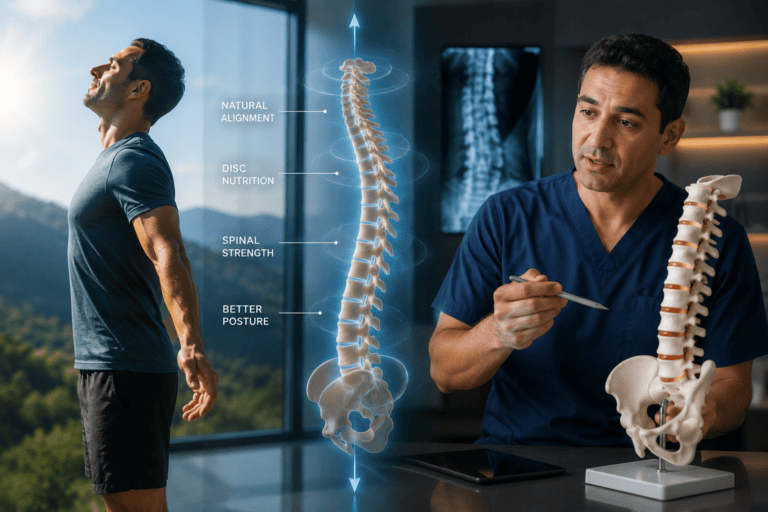
Do astronauts suffer permanent spinal damage from space travel?
Most spinal changes from space travel are reversible with appropriate rehabilitation after return to Earth. Disc rehydration normalises within days to weeks. Muscle mass and bone density recover over months with targeted exercise. However, astronauts who have sustained disc herniations in space or during the reloading phase of return may experience longer-term issues. Ongoing research by space agencies continues to refine prevention and rehabilitation protocols.
Is it true you are taller in the morning than at night?
Yes. Throughout the day, gravitational load compresses the intervertebral discs and forces out some of their water content. Overnight, lying horizontal removes this compressive load and the discs rehydrate. The height difference is typically around 1 to 2 centimetres between first thing in the morning and end of day.
Does this mean bed rest is bad for back pain?
For most back pain presentations, prolonged bed rest is counterproductive. It removes the mechanical stimulus that the spine’s supporting muscles, discs, and bones need to maintain condition. Current guidelines recommend staying as active as pain allows, with specific physiotherapy to address the underlying cause of pain. Bed rest is not recommended as a treatment for non-specific back pain.
Can exercise really prevent disc degeneration?
Exercise cannot reverse established disc degeneration, but it significantly slows its progression and reduces the functional impact of degenerative changes. Strong paraspinal muscles reduce the load transmitted to the disc, and weight-bearing activity maintains the hydration cycle that keeps discs healthy. Regular exercise is one of the most evidence-supported strategies for long-term spinal health.
How quickly does muscle atrophy if I stop exercising?
Measurable loss of muscle mass begins within the first week of complete inactivity. In conditions of true unloading (bed rest, microgravity), significant atrophy can occur within two to three weeks. The loss is faster in older adults. Recovery typically takes longer than the period of inactivity, reinforcing the importance of maintaining regular activity rather than stopping and restarting.
Is swimming a good exercise for spinal health?
Swimming is excellent for cardiovascular fitness and provides gentle spinal mobilisation without high compressive loads. However, it is largely non-weight-bearing, which means it does not provide the same bone density and paraspinal muscle loading stimulus as walking, running, or resistance training. For comprehensive spinal health, a combination of weight-bearing and non-weight-bearing activity is optimal.
Space travel has given medicine one of the most revealing natural experiments in the study of spinal health. Remove gravity from the equation entirely, and the spine does something remarkable, and instructive. Understanding what happens to the human spine without the compressive force of gravity explains, in reverse, why everything that keeps you upright, active, and loading your spine is not damaging it but protecting it.
Dr. Sherief Elsayed, Consultant Spine Surgeon in Dubai, uses the vivid example of Katy Perry’s brief spaceflight to illustrate what happens to the spine when gravity disappears, and what the long-term consequences would be with extended exposure.
What Happens to the Spine Without Gravity?
The effects begin almost immediately. Dr. Sherief Elsayed explains: “This is what could have happened to Katy Perry’s spine if she had stayed longer in space. No gravity pulling down on your spine. So the discs expand, they absorb more water. There’s nothing compressing them, so they expand. You get taller by about two or three inches with enough time.”
This is not a metaphor. Astronauts genuinely return from extended space missions measurably taller than when they left, sometimes by as much as three inches, before the spine recompresses upon return to Earth’s gravity over the following days. The intervertebral discs, normally under constant compressive load from body weight and muscle activity, are free to hydrate fully and expand in microgravity.
The disc is a viscoelastic structure. Under load, it compresses and loses some of its water content throughout the day, which is why you are slightly shorter in the evening than when you wake up. Lying down overnight, with the compressive load reduced, the disc rehydrates. In space, without any gravitational compression at all, this rehydration happens continuously and without limit.
The Muscular Consequences: 30% Loss Within Months
Disc expansion is the least serious consequence of prolonged weightlessness. The muscular deterioration that follows is far more clinically significant.
Dr. Sherief Elsayed continues: “Now, if she’d stayed there for several weeks, all the big muscles either side of the spine wouldn’t be working as hard. Over a few months, she could lose around 30% of her muscle mass.”
The paraspinal muscles. The erector spinae, multifidus, and quadratus lumborum that run in strong columns alongside the vertebral column, exist to support and control the spine under gravitational load. In space, that load disappears. Without the constant need to stabilise against gravity, these muscles rapidly atrophy. They are no longer required to work, and the body, with its extraordinary efficiency, reduces their mass accordingly.
This is precisely the same process that occurs with prolonged bed rest on Earth, with excessive sitting without adequate movement, or with any condition that unloads the spine for extended periods. The spine loses its muscular support system, and when load returns, whether re-entering Earth’s atmosphere or returning to normal daily activity. It does so without the protection that muscle provides.
This is why physiotherapy programmes for back pain focus so heavily on core strengthening. Building and maintaining the paraspinal muscles is not aesthetic. It is protective, structural, and essential for long-term spinal health. The article Why There Is No Single Cure for Lower Back Pain explains why exercise is one of the only interventions with consistent evidence across all presentations of back pain.
Bone Density Loss: The Fragility Risk
Beyond muscle, prolonged weightlessness attacks the bones themselves. Dr. Sherief Elsayed explains: “Similarly, in time, the bones aren’t being stressed, so they reduce their density and the bones become more fragile. You’re more prone to a fracture.”
Bone is a living tissue in a constant state of remodelling. Osteoblasts build new bone; osteoclasts break it down. The stimulus that tips this balance toward building is mechanical stress. The loading forces transmitted through bone during weight-bearing activity. Without that stimulus, the balance shifts toward resorption, and bone density falls.
This process mirrors exactly what happens in osteoporosis, where loss of bone density in the vertebral bodies leads to fragility fractures, painful vertebral compression fractures, and progressive height loss. The UAE has a significant and underdiagnosed burden of osteoporosis, particularly in the older female and male population, making this parallel particularly relevant.
For astronauts, bone density loss in the spine and lower limbs can reach 1 to 2 percent per month in microgravity. A rate far exceeding the normal age-related bone loss of approximately 1 percent per year. Returning astronauts follow intensive rehabilitation programmes to rebuild both muscle mass and bone density.
Back Pain in Astronauts: More Than 50% Are Affected
The cumulative effect of disc expansion, muscle atrophy, and bone remodelling is not merely theoretical. Dr. Sherief Elsayed notes: “Astronauts are prone to developing problems with their spine, including back pain. Over half of them report back pain due to these various changes.”
The mechanisms behind astronaut back pain are multiple:
- Disc expansion in microgravity stretches the posterior annulus and the longitudinal ligaments, which contain pain-sensitive nerve fibres
- The altered spinal geometry in a weightless environment, where the natural lumbar lordosis flattens, places the facet joints and posterior elements in unfamiliar loading patterns
- Return to gravity after extended weightlessness compresses rehydrated discs that are unaccustomed to load, increasing the risk of disc herniation
- Muscle imbalances from selective atrophy alter how load is distributed across the spine during the reloading phase
NASA and other space agencies have made spinal health a priority in their pre-flight conditioning and post-flight rehabilitation programmes precisely because of this well-documented vulnerability.
What This Tells Us About Spinal Health on Earth
The space medicine lesson translates directly to everyday spine care. The spine is designed to be loaded. It is designed to work against gravity. It is designed to be supported by strong muscles and stressed by regular weight-bearing activity. Remove any of these, through excessive sedentary behaviour, through deconditioning, through prolonged bed rest, and the same degenerative processes that occur in microgravity begin to unfold, simply at a slower rate.
Practical implications for patients in Dubai:
- Prolonged desk work and car commuting, which unload the spine in a flexed position without providing the dynamic loading of walking and standing, contribute to paraspinal muscle atrophy and disc degeneration over years
- Bed rest for back pain, historically prescribed but now clearly contraindicated by evidence, removes the loading stimulus that the spine needs to maintain disc, muscle, and bone health
- Weight-bearing exercise, including walking, resistance training, and activities that involve carrying load through the spine, is not dangerous for the back. For most patients, it is essential for it
- Vitamin D, calcium, and resistance exercise are the cornerstones of bone density preservation. In the UAE, where indoor lifestyles and sun avoidance are common despite abundant sunshine, Vitamin D deficiency is disproportionately prevalent and directly relevant to vertebral bone health
A Spinal Health Doctor in Dubai will assess not just structural pathology but the muscular and lifestyle factors that determine how well the spine tolerates its daily mechanical demands.
UAE-Specific Considerations
Several aspects of life in Dubai make the gravity lesson particularly applicable.
Sedentary professional culture: Long working hours at desks, combined with car-dependent commuting and limited incidental walking, produce exactly the sustained spinal unloading that drives muscle atrophy and disc degeneration, on a slower timescale than space, but through the same mechanisms.
Air conditioning and indoor lifestyle: The UAE’s climate encourages indoor, sedentary activity for much of the year. This reduces weight-bearing activity, sunlight exposure (and therefore Vitamin D synthesis), and the incidental movement that maintains spinal muscle conditioning.
Gym culture: Conversely, Dubai has a thriving gym culture that, when properly guided, is one of the most effective defences against spinal deconditioning. The challenge is distinguishing helpful loading from harmful loading, which requires clinical guidance rather than generalised restriction.
The published article Can Deadlifting Cause a Slipped Disc? Dr. Sherief Elsayed Warns Athletes in Dubai covers the fine line between beneficial and harmful spinal loading in athletic training.
Expert Summary
The spine without gravity undergoes rapid, measurable deterioration: discs expand without load, muscles atrophy without demand, bones lose density without stress. Astronauts experience all of this in accelerated form. The lesson for patients on Earth is that the forces they are often tempted to avoid, gravitational load, weight-bearing activity, resistance exercise, are precisely the forces their spines are designed to need.
Dr. Sherief Elsayed’s use of the spaceflight example is not a medical curiosity. It is one of the clearest illustrations in all of medicine that the human spine is built for use, and that the best thing most people can do for their spinal health is to keep using it. For a personalised assessment of spinal health and exercise guidance, consulting a Disc Health Specialist in Dubai is the most direct starting point.
Table of Contents
Recent Articles

Why Eight People Were Needed for One Spine Surgery in Dubai
Why Eight People Were Needed for One Spine Surgery in Dubai Does every spinal surgery require exactly eight team members? No, as Dr. Sherief Elsayed explains directly, the specific team

Three Spine Surgery Myths a Dubai Surgeon Wants You to Forget
Three Spine Surgery Myths a Dubai Surgeon Wants You to Forget Is it really safe to walk on the same day as spine surgery? Yes, for the majority of modern
Why Osteoporosis Is Called the Silent Disease in the UAE
Why Osteoporosis Is Called the Silent Disease in the UAE If osteoporosis doesn’t cause pain, how would I know if I needed a DEXA scan? Given the entirely silent nature