
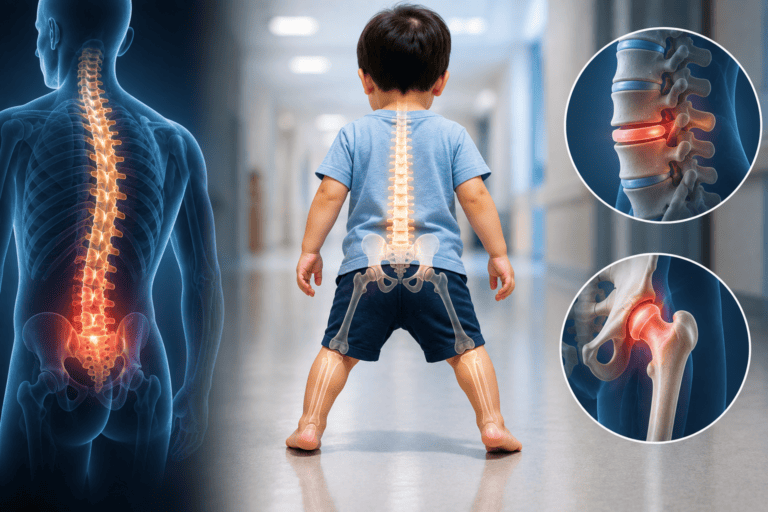
Why a Child Walking Like a Duck Could Be a Spine or Bone Problem
Can rickets occur in sunny countries like the UAE?
Yes. Despite abundant sunshine, vitamin D deficiency is extremely common in the UAE due to indoor lifestyles, sun-avoidance behaviour, covering clothing, and limited outdoor activity. Children and adults alike are at risk.
How is rickets diagnosed?
Rickets is diagnosed by a combination of clinical features (bowed legs, wrist widening, frontal bossing of the skull), blood tests (low vitamin D, low or normal calcium, raised alkaline phosphatase, raised parathyroid hormone), and X-rays showing characteristic changes at the growth plates including fraying, cupping, and metaphyseal widening.
At what age does rickets typically present?
Most commonly between 6 months and 3 years, when rapid bone growth creates the highest demand for mineralisation. However, as in this case, it can present in older children if the deficiency is severe and longstanding.
Will the bowed legs straighten with treatment?
In most children, particularly those treated before significant deformity is established, the bowing corrects spontaneously as bones mineralise properly. Children with severe bowing, particularly those over the age of 4 to 5 at diagnosis, may not correct fully and may require orthopaedic assessment for possible surgical correction.
Should children in the UAE take vitamin D supplements?
Given the high prevalence of deficiency in the UAE, routine vitamin D supplementation is widely recommended for children, particularly infants who are exclusively breastfed (as breast milk contains minimal vitamin D) and children with limited outdoor activity or significant skin coverage. The specific dose should be discussed with a paediatrician. For spinal involvement from metabolic bone disease, assessment by a Spinal Deformity Surgeon in Dubai ensures any structural consequence is identified and managed appropriately.
Can adults get rickets?
The adult equivalent of rickets is osteomalacia, softening of the bones due to inadequate mineralisation. It causes bone pain, muscle weakness, and fragility fractures, and is managed with vitamin D supplementation in the same way as childhood rickets.
A child who is not walking normally is a child who needs assessment. The way a child moves tells an experienced clinician an enormous amount about what is happening in their bones, joints, muscles, and nervous system. A waddling gait, bowed legs, and a history that includes geography and siblings is enough information to reach a working diagnosis before any investigation is performed, provided the clinician knows what to look for.
Dr. Sherief Elsayed, Consultant Spine Surgeon in Dubai, demonstrates this diagnostic reasoning in a rapid case exchange that ends with an urgent clinical instruction.
The Clinical Case: Walking Like a Duck
The presentation unfolds in a structured sequence:
“Six year old boy’s mom thinks he’s not walking normally. She’s wondering if it’s his spine. What do you mean he’s not walking normally? She says he’s walking like a duck. So, waddling from side to side? Exactly. Any problems with his knees? Well, she mentioned that his knees are bowing outwards. Okay, where does he live? He lives in the north of England. Siblings? He has two younger siblings. Are they both okay? They’re both alright.”
The conclusion: “Six years old, lives in the north of England, bowed knees, walking like a duck. What are his vitamin D levels doing? Level five. Level 5, wow, that’s very, very low. So he likely has a disease called rickets due to severe vitamin D deficiency. He needs to see a doctor urgently to get that supplemented.”
What Is Rickets?
Rickets is a disease of childhood bone development caused by severe deficiency of vitamin D, calcium, or phosphate, most commonly vitamin D. It is one of the most preventable serious bone conditions in children, yet it remains a significant clinical problem in parts of the world where sun exposure is limited, dietary intake is poor, or cultural practices limit skin exposure to sunlight.
The bones of a growing child are in a constant state of remodelling. New bone forms at the growth plates. The cartilaginous zones at the ends of long bones where longitudinal growth occurs. For this new bone to mineralise properly and become hard and strong, adequate calcium and phosphate must be deposited into the collagen matrix. Vitamin D is the essential regulatory molecule that controls calcium absorption from the gut, calcium reabsorption from the kidney, and the mineralisation of new bone.
Without adequate vitamin D, new bone formed at the growth plates does not mineralise properly. It remains soft and pliable, like rubber rather than stone. Under the compressive load of body weight and muscle activity, this undermineralised bone bows and deforms.
Why the Diagnostic Clues Matter
Every detail in the case history is doing clinical work.
Walking like a duck (waddling gait): A waddling gait in a young child suggests either weakness of the hip abductors or a structural deformity of the lower limbs or hip that alters the mechanics of walking. In rickets, the combination of bowed legs and generalised muscle weakness (hypotonia, which is also a feature of severe vitamin D deficiency) produces this characteristic waddle.
Bowed knees (genu varum): Bowing of the legs, specifically outward bowing at the knees (genu varum), is the classic skeletal deformity of rickets. The weight-bearing bones of the lower limb. The femur and tibia, are bowing under the body’s weight because their growth plate bone is insufficiently mineralised to resist the load. In a healthy child, these bones are hard and straight. In a child with active rickets, they bow progressively with continued weight-bearing.
Living in the north of England: This is a critical epidemiological detail. The north of England receives substantially less sunlight than southern regions, particularly between October and March when the sun’s angle is too low for sufficient UVB radiation to reach the skin for vitamin D synthesis. Children spending most of their time indoors, particularly in winter, may receive almost no sun-derived vitamin D for months at a time.
Two younger siblings who are “alright”: This detail serves two purposes. It suggests a shared domestic and dietary environment, making a familial genetic bone condition less likely (if it were inherited, siblings would also be affected). And it rules out the most serious alternative explanation. A genetic bone dysplasia, that would typically affect siblings as well.
The Vitamin D Level: What 5 nmol/L Means
A vitamin D level of 5 nmol/L is profoundly deficient. For context:
- Normal vitamin D levels are generally considered to be above 50 nmol/L (some guidelines use 75 nmol/L as optimal)
- Vitamin D deficiency is typically defined as below 25 to 30 nmol/L
- Severe deficiency causing rickets is typically below 12 to 15 nmol/L
- A level of 5 nmol/L is critically low: far below the threshold at which bone mineralisation can be maintained
At this level, the child’s bones are actively failing to mineralise. The rickets is not early or mild. It is established and likely progressing. The urgency of treatment is genuine.
Is the Spine Involved in Rickets?
The mother’s original question, whether the problem is with her son’s spine, is worth addressing directly. In rickets, the spine can be involved in several ways:
- Spinal deformity (kyphosis or scoliosis) can develop because the vertebral bodies, like all bones, are undermineralised and deform under load
- In severe cases, thoracic kyphosis (curvature of the upper back) may develop, sometimes called rachitic kyphosis
- Vertebral fractures can occur with minimal trauma because of the structural weakness of undermineralised bone
- Chest wall deformity, including a narrowed thoracic inlet, can occur from rib involvement
However, in this case, the primary visible manifestations are in the long bones of the lower limbs. The waddling gait and bowed legs are the cardinal clinical presentation, and the spine is not the primary concern at this stage. The importance of assessing the full musculoskeletal picture in a child with possible metabolic bone disease is why the clinical history needs to be comprehensive. A Scoliosis Specialist in Dubai assessing a child with spinal deformity will always consider metabolic bone conditions as an underlying cause, particularly in children from regions or backgrounds with known vitamin D deficiency risk.
Treatment of Rickets
Treatment of nutritional rickets caused by vitamin D deficiency is straightforward and highly effective, provided it is started before irreversible deformity has occurred.
Vitamin D supplementation: High-dose vitamin D is given either as a loading dose (a single large dose or a course of daily high doses) followed by maintenance supplementation, or as a lower daily dose over a longer period. The specific protocol depends on the severity of the deficiency and the child’s age.
Calcium supplementation: In children whose dietary calcium intake is also low, calcium supplementation alongside vitamin D accelerates bone mineralisation and clinical improvement.
Monitoring: Vitamin D levels, calcium, phosphate, and alkaline phosphatase (a marker of bone turnover) are monitored regularly during treatment to confirm response and adjust dosing.
Expected response: Most children with nutritional rickets respond well to treatment. The bony deformities, bowed legs in particular, often correct spontaneously as the bones mineralise properly and the growth plates respond to normal metabolic conditions. In children with severe, established bowing, particularly those approaching skeletal maturity, surgical correction may be considered if spontaneous correction is insufficient.
Rickets in the UAE: A Counterintuitive Problem
One might assume that rickets is exclusively a problem of sun-deprived northern climates. In fact, vitamin D deficiency is highly prevalent in the UAE and across the Middle East, paradoxically, despite abundant sunshine.
The reason is behavioural and cultural. The extreme heat of the UAE summer means that outdoor activity and sun exposure are minimal for much of the year. A Spinal Health Doctor in Dubai who encounters children with bone deformity or gait problems will always consider metabolic bone disease in the differential, given the UAE’s high prevalence of deficiency. Clothing practices that cover the majority of the skin for religious or cultural reasons reduce UV exposure further. Indoor lifestyles, air-conditioned environments, and the widespread practice of avoiding the sun for cosmetic reasons (to avoid tanning) compound the problem.
The UAE has among the highest rates of vitamin D deficiency in the world, with surveys consistently showing that a majority of the population, adults and children alike, have levels below the threshold for optimal bone health. This makes vitamin D deficiency a relevant clinical consideration for children presenting with bone or gait problems in Dubai just as much as for a child in the north of England.
Other Causes of a Waddling Gait in Children
The working diagnosis in this case is rickets based on the clinical picture and Vitamin D level. But a child presenting with abnormal gait and lower limb deformity warrants consideration of other conditions, particularly when the presentation is atypical.
Conditions that can cause a waddling gait in children:
- Developmental dysplasia of the hip (DDH): Abnormal hip socket development leading to instability and altered gait. Usually diagnosed in infancy but occasionally presents later.
- Muscular dystrophy (particularly Duchenne): Progressive proximal muscle weakness causing a waddling gait and Gower’s sign (difficulty rising from the floor). Typically presents in boys aged 3 to 5 years and should be excluded in any boy with unexplained proximal weakness.
- Bilateral Perthes disease: Avascular necrosis of both femoral heads in a child. Rare in bilateral form but produces gait abnormality.
- Skeletal dysplasias: Genetic conditions affecting bone growth and shape. Often produce characteristic proportionate or disproportionate short stature alongside gait abnormality.
- Cerebral palsy: Spastic diplegia affecting the legs bilaterally can produce a waddling or scissor gait pattern.
The clinical history and examination, together with the dramatically low vitamin D level in this case, make rickets the most likely diagnosis. But a full assessment including appropriate imaging and laboratory investigations ensures alternative or additional diagnoses are not missed. The article How Dr. Sherief Elsayed Diagnoses Rare Spine Conditions in Children Quickly covers the clinical reasoning approach that identifies serious paediatric conditions rapidly.
Expert Summary
A six-year-old waddling, with bowed knees, living in a low-sunlight environment, with a vitamin D level of 5 nmol/L, has rickets. The diagnosis is clinical before any investigation is needed, and the investigation confirms it. Treatment is urgent because the bones are actively failing to mineralise, and every week of continued severe deficiency is a week of continued deformity progression.
The case also illustrates something broader: gait abnormality in a child is never simply a variant of normal until the underlying cause has been established. Whether the cause is metabolic bone disease, hip pathology, muscular dystrophy, or spinal deformity, it requires assessment and, in the case of a critically low vitamin D level, prompt treatment.
Table of Contents
Recent Articles

Why Eight People Were Needed for One Spine Surgery in Dubai
Why Eight People Were Needed for One Spine Surgery in Dubai Does every spinal surgery require exactly eight team members? No, as Dr. Sherief Elsayed explains directly, the specific team
Three Spine Surgery Myths a Dubai Surgeon Wants You to Forget
Three Spine Surgery Myths a Dubai Surgeon Wants You to Forget Is it really safe to walk on the same day as spine surgery? Yes, for the majority of modern
Why Osteoporosis Is Called the Silent Disease in the UAE
Why Osteoporosis Is Called the Silent Disease in the UAE If osteoporosis doesn’t cause pain, how would I know if I needed a DEXA scan? Given the entirely silent nature