
How Dr. Sherief Elsayed Diagnoses Rare Spine Conditions in Children Quickly
How common is Grisel syndrome?
Grisel syndrome is rare, though its exact incidence is difficult to determine because mild cases may resolve spontaneously and go unreported. It is most commonly seen in children under 12, and most cases follow an upper respiratory tract infection or throat surgery.
Can adults get Grisel syndrome?
It is extremely rare in adults. The ligamentous laxity that allows the atlantoaxial joint to subluxate in the context of inflammation is much more pronounced in children. Adult cases have been reported but are exceptional.
Is a stiff neck in a child always Grisel syndrome?
No. A stiff neck in a child has many causes, most of which are benign, muscle spasm, lymph node swelling, or simple torticollis. Grisel syndrome is suspected specifically when the neck is fixed in rotation and cannot be moved, there is no injury, and there has been recent throat or ear infection. If in doubt, imaging is appropriate.
How long does recovery from Grisel syndrome take?
For early-diagnosed cases managed conservatively, most children recover within two to four weeks. Cases requiring traction or surgical stabilisation take longer, and rehabilitation may extend over several months.
Should children with back pain always be sent for an MRI?
Not as a first-line investigation for non-specific back pain. However, if red flag features are present, night pain, fever, neurological symptoms, or a visible deformity, MRI is the investigation of choice for evaluating the spinal cord, discs, and soft tissues in children.
At what age can scoliosis first appear?
Scoliosis can appear at any age, including in infants (infantile scoliosis). The most common form, adolescent idiopathic scoliosis, typically develops between the ages of 10 and 18, with girls at higher risk of progression. Early detection during the growth spurt allows for effective non-surgical management in many cases.
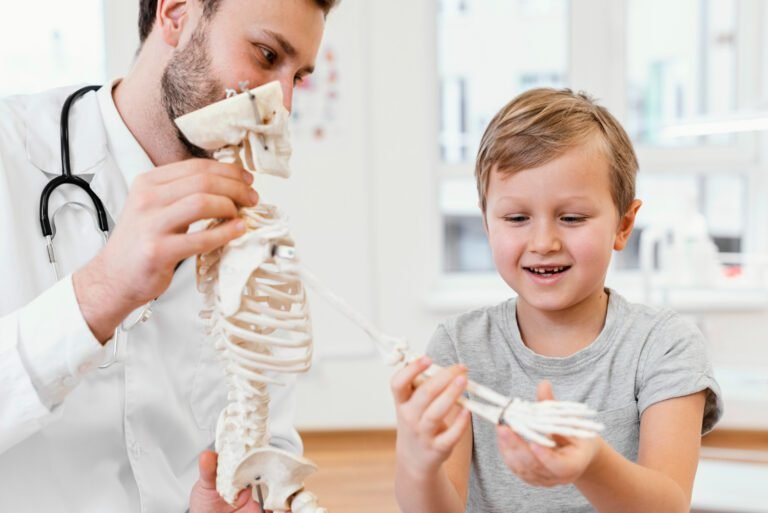
Spinal conditions in children are not simply smaller versions of adult problems. They have distinct causes, distinct presentations, and require a clinician who recognises the red flags specific to the paediatric spine. One of the most striking examples is a condition called Grisel syndrome, a rare but serious cause of a twisted, painful neck in a child, which most people have never heard of but which Dr. Sherief Elsayed can identify within 30 seconds of hearing the clinical details.
The 30-Second Diagnosis: Grisel Syndrome
Dr. Sherief Elsayed, UAE Spine Surgeon, uses a rapid case-based approach to illustrate how clinical reasoning works in practice:
“A six-year-old boy presents with a painful twisted head which he cannot move. How long has he had it for? One day. Any injury? No. Any recent illness? He had tonsillitis one week prior. Has he had any imaging? He’s had an X-ray and a CT scan done. What do they show? X-rays show an asymmetry of the lateral masses of C1 on the open mouth odontoid view and the CT scan shows rotatory subluxation.”
The answer: Grisel syndrome.
This rapid diagnostic sequence illustrates something important about clinical medicine: the history, the story of what happened and when, often provides more information than the imaging. Before the scan results are even mentioned, the pattern of recent tonsillitis followed by a fixed, painful head tilt in a child points strongly in one direction.
What Is Grisel Syndrome?
Grisel syndrome is a non-traumatic atlantoaxial rotatory subluxation, a rotational displacement of the joint between the first cervical vertebra (C1, the atlas) and the second cervical vertebra (C2, the axis). In plain terms, the top joint of the neck becomes stuck in a rotated position.
It occurs almost exclusively in children and adolescents, and it is almost always associated with an inflammatory process in the head and neck region, most commonly pharyngitis, tonsillitis, or recent surgery in the throat or neck area.
The proposed mechanism involves spread of inflammation from the infected throat directly to the tissues surrounding the atlantoaxial joint. The synovial membrane of the joint becomes inflamed, ligamentous laxity develops, and the joint shifts out of its normal position. Because the atlantoaxial joint has a complex geometry with very little inherent bony stability, it is particularly vulnerable to this kind of inflammatory displacement.
How Is Grisel Syndrome Recognised?
The clinical presentation is distinctive once you know what to look for.
Classic features of Grisel syndrome:
- A child or adolescent with a sudden onset of painful torticollis, the head is tilted and rotated and cannot be straightened
- No preceding trauma or injury
- A recent history of upper respiratory tract infection, tonsillitis, pharyngitis, or otitis media, typically within the preceding two weeks
- In some cases, recent adenotonsillectomy or other oropharyngeal surgery
- The child holds their head in the “cock robin” position, tilted to one side, rotated slightly, with the chin pointing toward the opposite shoulder
- Neck pain and significant restriction of movement, but intact neurological function in most cases
Imaging findings:
The open mouth odontoid X-ray view reveals asymmetry of the lateral masses of C1 relative to C2, the two sides do not sit symmetrically around the odontoid peg. The CT scan confirms rotatory subluxation and helps classify the degree of displacement.
Why Early Recognition Matters
Grisel syndrome is not just a stiff neck. Without prompt recognition and treatment, the atlantoaxial subluxation can progress, and in severe or longstanding cases, there is a risk of spinal cord compression. The upper cervical spinal cord is in close proximity to the atlantoaxial joint, and significant displacement can narrow the available space around it.
Classification of Grisel syndrome (Fielding and Hawkins):
- Type I: Simple rotatory fixation without anterior displacement, neurological injury very rare
- Type II: Rotatory fixation with anterior displacement of 3 to 5mm, some risk
- Type III: Rotatory fixation with anterior displacement greater than 5mm, significant risk
- Type IV: Rotatory fixation with posterior displacement, rarest and most dangerous
Most cases in children are Type I and resolve with appropriate treatment. But delayed diagnosis risks progression to a higher grade, and chronic untreated subluxation can lead to permanent deformity.
Treatment of Grisel Syndrome
Treatment depends on the duration of symptoms and the degree of displacement.
For recent onset (less than one week):
- Cervical collar immobilisation
- Anti-inflammatory medication and muscle relaxants
- Antibiotics if active infection is ongoing
- Most cases in this category resolve within one to two weeks with conservative management
For established subluxation (one to four weeks duration):
- Halter traction or halo traction to reduce the subluxation under controlled conditions
- Followed by immobilisation until the ligaments stabilise
- Close neurological monitoring throughout
For chronic cases (more than four weeks) or failed conservative management:
- Surgical atlantoaxial fusion may be required to achieve stable alignment and protect the spinal cord
- This is reserved for a minority of cases but is an important option when conservative management has not been effective
The earlier the condition is identified and treated, the better the outcome. This is why rapid recognition is not merely academically interesting, it directly changes what treatment is available and how well the child recovers. A Spine Surgeon in Dubai who encounters a child with this presentation will act promptly, knowing that the window for conservative management closes with each passing week.
Broader Lessons: Diagnosing Rare Paediatric Spine Conditions
Grisel syndrome is one example of a broader principle in paediatric spine care: the history is everything. In children, the diagnosis is often made before the imaging is reviewed, because the sequence of events, illness, then symptom, tells a coherent story that guides the clinician directly.
Other paediatric spine conditions that require prompt recognition:
Scoliosis: Abnormal lateral curvature of the spine that most commonly develops during the adolescent growth spurt. Screening by school doctors and paediatricians, with referral to a spinal specialist when curves are progressive or exceed specific thresholds, is the standard approach. The article on How Do Doctors Screen for Scoliosis in UAE? covers this in detail.
Scheuermann’s kyphosis: An abnormal forward curvature of the thoracic spine in adolescents, caused by irregular vertebral growth. It presents as a rigid, round-shouldered posture and thoracic back pain in teenagers. It is frequently dismissed as poor posture and undertreated.
Discitis: Infection of an intervertebral disc in children, presenting with back pain, refusal to walk, and fever. It is uncommon but serious. MRI is the investigation of choice.
Spondylolysis: A stress fracture through the pars interarticularis of the lumbar vertebra, common in young athletes involved in gymnastics, cricket, and other extension-loaded sports. It causes low back pain in active teenagers and is often missed on standard X-rays.
Spinal cord injury without radiological abnormality (SCIWORA): Children’s spines are more flexible than adults’, and the spinal cord can be injured by extreme movement without any bony fracture being visible on X-ray or CT. MRI is essential when a child presents with neurological symptoms following trauma.
When to Refer a Child to a Spine Specialist
Most children with back pain do not have serious spinal pathology – the majority have muscular or postural causes that resolve with physiotherapy and reassurance. A Scoliosis Specialist in Dubai should be consulted whenever a progressive spinal deformity is suspected. However, certain features in a child or adolescent with spinal complaints require specialist assessment.
Refer promptly if a child presents with:
- Sudden onset of a fixed, painful head or neck tilt following recent illness or infection
- Back pain that wakes the child from sleep
- Back pain associated with fever, weight loss, or general malaise
- Any neurological symptoms, weakness, numbness, difficulty walking, bladder or bowel changes
- A progressive or rigid spinal deformity
- Back pain following significant trauma
- Onset of a spinal deformity before puberty (more likely to progress and less likely to be idiopathic)
These presentations warrant urgent or early specialist review. Waiting and watching is appropriate for many benign presentations, but these specific features require active investigation.
Expert Summary
The 30-second diagnosis of Grisel syndrome demonstrates something that applies across all of medicine, not just the spine: clinical reasoning from the history is often faster and more accurate than waiting for scan results. The combination of recent tonsillitis and a fixed, painful head tilt in a child is a pattern that an experienced clinician recognises immediately, and that recognition opens the door to prompt treatment and a much better outcome.
The question of how much clinical decision-making can be delegated to technology is explored directly in Dr. Sherief Elsayed on Why AI Is a Useful Guide but Not a Replacement for Your Doctor, which examines both the genuine value and the current limits of AI in medicine.
Dr. Sherief Elsayed’s approach to paediatric and complex spinal presentations reflects the same principle that runs through all his clinical work: listen carefully, examine thoroughly, and let the clinical picture guide you rather than waiting for a scan to make the diagnosis. A Consultant Spine Surgeon in Dubai who applies this approach will identify rare conditions quickly and direct children to the right treatment before complications develop.
Table of Contents
Recent Articles

Why Eight People Were Needed for One Spine Surgery in Dubai
Why Eight People Were Needed for One Spine Surgery in Dubai Does every spinal surgery require exactly eight team members? No, as Dr. Sherief Elsayed explains directly, the specific team
Three Spine Surgery Myths a Dubai Surgeon Wants You to Forget
Three Spine Surgery Myths a Dubai Surgeon Wants You to Forget Is it really safe to walk on the same day as spine surgery? Yes, for the majority of modern
Why Osteoporosis Is Called the Silent Disease in the UAE
Why Osteoporosis Is Called the Silent Disease in the UAE If osteoporosis doesn’t cause pain, how would I know if I needed a DEXA scan? Given the entirely silent nature