
What Makes Dr. Sherief Elsayed Different as a UAE Spine Surgeon
Is Dr. Sherief Elsayed a neurosurgeon or an orthopaedic surgeon?
He is an orthopaedic spine surgeon, trained in trauma and orthopaedics in the UK with a fellowship in complex spine surgery. Both neurosurgeons and orthopaedic spine surgeons treat the spine, with some differences in training emphasis.
Does he only offer surgery?
No. Many patients are advised to follow a non-operative plan, including physiotherapy, medication and injections. Surgery is recommended only when the diagnosis, symptoms and scan all point to a procedure likely to help.
Can I bring my own MRI for a second opinion?
Yes. Bring the actual images on a disc or link, not just the written report, along with any previous reports and a list of medications. Images allow a far more accurate view than a report alone.
What languages does he speak?
He is fluent in English and Arabic.
Does he see patients without insurance?
He has said publicly that patients who cannot afford a consultation or do not have insurance can request an appointment through the website and explain their situation. Availability and arrangements can vary.
How do I know if I need a spine surgeon at all?
You may benefit from a spine specialist if you have persistent nerve symptoms, weakness, symptoms that limit walking, or pain that is not improving after several weeks. Red-flag symptoms such as bladder or bowel changes need emergency care.
Choosing a spine surgeon is a bigger decision than most people expect. You are not just picking someone to operate. You are picking the person who will tell you whether you need an operation at all, and that judgment call is where much of a spine surgeon’s value lies.
This article explains how Dr. Sherief Elsayed practises, in his own words where possible, and what patients can reasonably expect. It is written so that you can compare it with how any surgeon works, not as a substitute for your own research.
Where did his training take place?
Dr. Sherief Elsayed, Consultant Spine Surgeon in Dubai, qualified in medicine at Cardiff University in the UK in 2000. He went on to complete his surgical training in the British system, earning the MRCS from the Royal College of Surgeons of England, followed by the FRCS in Trauma and Orthopaedics and a Certificate of Completion of Training (CCT) in 2012.
He then undertook a fellowship in complex spine surgery at the Queen’s Medical Centre in Nottingham, one of the UK’s major teaching hospitals, and worked as a consultant and lead clinician for spinal surgery in the NHS before moving to the UAE. He has also trained in robot-assisted spine surgery.
Credentials on their own do not make a good surgeon. But they tell you something about the kind of training behind the decisions: a long apprenticeship, formal examinations, and a fellowship dedicated entirely to spinal surgery. In his own advice on choosing a surgeon, he highlights fellowship training first, because it means years devoted solely to complex spine problems rather than the whole of orthopaedics or neurosurgery.
Why does a spine-only practice matter?
His practice focuses on the spine. Surgeons who operate on many parts of the body can be excellent, but a spine-only practice means that the conditions, the anatomy and the complications are encountered every day. Experience with rarer problems, including spinal tumours, deformities and revision surgery, builds from volume.
Spine care also benefits from a clear sense of what not to do. Many patients who come for an opinion are relieved to learn that they do not need surgery. Dr. Sherief Elsayed has often described half of his job as advising patients that an operation is not the answer.
How does he decide whether you need surgery?
His approach is built around a few questions that he asks of every patient and every scan:
- Is there true nerve pain? Pain travelling into an arm or leg, with tingling, numbness or weakness, is different from pain confined to the back.
- Is it limiting what you can do? For instance, how far you can walk before you have to stop.
- Is there any weakness? Progressive weakness changes the urgency.
- Do the examination findings match your story?
- Do the images explain the symptoms? If the scan does not fit, surgery is usually the wrong answer.
- What treatment have you had, and how did you respond?
This reflects a principle that appears throughout his practice: treat the person, not the scan. Many people have disc bulges, joint wear and other changes on an MRI that cause no symptoms at all. Treating the picture rather than the patient is how people end up with unnecessary operations.
The reasoning behind this is what a Spine Diagnosis Specialist in Dubai means by saying a scan report alone is not enough.
What does conservative care look like in his practice?
Most spine problems improve without surgery, so the pathway starts with non-operative care. Depending on the diagnosis, this may include education and reassurance, physiotherapy, medication used sparingly, activity changes, and targeted injections. He is open about the fact that no single treatment works for everyone with low back pain, which is why evidence-based options are tried in a sensible order.
Where surgery is appropriate, the options are discussed openly, including less invasive routes where they fit. The pathway generally moves from conservative care, to minimally invasive options, to more extensive surgery only when it is truly needed. A Conservative Spine Care Doctor in Dubai will follow that progression.
How does he handle fear and uncertainty?
Spine problems frighten people, partly because of what they have heard. A comment he often counters is the sentence “you’ll need surgery eventually.” He has said that fear-based predictions of this kind drive disability, and that the majority of bulging discs and joint changes are normal age-related wear that do not need an operation.
On the day, his manner is consistent with that. He explains what he is about to do while doing it, because patients cope better when they know what to expect. Before surgery, he emphasises that patients should understand the aim, the risks and the alternatives before agreeing.
What about honesty on risk and outcomes?
Good surgeons are honest about both benefits and risks. In his explanations, he is direct that surgery can have complications, that some problems recur, and that results depend on selecting the right patient. For example, he is open about the fact that some patients, around 5 percent in an international consensus, have a recurrent disc herniation after disc surgery, even when they follow instructions carefully.
He also encourages patients to ask a prospective surgeon about their complication rates, their experience with the specific operation, and how comfortable they feel with the plan. Rapport is part of the process, and it may build over more than one visit.
Does he welcome second opinions?
Yes, and this is a meaningful signal. A surgeon who is confident in the advice does not mind it being checked. Patients who have been told they need a fusion, or who are uncomfortable with a recommendation, are welcome to bring their scans and reports for a second view.
Sometimes the second opinion confirms the plan and gives the patient confidence to proceed. Sometimes it identifies a less invasive route. Occasionally it reveals that the problem lies somewhere other than the spine, as with a patient whose leg pain turned out to be coming from the hip rather than from sciatica. Distinguishing those situations is a skill that comes from examination, not from the scan alone, and is central to how a Sciatica Doctor in Dubai works.
How does he approach complex and rare conditions?
Because his training and practice cover the whole spine, his work extends beyond common disc and nerve problems. The practice includes cervical and thoracic disease, deformity such as scoliosis, fractures and spinal tumours, as well as revision of previous surgery. He has also contributed to research, teaching and editorial work, which keeps his practice anchored in current evidence.
Where a case is better managed by a colleague in another specialty, such as a hip surgeon, a cardiologist or an oncologist, he refers on. A multidisciplinary approach is the norm, particularly in tumour care and complex reconstruction. Further background is available on the work of a Research-Active Spine Surgeon in Dubai.
Where does he practise in Dubai?
Dr. Sherief Elsayed consults in Dubai at OrthoPro Clinic in Dubai Science Park, and operates at hospitals including American Hospital Dubai and Emirates Hospital Jumeirah. Appointments and details can change, so it is best to confirm current locations when booking.
What should you expect at a first visit?
A first visit is designed to answer a simple question: what is actually going on, and what are the sensible options? Expect:
- A detailed conversation about your symptoms, history and goals
- A hands-on examination of your spine and nerves
- Review of any scans, which is most helpful if you bring the images as well as the reports
- A clear explanation of the likely diagnosis
- A plan that starts with the least invasive option that is likely to work
You will not be pushed towards an operation. If surgery is the right choice, the reasons will be explained and the decision will be shared.
Those thinking about what to ask can read What to Ask at Your First Spine Consultation in Dubai.
The bottom line
What distinguishes a good spine surgeon is rarely a particular technology. It is judgment: knowing when surgery helps, when it does not, and being honest about the difference. Dr. Sherief Elsayed’s training, spine-only focus and conservative-first approach are all aimed at that. If you would like to discuss your own situation, you can arrange a visit with a Consultant Orthopaedic Spine Surgeon in Dubai.
Table of Contents
Recent Articles
Why Dubai Desk Workers Are Getting Disc Problems at a Younger Age
What Is a Nerve Root Block and How Does It Help Back Pain in UAE? Does sitting all day cause herniated discs? Not directly. Studies show a modest association between
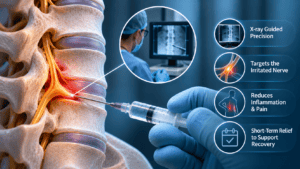
What Is a Nerve Root Block and How Does It Help Back Pain in UAE?
What Is a Nerve Root Block and How Does It Help Back Pain in UAE? Is a nerve root block painful? Most people describe pressure and a brief sharp sting

Why Long Flights From Dubai Can Trigger Sciatica and Back Pain
Why Long Flights From Dubai Can Trigger Sciatica and Back Pain Can sitting on a plane cause a slipped disc? A long flight does not usually cause a disc to