
What Are the Risks of Spine Surgery in Elderly Patients in UAE?
Is there an absolute age cutoff beyond which spine surgery is never performed?
No, as this article demonstrates, there is no fixed age cutoff. Suitability is assessed individually based on overall health status and anaesthetic fitness rather than chronological age alone.
What specific tests are done to assess whether an elderly patient is fit for spine surgery?
Pre-operative assessment typically includes cardiovascular evaluation, respiratory function assessment, blood tests, and a comprehensive anaesthetic consultation, with the specific tests tailored to the individual patient’s medical history and the complexity of the planned procedure.
Does recovery take longer for elderly patients compared to younger patients?
Recovery timelines can be somewhat longer in elderly patients, and rehabilitation may need to be more carefully paced, though many elderly patients recover functional mobility successfully with appropriate post-operative care and rehabilitation support.
Is the risk of dural tear during surgery something patients should be specifically worried about?
While it is a genuine, recognised risk that increases with age due to dural thinning, dural tears are a manageable complication when they occur, with established repair techniques, and should be understood as part of an honest risk discussion rather than a reason to avoid surgery outright when surgery is otherwise appropriate.
Should family members be involved in the decision-making process for elderly relatives considering spine surgery?
This is often valuable and appropriate, particularly for understanding the patient’s overall functional goals and supporting informed decision-making, though the ultimate decision rests with the patient themselves, guided by their treating medical team’s honest assessment.
What happens if an elderly patient is found not to be fit enough for surgery?
In this situation, the medical team will discuss alternative, non-surgical management strategies for the underlying condition, aiming to optimise function and quality of life through the best available conservative approaches given the individual patient’s circumstances.
Age alone is one of the most persistent and least accurate reasons patients and families cite for avoiding necessary spinal surgery. The assumption that an elderly patient is simply too old for a meaningful surgical intervention frequently deprives genuinely suitable candidates of a treatment that could transform their remaining years of mobility and independence. The real clinical picture is considerably more nuanced, and considerably more encouraging, than this blanket assumption suggests.
Dr. Sherief Elsayed, Consultant Spine Surgeon in Dubai, addresses this directly, drawing on the most striking case in his own personal surgical experience.
Age Is Not a Barrier: The Evidence From a 95-Year-Old Patient
Dr. Sherief Elsayed states his clinical position without hesitation: “The age of a patient is not a barrier to surgery. The oldest I’ve operated on is a 95 year old with severe spinal stenosis.”
This single clinical fact fundamentally reframes the question that many patients and families implicitly ask, which is often phrased around age itself, “am I too old for surgery,” rather than the genuinely relevant clinical question, “am I fit enough for surgery, and would surgery meaningfully improve my quality of life.”
The Outcome That Illustrates the Point
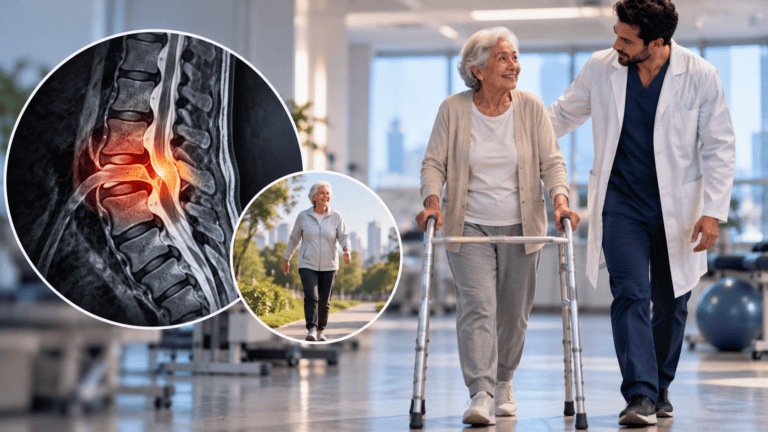
The result of this particular case is described with evident satisfaction: “I decompress those nerves, she gets up and starts walking properly. It’s a new lease of life for those patients.”
This outcome directly connects to the pathology discussed extensively in the earlier article Why Your Legs Feel Heavy and Painful When You Walk, where spinal stenosis produces neurogenic claudication, progressive leg heaviness and pain with walking that severely limits functional mobility and independence, precisely the condition that most disproportionately affects quality of life in elderly patients specifically.
For an elderly patient whose walking ability, and with it, independence, social engagement, and overall quality of life, has been progressively curtailed by untreated spinal stenosis, surgical decompression genuinely can represent exactly the “new lease of life” Dr. Sherief Elsayed describes, restoring functional capacity that had been lost, sometimes over an extended period, to a treatable structural cause.
“It’s a Very Straightforward Surgery”: Setting Realistic Expectations
Dr. Sherief Elsayed’s characterisation of the procedure itself as “very straightforward” is an important and deliberately calibrated piece of reassurance. Lumbar decompression for spinal stenosis, addressing the specific structural narrowing of the spinal canal that compresses the nerves, is technically one of the less complex procedures within the spectrum of spinal surgery, particularly compared to the more extensive reconstructive and deformity correction procedures discussed elsewhere in this blog series.
This distinction matters directly for elderly patients specifically, because the overall risk profile of any surgical procedure reflects not only the patient’s individual health status but also the complexity, duration, and physiological demand of the specific operation being considered. A relatively contained, technically straightforward decompression procedure carries a meaningfully different risk profile from an extensive, multi-hour reconstructive procedure, even in the same elderly patient.
The Genuine, Age-Specific Risks: Honest Acknowledgement
Dr. Sherief Elsayed does not present an unrealistically risk-free picture. He is specific and honest about how risk genuinely does differ with age: “Risks are different of course for a 95 year old compared to a 40 year old.”
Increased risk of dural tear:
Dr. Sherief Elsayed identifies a specific, anatomically grounded age-related risk: “The dura, the sac that the spinal cord is covered in, is very thin, almost like an onion skin. An increased risk of dural tear, for example.”
The dura mater, the protective membrane surrounding the spinal cord and nerve roots, undergoes genuine age-related thinning and reduced elasticity, much like skin and other connective tissues throughout the body. This makes the dura in an elderly patient genuinely more fragile and more susceptible to inadvertent tearing during the careful dissection required to access and decompress the spinal canal, compared to the more robust, resilient dura typically encountered in a younger patient.
A dural tear, while a recognised and generally manageable complication of spinal surgery when it does occur, requires specific intraoperative repair technique and can, in some cases, necessitate a period of post-operative flat bed rest to allow adequate healing, adding a specific consideration to the recovery process when it occurs.
Other medical comorbidities:
Dr. Sherief Elsayed identifies the second major category of age-related risk directly: “And of course, other medical problems, chest, heart, etc.”
This reflects the well-established reality that increasing age is generally associated with an increasing prevalence and burden of comorbid medical conditions, including cardiovascular disease, respiratory conditions, and other chronic health issues, each of which can independently affect a patient’s ability to safely tolerate the physiological demands of surgery and anaesthesia. This is not a risk factor specific to spinal surgery itself, but a general surgical and anaesthetic consideration that applies across all types of procedures in elderly patients, and it is precisely why thorough pre-operative medical assessment, as discussed in the earlier articles on anaesthesia and pre-operative optimisation elsewhere in this series, takes on particular importance in this population.
The Decisive Factor: Anaesthetic Fitness Assessment
Dr. Sherief Elsayed identifies the specific clinical threshold that ultimately determines surgical suitability: “But overall, on balance, if the anaesthetist is happy to put the patient to sleep, they do very well.”
This is a genuinely important and practically useful framing. Rather than age itself being the determining factor, the actual clinical gatekeeping question is whether the patient’s overall physiological status, assessed comprehensively by the anaesthetic team, supports safe tolerance of the anaesthesia and surgical process itself. This assessment considers the whole clinical picture, cardiovascular function, respiratory reserve, kidney and liver function, overall frailty, and the specific demands of the planned procedure, rather than applying a blanket age cutoff.
As discussed in the earlier article on choosing the right spinal surgeon, and directly relevant here, a thorough pre-operative anaesthetic assessment is not a bureaucratic formality but a genuine clinical safety process specifically designed to identify exactly this kind of individual variation in surgical fitness, allowing appropriately selected elderly patients to proceed safely while identifying the smaller proportion for whom surgical risk genuinely outweighs benefit.
Why Untreated Spinal Stenosis Carries Its Own Significant Risks in Elderly Patients
An important and often overlooked part of the risk-benefit calculation in elderly patients specifically is that declining surgery is not automatically the safer option. A Spinal Deformity Surgeon in Dubai weighs this full picture carefully for every elderly patient assessed. in elderly patients specifically is that declining surgery is not automatically the “safer” option. Untreated severe spinal stenosis, causing progressive mobility limitation, directly contributes to several serious downstream risks that disproportionately affect elderly patients.
Deconditioning and frailty: Progressive reduction in walking capacity leads to reduced overall physical activity, accelerating the loss of muscle mass, cardiovascular fitness, and bone density discussed in earlier articles on spinal and skeletal health, creating a cycle of worsening frailty.
Falls risk: Impaired walking capacity and balance, directly resulting from significant spinal stenosis, meaningfully increases the risk of falls, which carry their own serious potential consequences in elderly patients, including hip and other fragility fractures, particularly relevant given the bone density considerations discussed in earlier articles.
Loss of independence: Progressive mobility limitation frequently drives loss of independent living capacity, with significant quality of life, psychological, and social consequences that extend well beyond the physical symptoms themselves.
Understanding these genuine risks of the untreated condition provides essential context for the overall risk-benefit assessment in elderly patients, rather than considering surgical risk in isolation.
How This Assessment Process Works in Practice
A Consultant Spine Surgeon in Dubai assessing an elderly patient with significant spinal stenosis will undertake a comprehensive, individualised evaluation considering the specific procedure required, the patient’s overall medical comorbidity burden, a thorough anaesthetic fitness assessment, and a genuinely honest discussion of the expected functional benefit weighed against the specific, individual risk profile, precisely the balanced, evidence-based approach reflected throughout Dr. Sherief Elsayed’s clinical philosophy across this blog series.
UAE-Specific Context
The UAE’s demographic profile includes a significant and growing elderly population. A Spine Surgeon in UAE applies this same individualised, evidence-based approach to elderly patients considering surgery, both within the Emirati population and among long-term expatriate residents who have aged within the country. Major spinal surgical centres across Dubai maintain the comprehensive multidisciplinary infrastructure, including specialist geriatric anaesthetic assessment where needed, necessary to appropriately evaluate and safely treat elderly patients presenting with significant spinal conditions.
Expert Summary
Age itself is not a valid barrier to appropriate spinal surgery, as illustrated directly by the successful treatment of a 95-year-old patient with severe spinal stenosis. Genuine, age-related risks do exist, including increased dural fragility and a higher burden of medical comorbidities, but these are individually assessable and manageable rather than absolute contraindications. The determining factor is a comprehensive assessment of overall physiological fitness, particularly the anaesthetic team’s evaluation, rather than chronological age alone, and this assessment must weigh surgical risk against the genuine, serious risks of leaving significant, treatable spinal conditions unaddressed in elderly patients.
Table of Contents
Recent Articles
Why Eight People Were Needed for One Spine Surgery in Dubai
Why Eight People Were Needed for One Spine Surgery in Dubai Does every spinal surgery require exactly eight team members? No, as Dr. Sherief Elsayed explains directly, the specific team
Three Spine Surgery Myths a Dubai Surgeon Wants You to Forget
Three Spine Surgery Myths a Dubai Surgeon Wants You to Forget Is it really safe to walk on the same day as spine surgery? Yes, for the majority of modern
Why Osteoporosis Is Called the Silent Disease in the UAE
Why Osteoporosis Is Called the Silent Disease in the UAE If osteoporosis doesn’t cause pain, how would I know if I needed a DEXA scan? Given the entirely silent nature