
Could a Shorter Leg Be Causing Your Scoliosis? A UAE Surgeon Explains
How much leg length difference is needed to cause scoliosis?
There is no single universal threshold, as individual sensitivity to leg length asymmetry varies. However, discrepancies exceeding approximately 1 to 2 centimetres are more likely to produce a clinically noticeable compensatory pelvic tilt and secondary spinal curve significant enough to warrant
Will a shoe raise need to be worn permanently?
This depends on the underlying cause of the leg length discrepancy. For a fixed, permanent structural difference, ongoing use of a shoe raise or, in some cases, a surgical limb-lengthening procedure, may be needed long-term. For some growth-related or temporary causes in children, the discrepancy itself may change over time and require periodic reassessment.
Can adults develop a compensatory scoliosis from a leg length discrepancy that was always present but unnoticed?
Yes. Some adults are unaware of a longstanding mild to moderate leg length discrepancy until it is specifically assessed during an evaluation for back pain or apparent scoliosis. Correcting it at any age can still provide benefit by reducing the compensatory postural strain on the spine.
Is surgery ever needed to correct a leg length discrepancy?
For smaller discrepancies, a shoe raise or orthotic insert is usually sufficient. For larger discrepancies, particularly in growing children, surgical options including growth plate procedures to slow growth of the longer leg, or limb lengthening procedures for the shorter leg, may be considered by a paediatric orthopaedic specialist.
How is true structural scoliosis distinguished from a compensatory curve on examination?
One useful clinical sign is the response to correcting the leg length discrepancy, either by adding a measured block under the shorter leg during examination or with a trial shoe raise. If the spinal curve significantly improves or resolves once the pelvis is leveled, this strongly suggests a compensatory rather than a fixed structural curve.
Should every child with scoliosis have a leg length assessment?
Yes, a limb length assessment is considered a standard, important component of a thorough scoliosis evaluation in both children and adults, as it directly affects how the underlying cause of the observed curve is understood and how treatment should proceed.
A diagnosis of scoliosis prompts most patients to focus entirely on the spine itself: the degree of curvature, whether bracing or surgery might be needed, and how the curve might progress over time. But in some patients, the true origin of the problem lies not in the spine at all, but in the legs. A simple, easily measured difference in leg length can be the underlying cause of an apparent spinal curve, and identifying this changes the entire treatment approach.
Dr. Sherief Elsayed, Consultant Spine Surgeon in Dubai, raises a specific and important question that every patient newly diagnosed with scoliosis should have answered before treatment begins.
The Key Question: Has Your Limb Length Been Assessed?
Dr. Sherief Elsayed’s advice is direct and actionable: “If you’ve been diagnosed with scoliosis, make sure you’ve had a limb length assessment to make sure that your legs are equal in length.”
This single recommendation addresses a diagnostic step that is sometimes overlooked, particularly when imaging and clinical attention are focused entirely on the visible spinal curve itself rather than considering what might be driving it from below.
The Mechanism: How a Leg Length Difference Creates a Spinal Curve
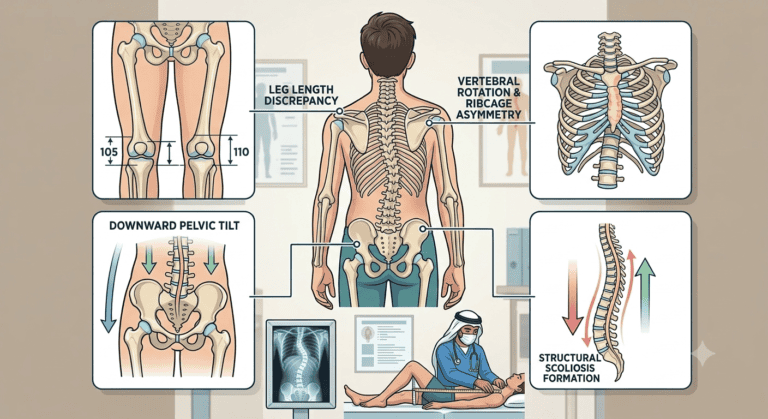
Understanding why a leg length discrepancy produces scoliosis requires thinking about the body’s biomechanical priorities. Dr. Sherief Elsayed explains the chain of events clearly: “If you imagine one leg is shorter than the other, the pelvis will tilt to one side and what the spine does is it compensates. It wants the head to be centred over the pelvis so you develop a scoliosis.”
This is a logical, sequential mechanical process:
Step one, the pelvic tilt: When one leg is measurably shorter than the other, standing places the pelvis at an angle rather than level. The hip on the side of the shorter leg sits lower than the hip on the side of the longer leg.
Step two, the compensatory curve: The spine, which sits directly on top of the pelvis, must adapt to this tilted foundation. The body’s powerful postural reflexes work to keep the head centred over the pelvis and the eyes level with the horizon, which is essential for balance, gait, and visual function. To achieve this with a tilted pelvic base, the spine curves to compensate, creating what is known as a functional or compensatory scoliosis.
Step three, the apparent diagnosis: On standing X-ray, this compensatory curve looks like scoliosis, because anatomically and radiographically, it is a curve in the spine. But its underlying cause is not a problem intrinsic to the spinal column itself. It is a secondary, compensatory response to an asymmetry below it.
Why This Distinction Matters Enormously
The difference between true structural scoliosis and a leg-length-related compensatory curve is not academic. It fundamentally changes the appropriate treatment.
True structural (idiopathic) scoliosis:
In structural scoliosis, the vertebrae themselves have developed a fixed, three-dimensional deformity, including rotation, as discussed in the published article What Is Spinal Derotation and Why Is It Key to Scoliosis Surgery in the UAE. This curve does not correct simply by addressing something outside the spine, because the structural change is within the spine itself. Treatment may involve monitoring, bracing, or surgical correction depending on severity and growth status, as covered in the article When Does Scoliosis Actually Need Surgery? A UAE Spine Surgeon Explains the Threshold.
Functional scoliosis from leg length discrepancy:
In this scenario, the spine itself has no inherent structural deformity. It has simply adapted, in a compensatory but reversible way, to an asymmetric foundation. The treatment target is not the spine at all. It is the underlying leg length difference.
The Treatment: Correcting the Leg, Not the Spine
Dr. Sherief Elsayed’s conclusion is precisely targeted: “If you correct that limb length discrepancy, say with a shoe raise, it may straighten out your spine.”
This is a remarkably simple intervention for a condition that, viewed only on an X-ray of the spine, might otherwise prompt consideration of bracing or even surgical correction. By adding a heel or sole raise to the shoe on the shorter leg side, the effective leg length is equalised. The pelvis levels out as a direct mechanical consequence, and because the compensatory spinal curve was never a fixed structural deformity but a flexible postural adaptation, it has the capacity to straighten once its underlying cause, the pelvic tilt, has been corrected.
Why this works only for functional scoliosis:
This approach is specifically effective for compensatory curves caused by leg length discrepancy. It will not correct a genuine structural scoliosis, because in that situation, the curve exists independently of any leg length issue and has its own intrinsic cause within the vertebral column. This is precisely why accurate diagnosis, distinguishing true structural curves from compensatory ones, is the essential first step before deciding on any treatment pathway.
How Is Limb Length Discrepancy Assessed?
A limb length assessment is a straightforward but important part of a complete scoliosis evaluation.
Clinical assessment methods:
- Direct measurement from a fixed bony landmark on the pelvis (the anterior superior iliac spine) to a fixed landmark on the ankle (the medial malleolus), comparing both legs
- Observation of pelvic level while the patient stands, sometimes using blocks of measured thickness placed under the shorter leg until the pelvis appears level, which both confirms the discrepancy and quantifies it
- Assessment of gait for any visible limp or compensatory movement pattern
Radiographic assessment:
A standing full-length X-ray of both lower limbs, sometimes called a scanogram, provides the most precise measurement. A Spinal Deformity Surgeon in Dubai will order this specific imaging when leg length discrepancy is suspected as a contributor to an observed spinal curve, measuring the femur and tibia on each side independently for a millimetre-accurate determination of the discrepancy.
How Common Is Leg Length Discrepancy?
Minor degrees of leg length difference are extremely common in the general population and are frequently asymptomatic, causing no functional problems and requiring no treatment. Studies suggest that a difference of up to around 1 centimetre is present in a substantial proportion of otherwise healthy individuals and rarely causes clinically significant issues on its own.
It is generally larger discrepancies, often cited as those exceeding 1 to 2 centimetres, that are more likely to produce a clinically apparent compensatory pelvic tilt and secondary postural scoliosis significant enough to be noticed and investigated.
Causes of leg length discrepancy:
- Congenital (present from birth), where one limb simply develops to a different length than the other
- Developmental, related to growth plate differences during childhood, sometimes following injury to a growth plate
- Post-traumatic, following a fracture that has healed with some shortening, particularly in growing children where a fracture can also stimulate or inhibit growth at the affected growth plate
- Post-surgical, following certain orthopaedic procedures
- Neuromuscular conditions affecting growth and muscle development asymmetrically
What If Both Structural Scoliosis and Leg Length Discrepancy Are Present?
In some patients, both conditions can coexist, a degree of true structural scoliosis alongside an independent leg length difference. In this more complex scenario, a thorough assessment by a specialist is essential to determine how much of the observed spinal curve is attributable to each factor.
A Scoliosis Specialist in Dubai assessing a patient with scoliosis and a confirmed leg length discrepancy will typically recommend correcting the leg length first, often with a trial shoe raise, and then reassessing the spinal curve once the pelvis has been levelled. This allows the residual curve, if any, attributable to true structural scoliosis to be properly evaluated independently of the compensatory component, ensuring that any further treatment decisions are based on accurate information.
UAE-Specific Considerations
Leg length assessment should be a standard part of any scoliosis evaluation for patients in Dubai, just as it is internationally. Patients who have been diagnosed with scoliosis, particularly where the curve seems disproportionate to other clinical findings, or where there is any history of leg fracture, congenital limb difference, or noticeable limp, should specifically ask whether a limb length assessment has been performed as part of their evaluation.
Expert Summary
Not every curve visible on a spinal X-ray represents true structural scoliosis. A leg length discrepancy tilts the pelvis, and the spine compensates to keep the head level, producing a curve that looks like scoliosis but is, in fact, a secondary and potentially fully correctable adaptation. Identifying this distinction through a simple limb length assessment, and treating the underlying leg length difference with something as straightforward as a shoe raise, can resolve the apparent scoliosis entirely without bracing or surgical intervention directed at the spine itself. This is exactly why every new scoliosis diagnosis should include consideration of what might be happening below the spine, not only within it.
Table of Contents
Recent Articles

Why Eight People Were Needed for One Spine Surgery in Dubai
Why Eight People Were Needed for One Spine Surgery in Dubai Does every spinal surgery require exactly eight team members? No, as Dr. Sherief Elsayed explains directly, the specific team
Three Spine Surgery Myths a Dubai Surgeon Wants You to Forget
Three Spine Surgery Myths a Dubai Surgeon Wants You to Forget Is it really safe to walk on the same day as spine surgery? Yes, for the majority of modern
Why Osteoporosis Is Called the Silent Disease in the UAE
Why Osteoporosis Is Called the Silent Disease in the UAE If osteoporosis doesn’t cause pain, how would I know if I needed a DEXA scan? Given the entirely silent nature