
Can You Walk Again After a Cervical Spine Dislocation in UAE?
How quickly does surgery need to happen after a cervical facet dislocation to give the best chance of recovery?
As Dr. Sherief Elsayed emphasises, this is an immediate surgical emergency, with treatment undertaken as soon as the patient is identified and adequately assessed, given that the duration of ongoing spinal cord compression directly affects the potential for neurological recovery.
Is the combined front-and-back surgical approach always necessary for this injury?
This combined approach represents the standard treatment for significant facet dislocation injuries given the multi-directional instability involved, though the specific surgical plan is always individualised based on the exact injury pattern and severity present in each patient.
How long does recovery take after this kind of complex spinal surgery?
Recovery timelines vary significantly depending on the severity of the initial neurological injury and the extent of the surgical reconstruction performed. Initial hospital stay and early rehabilitation typically extend over weeks, with continued neurological recovery, where it occurs, often progressing over months following the surgery itself.
What determines whether a patient will walk again after this kind of injury?
The most important factors are the completeness of the initial spinal cord injury (complete versus incomplete, as discussed in the earlier article on spinal cord injury symptoms), and how quickly the spinal cord compression is surgically relieved following the injury.
Can this injury occur without any spinal cord compression or neurological symptoms?
Less severe degrees of facet joint injury, without the complete locked dislocation described here, can occur and may not necessarily produce significant spinal cord compression, though any suspected cervical spine injury following significant trauma requires urgent assessment and imaging to determine the exact injury pattern present.
Is this type of injury always caused by very high-energy trauma?
Yes, facet dislocation injuries of the severity described here typically require substantial force, commonly seen in road traffic accidents, falls from significant height, and high-energy sporting injuries, consistent with the mechanisms discussed in the earlier articles on motorbike accident spinal cord injuries and trampoline-related paediatric spinal trauma.
Few injuries carry as immediate and stark a neurological threat as a cervical spine dislocation with spinal cord compression. The gap between recovering meaningful function and permanent, complete paralysis can be measured in hours rather than days, and the surgical response required is among the most complex and demanding in all of spinal surgery, precisely because the goal is not simply structural repair but genuine neurological rescue.
Dr. Sherief Elsayed, Consultant Spine Surgeon in Dubai, walks through exactly what this injury looks like on imaging, why it is so dangerous, and the specific multi-stage surgical approach required to give a patient the best possible chance of walking again.
What Normal Cervical Alignment Looks Like
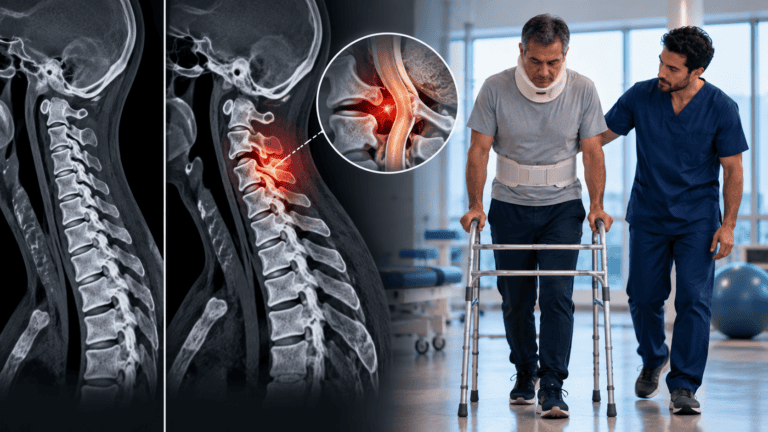
Dr. Sherief Elsayed begins by establishing the baseline: “This is what a normal CT of the cervical spine looks like. There’s good alignment of all the vertebrae at the front and at the back.”
In a normal cervical spine, each vertebra sits directly above the one below it, maintaining continuous, smooth alignment along both the anterior (front) and posterior (back) margins of the vertebral column. This alignment is maintained by the facet joints, the small paired joints at the back of each vertebral level that guide and limit movement between adjacent segments, as discussed extensively in the earlier articles on facet joint anatomy in this series.
What a Cervical Dislocation Looks Like
Dr. Sherief Elsayed then describes the pathological finding: “If we look over here, we can see that the vertebrae slip forward over the other one because the joints have essentially jumped, allowing those vertebrae to slip forward.”
This describes what is known as a facet dislocation, a severe traumatic injury in which the normal joint relationship between the facet joints of two adjacent vertebrae is completely disrupted. Rather than the joints simply moving through their normal range of motion, the inferior facet of the upper vertebra has moved forward and upward, jumping over and locking in front of the superior facet of the vertebra below, a configuration that mechanically locks the two vertebrae in a significantly displaced, forward-slipped position relative to each other. A Cervical Spine Surgeon in Dubai manages exactly this kind of acute, complex cervical trauma.
This injury typically results from severe, high-energy trauma involving forced flexion (forward bending) of the neck combined with rotation, mechanisms commonly seen in road traffic accidents, falls from height, and sporting injuries.
Why This Is So Dangerous: Direct Spinal Cord Compression
Dr. Sherief Elsayed identifies the immediate and severe consequence: “Right behind those vertebrae, the spinal cord’s severely compressed. This patient is at least weak, if not paralysed.”
The forward displacement of one vertebra relative to the one below it directly narrows the spinal canal at that level, compressing the spinal cord that runs through it. Given the severity of displacement typically seen in a facet dislocation, this compression is frequently severe, producing exactly the kind of significant neurological deficit, ranging from meaningful weakness through to complete paralysis, that Dr. Sherief Elsayed describes.
Why Speed Is Everything: The Urgency of Surgical Treatment
Dr. Sherief Elsayed is unambiguous about the time-critical nature of the required response: “It’s really crucial to get the patient into the operating theatre immediately if we want to try and recover that neurological function.”
This urgency reflects the same fundamental principle discussed in the earlier article How Long Can a Compressed Nerve Wait Before Surgery? A Dubai Spine Surgeon Answers, applied here in its most acute and severe form. The longer the spinal cord remains compressed and mechanically distorted by a severely displaced vertebral segment, the less likely meaningful neurological recovery becomes, and the greater the risk that whatever function remains at presentation will be permanently lost rather than potentially recovered.
For a patient presenting with a cervical facet dislocation and significant weakness, immediate transfer to the operating theatre for decompression and stabilisation represents the only intervention capable of giving the patient a genuine chance at meaningful neurological recovery.
The Surgical Approach: A Combined Front and Back Procedure
The complexity of correcting a locked facet dislocation, restoring normal alignment, and achieving durable stability requires a surgical approach that addresses the spine from both directions in a single, extended operative session.
Dr. Sherief Elsayed describes the sequence in detail: “We start by going in from the front, taking out the disc and reducing the dislocation if we can. Then flip the patient over and we insert rods and screws in from the back before coming around again to the front where we put a cage and a plate on top to get a nice solid construct from the front and back.”
Stage one: Anterior approach and attempted reduction
The procedure begins with an anterior (front) approach to the cervical spine, using the same surgical corridor described in the earlier article on cervical disc surgery, navigating carefully between the carotid artery, jugular vein, trachea, and oesophagus to reach the front of the vertebral bodies. The disc at the affected level is removed, both because it is often damaged in the traumatic dislocation and because its removal provides the surgical access needed to attempt reduction, the process of manipulating the locked, jumped facet joints back into their normal anatomical position, directly relieving the compression on the spinal cord.
Stage two: Repositioning and posterior fixation
Following the anterior stage, the patient is repositioned, turned from lying on their back to lying face down, to allow posterior (back) surgical access. Through this posterior approach, pedicle or lateral mass screws and connecting rods are inserted, providing strong, direct fixation across the affected and adjacent levels. This posterior instrumentation is particularly important in facet dislocation injuries because the posterior ligamentous and joint structures, exactly the structures disrupted by the dislocation itself, are often severely damaged, meaning posterior fixation provides essential stability that the injured native anatomy can no longer reliably provide on its own.
Stage three: Return to the anterior approach for final reconstruction
Following posterior fixation, the surgical team returns to the anterior approach, inserting a cage into the disc space (using the same principles described in the earlier article on cervical disc surgery) along with an anterior plate secured with screws across the front of the vertebral bodies.
Why this combined, three-stage approach is necessary:
Dr. Sherief Elsayed summarises the rationale directly: to “get a nice solid construct from the front and back.” A facet dislocation injury damages the spine’s stability from multiple directions simultaneously, the disc and anterior structures from the flexion component of the injury, and the facet joints and posterior ligamentous structures from the dislocation itself. Achieving durable, reliable stability that will safely support the spine through the healing and fusion process requires addressing and reinforcing both the anterior and posterior columns of the spine, which is precisely why this combined front-back-front surgical sequence, while extensive and technically demanding, represents the appropriate treatment for this severe injury pattern.
The Outcome Dr. Sherief Elsayed Describes
The conclusion offered is genuinely hopeful, grounded in the specific clinical experience of managing these injuries: “Then quickly enough, patients can walk again.”
This outcome, while not universal or guaranteed for every patient presenting with this injury, reflects the genuine potential for meaningful neurological recovery when a cervical facet dislocation with spinal cord compression is treated with the urgency and surgical thoroughness described here. The key determinants of this favourable outcome are precisely the two elements Dr. Sherief Elsayed has emphasised: getting the patient into surgery immediately to minimise the duration of cord compression, and performing a surgically complete, appropriately extensive reconstruction that achieves genuine mechanical stability from both the front and back of the spine.
Why Not Every Patient Achieves This Outcome
It is important to note, with appropriate clinical honesty, that the degree of neurological recovery following this kind of severe injury depends on multiple factors, including the severity and duration of the initial spinal cord compression before surgical decompression, whether the injury represents a complete or incomplete spinal cord injury as discussed in the earlier article on spinal cord injury symptoms, and individual patient factors affecting overall recovery capacity. A Spine Trauma Surgeon in Dubai will provide an honest, individualised prognosis based on the specific injury presentation.
Patients presenting with a complete spinal cord injury, meaning no function whatsoever is preserved below the level of injury, carry a considerably less favourable prognosis for recovery, consistent with the discussion in the earlier article on why spinal cord injuries from motorbike accidents are frequently irreversible. The genuinely favourable outcomes Dr. Sherief Elsayed describes are most achievable in patients with incomplete injuries treated with the urgency and surgical thoroughness this injury demands.
UAE-Specific Context
Cervical facet dislocation injuries in the UAE most commonly result from road traffic accidents and, as discussed in earlier articles, high-energy motorcycle collisions specifically. Major trauma centres across Dubai and the UAE maintain the surgical infrastructure, including access to intraoperative neuromonitoring as discussed in the earlier article on new spine surgery technology, necessary to manage these injuries with the urgency and surgical complexity they require. A Spinal Cord Surgeon in Dubai managing this kind of acute trauma case applies exactly the combined anterior-posterior surgical strategy described here as the established, evidence-based standard of care for this specific injury pattern.
Expert Summary
A cervical spine facet dislocation, where the normal joint relationship between adjacent vertebrae is disrupted and locked in a forward-displaced position, produces direct and often severe spinal cord compression requiring immediate surgical intervention. The combined anterior-posterior-anterior surgical approach described here, involving disc removal and attempted reduction from the front, followed by posterior screw and rod fixation, followed by a return to the front for final cage and plate reconstruction, addresses the multi-directional instability this injury creates and provides the mechanical foundation needed for genuine neurological recovery when treatment is delivered with appropriate urgency.
Table of Contents
Recent Articles
Why Eight People Were Needed for One Spine Surgery in Dubai
Why Eight People Were Needed for One Spine Surgery in Dubai Does every spinal surgery require exactly eight team members? No, as Dr. Sherief Elsayed explains directly, the specific team
Three Spine Surgery Myths a Dubai Surgeon Wants You to Forget
Three Spine Surgery Myths a Dubai Surgeon Wants You to Forget Is it really safe to walk on the same day as spine surgery? Yes, for the majority of modern
Why Osteoporosis Is Called the Silent Disease in the UAE
Why Osteoporosis Is Called the Silent Disease in the UAE If osteoporosis doesn’t cause pain, how would I know if I needed a DEXA scan? Given the entirely silent nature