
How to Sleep With Lower Back Pain, A UAE Spine Surgeon Advises
What is the best sleeping position for lower back pain?
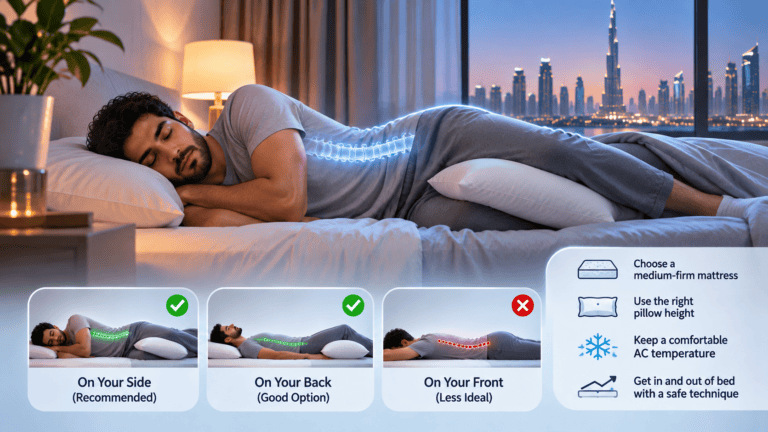
There is no single best position. Side-lying with a pillow between the knees, or back-lying with a pillow under the knees, suits many people. Front-lying is usually least helpful. Choose the position that feels comfortable and keeps the spine neutral
Is a firm mattress good for back pain?
Not necessarily. A randomised trial found that a medium-firm mattress led to better outcomes than a firm one in people with chronic low back pain. A medium-firm surface is a reasonable starting point, but personal comfort matters most.
Should I use a pillow between my knees?
If you sleep on your side, many people find it helpful because it keeps the pelvis and lower spine aligned. It costs nothing to try for a few nights.
Why is my back worse in the morning?
Stiffness after being still for hours is common, particularly in degenerative conditions, and usually eases within 30 minutes of moving. Longer-lasting morning stiffness, especially in younger people, is worth discussing with a doctor.
Can poor sleep make back pain worse?
Yes. Poor sleep lowers pain tolerance and can increase the perception of pain, which in turn disrupts sleep. Improving sleep can help break the cycle.
Is it safe to sleep on a sofa or floor?
Neither is ideal for most people. A floor is usually too firm, and a soft sofa may sag. If you try an alternative surface, keep it short term and listen to your body.
Few things make back pain feel worse than a bad night. You go to bed hoping for relief, spend hours shifting between positions, and wake up stiffer than when you lay down. Then you spend the day tired, which makes the pain harder to cope with, and the cycle repeats.
The good news is that sleep position and bedding are among the easier parts of back pain to adjust. Small changes often help, and none of them need expensive equipment. Here is what is known, what is not, and what is worth trying.
Does the way you sleep really affect back pain?
It can, though the effect is usually modest rather than dramatic. Sleep posture changes how the spine and surrounding muscles are loaded for six to eight hours a night. A position that twists the lower back or leaves it arched for hours can irritate sensitive joints and discs. Conversely, a position that keeps the spine in a neutral alignment tends to feel more comfortable.
Research on sleep and back pain is limited by the difficulty of measuring what people do while asleep. A 2025 review of sleep position and back pain concluded that evidence for one single best position is lacking, and that comfort and individual response are the most reliable guides. The advice below is therefore practical and flexible rather than rigid.
Which sleeping position is best?
There is no universal answer, but there are sensible starting points for different problems.
Sleeping on your side
For many people with lower back pain, side-lying is comfortable. To keep the spine aligned:
- Place a pillow between your knees, so the top leg does not drag the pelvis forward and twist the lower back
- Keep your knees slightly bent
- Use a pillow that fills the gap between your shoulder and head, so your neck stays level
- Consider a small pillow or rolled towel at the waist if there is a gap between your waist and the mattress
Sleeping on your back
Lying on your back distributes weight evenly, and many people find it comfortable for back pain, especially if:
- A pillow sits under your knees to reduce the arch in the lower back
- A small rolled towel is placed under the curve of the lower back if it feels unsupported
- Your head pillow is not so tall that it pushes your chin to your chest
Sleeping on your front
This is usually the least helpful for back and neck pain, because it tends to arch the lower back and twist the neck. If you cannot sleep any other way, a thin pillow under the abdomen and little or no head pillow reduces the strain. Trying to shift gradually to your side may help over time.
Special situations
- Sciatica or disc herniation: Some people find lying on the side that does not hurt, with knees bent, easier. Others prefer lying on the back with knees supported. Try variations and note what eases your leg symptoms.
- Spinal stenosis: Many people with narrowing of the spinal canal feel better when the spine is slightly flexed, for instance lying curled on the side or with knees raised. This mirrors why they often feel better sitting or leaning forward during the day.
- Facet joint pain: Pain from the small joints at the back of the spine often worsens when arching backwards, so positions that increase the arch, like lying on the front, can be uncomfortable.
Does mattress firmness matter?
Probably more than most beliefs about firmness suggest, but not in the way advertising implies. The best-known evidence comes from a randomised trial published in The Lancet in 2003 by Kovacs and colleagues, involving 313 adults with chronic non-specific low back pain. Participants who slept on a medium-firm mattress had better outcomes than those on a firm mattress, with improved pain lying in bed, pain on rising and disability. The odds of improvement for the medium-firm group were roughly double on several measures.
Later reviews support the general idea that very firm mattresses are not better for back pain, and that medium-firm is a reasonable starting point. Beyond that, the evidence is weak. There is no proven advantage for any particular brand, material or price level.
Practical points on bedding:
- Choose a mattress that feels supportive but allows your hips and shoulders to sink slightly, especially if you sleep on your side
- If your mattress sags visibly or is more than eight to ten years old, replacing it may help
- Try before you buy where you can, and check return policies
- A mattress topper can adjust firmness more cheaply than buying a new bed
What about pillows?
A pillow’s job is to keep the neck in line with the rest of the spine. If you sleep on your back, a pillow of moderate height is usually enough. If you sleep on your side, you need a taller one to fill the space between your shoulder and head. Pillows that are too high or too low can strain the neck and indirectly affect the upper back.
Can the bedroom environment matter?
In Dubai, air conditioning runs for much of the year. Cold air blowing directly onto the back can leave muscles tight in some people, though the evidence that this causes lasting back problems is limited. Reasonable steps include:
- Setting the temperature to a comfortable level rather than very cold
- Directing airflow away from your body
- Keeping a light blanket or layer over your back
- Taking a warm shower before bed to relax muscles
How can you get in and out of bed more comfortably?
Many people find that the movements around sleep cause more pain than lying still. A simple technique helps:
- To get out of bed, roll onto your side first, bringing your knees up
- Drop your legs over the edge of the bed while pushing up with your arms
- Let the movement come from your arms and legs, keeping your trunk straight
- Avoid sitting straight up from lying on your back, which loads the spine
To get into bed, reverse the process: sit on the edge, lower yourself onto your side, then bring your legs up and roll into position.
Which habits before bed help?
- Move gently during the evening. A short walk or gentle stretching prevents stiffness. Avoid vigorous exercise very late if it keeps you awake.
- Use heat. A warm shower or heat pack for 15 to 20 minutes can ease muscle tension.
- Wind down. Pain tolerance falls when you are tired and stressed, so a calming routine helps.
- Be careful with medication. Painkillers may help some people sleep, but they should be used sensibly and under advice. A Spine Medication Specialist in the UAE can cover the options and cautions.
- Limit caffeine and large late meals, which can disrupt sleep.
Should you stay in bed when your back hurts?
Not for long. Extended bed rest tends to make stiffness and pain worse. Short rests are fine, but gentle movement during the day is more helpful for recovery than lying down for hours. This echoes the broader picture of recovery described in Why Most Back Pain in Dubai Resolves Without Surgery in 6 Weeks.
When is night-time pain a concern?
Most sleep-related back pain is mechanical and eases when you change position. It deserves a closer look if:
- The pain is constant and unrelated to position
- It wakes you repeatedly and does not ease when you get up
- You have unexplained weight loss, fever or night sweats
- You notice leg weakness, numbness or changes in bladder or bowel control
Those patterns are examined in more detail in When Back Pain Wakes You at Night, What Could It Mean in Dubai?. If you have persistent symptoms, a specialist assessment can identify the cause and guide treatment. Dr. Sherief Elsayed, Consultant Spine Surgeon in Dubai, assesses the whole picture, including examination, rather than the scan alone, and starts with conservative measures wherever possible. A Lower Back Pain Specialist in Dubai can outline a structured approach to exercise and rehabilitation.
A simple plan to try for two weeks
- Pick your most comfortable position: side with a pillow between the knees, or back with a pillow under the knees
- Check your pillow height so the neck stays level
- Use a rolled towel for waist or lumbar support if there is a gap
- Turn the air conditioning down in intensity and direct it away from you
- Practise the roll-and-push technique to get out of bed
- Take a short walk and a warm shower in the evening
- Note which changes help and which do not
If there is no improvement after a couple of weeks, or if red-flag symptoms are present, arrange an assessment. You can contact a Spine Care Specialist in the UAE to book a consultation.
Table of Contents
Recent Articles

Why the Right Spine Diagnosis Matters More Than Surgery in UAE
Why the Right Spine Diagnosis Matters More Than Surgery in UAE Why do doctors sometimes disagree about my diagnosis? Spine symptoms can overlap, and scans often show findings unrelated to
How to Sleep With Lower Back Pain, A UAE Spine Surgeon Advises
How to Sleep With Lower Back Pain, A UAE Spine Surgeon Advises What is the best sleeping position for lower back pain? There is no single best position. Side-lying with
Why Dubai Desk Workers Are Getting Disc Problems at a Younger Age
What Is a Nerve Root Block and How Does It Help Back Pain in UAE? Does sitting all day cause herniated discs? Not directly. Studies show a modest association between