
What Is Cauda Equina Syndrome and Why Is It a Spine Emergency?
What is the earliest sign of cauda equina syndrome?
Often it is a change in bladder function, such as difficulty starting to urinate, a weak stream or not feeling when the bladder is full. Altered sensation in the saddle area can come just as early. Back pain may be present, but it is not always severe.
Can cauda equina syndrome come on slowly?
Yes. It can develop suddenly over hours, or gradually over days or weeks. Slower onset can make it harder to recognise because people adapt to the changes. Any new or progressing bladder, bowel, saddle or both-leg symptoms should be assessed promptly.
Does everyone with a large disc herniation get cauda equina syndrome?
No. CES is rare, even among people with large herniations. Most disc herniations improve without surgery and never affect bladder or bowel function. The aim is to recognise the small number who need emergency treatment.
Is cauda equina syndrome always treated with surgery?
When compression is confirmed and causing symptoms, urgent surgical decompression is usually recommended. In some cases, such as infection or tumour, additional treatments are needed alongside or instead of standard disc surgery.
Will I recover fully after surgery?
It depends mainly on how much function was lost before surgery and how long the compression lasted. People treated early, before bladder control is lost, generally do better. Some recover fully, while others have lasting bladder, bowel or sexual symptoms and need ongoing support.
What should I do if I am unsure whether my symptoms count?
If you have back or leg symptoms plus any new bladder, bowel or saddle-area change, treat it as urgent and go to an emergency department. A normal scan is a good result. A missed diagnosis is not
Cauda equina syndrome is a rare but serious condition in which the bundle of nerves at the bottom of the spinal canal is squeezed hard enough to stop working properly. It is one of the few spine problems where hours genuinely matter, and one of the few where waiting to see if it settles can cost someone their bladder, bowel or sexual function for good.
Most back pain is nothing like this. If you are reading because your back hurts, the odds are very strongly in your favour. But if you are reading because something feels different, such as new numbness between your legs or trouble passing urine, please treat this article as a reason to act today, not a reason to read further.
What the cauda equina actually is
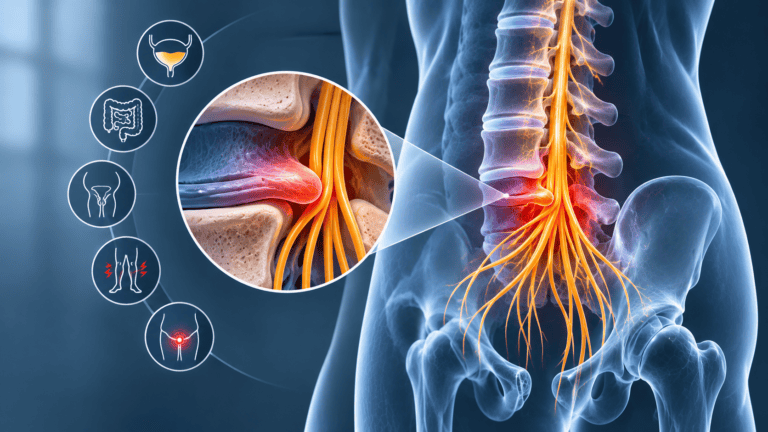
The spinal cord itself ends around the level of your first or second lumbar vertebra, roughly at the waistline. Below that, the canal is filled with a loose bundle of nerve roots that looks like a horse’s tail, which is where the Latin name comes from. These nerves carry signals to and from the legs, the bladder, the bowel, the genitals and the skin around the saddle area.
Cauda equina syndrome (CES) happens when those nerve roots are compressed. The most common cause is a large lumbar disc herniation pushing backwards into the canal. Other causes include severe spinal stenosis, a tumour, an infection or abscess, a bleed around the nerves, or a complication after spinal surgery or trauma.
The warning signs, in plain language
The symptoms can be subtle at first, which is part of the problem. Patients rarely arrive saying “I think I have cauda equina”. They say something odd is going on down there.
Watch for any of these, particularly if they are new or getting worse:
- Numbness or altered feeling in the saddle area, meaning the inner thighs, genitals, buttocks and around the back passage
- Difficulty starting to pass urine, a weak stream, or not feeling that your bladder is full
- Loss of control of the bladder or bowel, or not noticing when you have passed urine or stool
- New sexual dysfunction, including numbness during sex or difficulty with erection
- Weakness, heaviness or numbness in both legs, or a leg that is giving way
- Severe back pain with sciatica affecting both legs
Not everyone has every symptom, and back pain is not always present. Bladder changes are often the earliest sign, and they are easy to explain away as stress, age, or a urinary infection. If urinary symptoms appear alongside back pain or leg symptoms, they deserve to be taken seriously.
Why hours matter
The principle is simple. Nerves that are compressed for longer recover less well. Once bladder and bowel control has been lost, recovery is far less certain than if the pressure is relieved while the nerves are still working.
In England, the national Getting It Right First Time (GIRFT) programme recommends that a patient with suspected CES has an emergency MRI scan within four hours of the request, and that confirmed cases have surgery within 24 hours of the scan. These are English NHS targets rather than UAE rules, but they reflect a broadly shared clinical view: this is a time-critical emergency, and the sooner the nerves are decompressed, the better the chance of preserving function.
How common is it, really?
Rare is the honest answer. A population study in Scotland put CES at roughly 1 to 3 cases per 100,000 people per year, so it is rare among people with back pain. In emergency departments that scan suspected cases, only a small minority of scans, about 5 percent in one UK study, turn out to show true CES. Most urgent scans are negative.
That is reassuring in one sense and frustrating in another. Because CES is rare, doctors and patients both tend to dismiss early symptoms. A low threshold for scanning means many people have a scan that turns out normal, and that is a good outcome, not a wasted one.
What happens when you arrive at hospital
If you have the red-flag symptoms above, go straight to an emergency department that has MRI available around the clock. In the UAE, you can call 998 for an ambulance. Do not book a routine appointment and wait.
At the hospital, expect a quick but thorough assessment:
- A history focused on bladder, bowel, sexual function and leg symptoms
- A neurological examination of leg strength, sensation and reflexes
- A check of saddle-area sensation and, where appropriate, anal tone
- A bladder scan to see whether the bladder is emptying
- An urgent MRI of the lumbar spine
If MRI confirms significant compression, the treatment is usually urgent surgical decompression, typically removing the herniated disc material or bone pressing on the nerves.
Common misunderstandings
Some ideas get in the way of timely care, so they are worth naming directly.
“The pain isn’t bad enough.” Pain can be mild in CES. The problem is the nerve function, not the pain level.
“It’s just a urine infection.” Possibly, but a urinary problem together with back pain, leg symptoms or numbness between the legs needs the spine ruled out.
“I’ll see my usual doctor next week.” If the red-flag symptoms are present now, a week is too long.
“The scan will just show a slipped disc, which I already know about.” A known disc bulge is exactly the setting in which CES can develop. A new change in symptoms matters more than the old scan.
This is also why a Spine MRI Specialist in Dubai treats a scan report as only one part of the story. What the nerves are doing matters as much as what the images show.
When back pain is not an emergency
The vast majority of back pain, including bad back pain with sciatica, is not CES. Many people live with a disc herniation or narrowing of the canal for months without any risk to their bladder or bowel, and most improve with time and conservative care. People with these conditions are not in constant danger, but they should know the warning signs so that a genuine change is recognised quickly.
If you have a known disc problem, read the red flags once and keep them in mind. For a fuller picture of how disc problems are assessed and treated, a Disc Prolapse Surgeon in Dubai can explain how these problems are assessed and treated.
How Dr. Sherief Elsayed approaches suspected cauda equina
Dr. Sherief Elsayed, Consultant Spine Surgeon in Dubai, trained in the UK system where CES pathways are well defined, and his approach reflects that. The assessment starts with the story, followed by a careful examination, and only then the scan. In suspected CES, the scan is not delayed to finish a long consultation.
His practical message to patients is consistent: know the warning signs, do not wait for severe pain, and if bladder, bowel or saddle symptoms appear, go to an emergency department rather than booking a routine visit. For people who have had previous spine surgery or know they have significant canal narrowing, he encourages agreeing in advance what they will do if symptoms change.
The condition itself is covered in more depth by a Cauda Equina Specialist in Dubai. For non-urgent questions about your own spine, you can contact a Spine Specialist in Dubai to arrange a routine appointment. Please do not use a web form or message for suspected CES; go to an emergency department.
Table of Contents
Recent Articles
Why Dubai Desk Workers Are Getting Disc Problems at a Younger Age
What Is a Nerve Root Block and How Does It Help Back Pain in UAE? Does sitting all day cause herniated discs? Not directly. Studies show a modest association between
What Is a Nerve Root Block and How Does It Help Back Pain in UAE?
What Is a Nerve Root Block and How Does It Help Back Pain in UAE? Is a nerve root block painful? Most people describe pressure and a brief sharp sting

Why Long Flights From Dubai Can Trigger Sciatica and Back Pain
Why Long Flights From Dubai Can Trigger Sciatica and Back Pain Can sitting on a plane cause a slipped disc? A long flight does not usually cause a disc to