
Why Bony Overgrowth in the Lower Spine Causes One-Sided Pain
Is Bertolotti syndrome a common cause of back pain?
The underlying anatomical variant, lumbosacral transitional vertebra, is relatively common in the general population, though only a proportion of those with this variant develop genuine symptomatic Bertolotti syndrome, making it a less common but clinically important specific diagnosis within the broader differential of lower back pain.
Can Bertolotti syndrome be present from birth?
Yes, the underlying anatomical variant is a developmental condition present from birth, though symptoms typically develop later, often in young adulthood, related to the cumulative mechanical stress at the abnormal contact point over time.
Does everyone with this anatomical variant on imaging need treatment?
No, as emphasised throughout this article, the anatomical variant alone, without correlating symptoms, does not require specific treatment. Treatment is directed at patients whose clinical pain pattern genuinely correlates with the identified anatomical finding.
How is Bertolotti syndrome different from a typical disc-related back pain?
The pain pattern, characteristically one-sided and localised to the lumbosacral junction, and the identifiable structural cause, the enlarged transverse process itself rather than the intervertebral disc, distinguish this condition from typical discogenic back pain, though the two can occasionally coexist in the same patient.
Is surgery usually needed for Bertolotti syndrome?
No, the majority of patients are managed successfully with conservative treatment including physiotherapy and, where needed, targeted injections. Surgery is reserved for patients with persistent, significant symptoms that have not responded adequately to conservative management, and where diagnostic injection has clearly confirmed the specific source of the pain.
Can Bertolotti syndrome affect athletic performance or exercise capacity?
Given that the condition characteristically causes activity-related mechanical pain at the abnormal contact point, it can meaningfully affect exercise tolerance and athletic performance in affected individuals until appropriately diagnosed and treated.
Certain conditions in spine medicine are strikingly visible on imaging yet remain unfamiliar to most patients, and even to some clinicians outside specialist spinal practice, until they are directly encountered. A 30-year-old with one-sided lower back pain and a specific, identifiable structural asymmetry on imaging represents exactly this kind of clinical scenario: a distinctive and specifically named condition that explains a very particular pain pattern once you know precisely what to look for.
Dr. Sherief Elsayed, Consultant Spine Surgeon in Dubai, walks through the diagnostic reasoning behind exactly this kind of case.
The Case: A Young Patient With One-Sided Back Pain
Dr. Sherief Elsayed presents the case directly, using a teaching format: “This is a spine of a 30 year old. What’s wrong with it? What are his symptoms? He has low back pain, and it’s more on the left side.”
This detail, that the pain is specifically more prominent on one side rather than being centrally located or symmetrical, is an important early clinical clue. Genuine one-sided (unilateral) lower back pain, particularly in a younger patient without an obvious history of asymmetric trauma, points the clinical reasoning toward a structural cause that itself involves some degree of anatomical asymmetry, rather than the more diffuse, typically bilateral pain patterns associated with many common causes of mechanical back pain.
The Imaging Finding: Bony Overgrowth
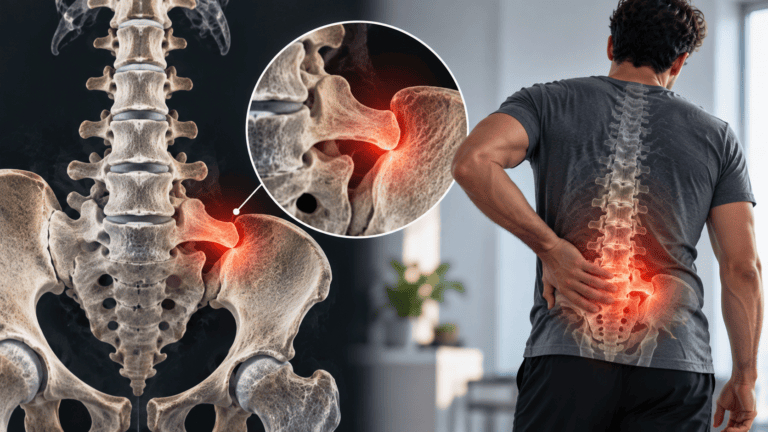
Dr. Sherief Elsayed identifies the specific structural finding directly: “Okay, so on the left I can see some bony overgrowth. If you look here, see this bone is overgrown compared to on the right there.”
This asymmetric bony overgrowth, clearly identifiable on comparison between the left and right sides of the patient’s lower spine at the relevant level, is the key diagnostic finding that explains both the presence and the specific one-sided location of the patient’s pain.
What This Bony Overgrowth Represents: The Transverse Process and Sacrum Relationship
Dr. Sherief Elsayed explains the functional consequence of this structural finding: “This bony overgrowth is likely impinging on the pelvis, and that’s likely to be causing his pain.”
This description points to a specific and well-recognised anatomical variant affecting the lowest lumbar vertebra, most commonly L5, in which one of the transverse processes, the bony projections extending laterally from each vertebra, is enlarged and, in some cases, makes direct bony or pseudo-articular (joint-like) contact with the adjacent sacrum or iliac bone of the pelvis, rather than the normal, non-contact relationship expected at this level.
The Diagnosis: Bertolotti Syndrome
Dr. Sherief Elsayed confirms the specific diagnosis directly, in response to a colleague’s correct identification: “Bertolotti syndrome. Correct.”
Bertolotti syndrome refers specifically to lower back pain arising from this enlarged transverse process making abnormal contact with the sacrum or pelvis, most typically occurring at the lumbosacral junction, the transition point between the lumbar spine and the sacrum. The condition is named after the Italian physician Mario Bertolotti, who first described this specific anatomical variant and its clinical association with lower back pain in the early twentieth century.
The underlying anatomical variant:
This condition arises from a developmental anomaly known as lumbosacral transitional vertebra (LSTV), in which the lowest lumbar vertebra shows some degree of “sacralisation,” meaning it has taken on anatomical features more typical of the sacrum, including an enlarged transverse process that extends further than normal and, in more pronounced cases, makes direct bony contact or forms an actual pseudo-joint with the sacral ala (the wing-like lateral portion of the sacrum) or the adjacent iliac bone.
Why Bertolotti Syndrome Causes One-Sided Pain
Understanding why this condition specifically produces the kind of unilateral pain pattern described in this case requires understanding the mechanical consequences of this abnormal bony contact.
The mechanical source of pain:
Where the enlarged transverse process makes contact with the sacrum or ilium, whether through direct bony fusion, a genuine pseudo-joint with its own synovial lining, or simple abnormal soft tissue impingement without a formal joint structure, this contact point is subjected to ongoing mechanical stress during normal movement and weight-bearing activity. Unlike the normal, well-adapted joints of the spine, including the facet joints discussed extensively elsewhere in this blog series, this abnormal contact point is not a naturally evolved, optimally functioning articulation, and it frequently becomes a source of localised inflammation and pain, precisely at the specific location of the abnormal bony contact.
Why the pain is one-sided:
Because this anatomical variant, when present, is frequently asymmetric, affecting one side of the lowest lumbar vertebra more prominently than the other, exactly as illustrated in this case, the resulting pain characteristically localises to that same, specific side. This distinguishes Bertolotti syndrome from many other common causes of lower back pain, which tend to produce more symmetrical, central, or bilateral symptom patterns. A Back Pain Doctor in Dubai should specifically consider this diagnosis when assessing clearly one-sided lower back pain.
How Bertolotti Syndrome Is Diagnosed
Imaging identification:
The characteristic enlarged transverse process and its abnormal relationship with the sacrum or ilium is typically well visualised on plain X-ray, and further characterised in greater detail on CT or MRI, which can also assess for any secondary degenerative changes, disc pathology, or nerve involvement at the affected and adjacent levels.
Clinical correlation:
As emphasised consistently throughout this blog series, including the discussion in the earlier article on cervical kyphosis regarding the importance of correlating imaging findings with actual symptoms, the presence of a lumbosacral transitional vertebra on imaging alone does not automatically confirm Bertolotti syndrome as the cause of a patient’s pain. This anatomical variant is present in a meaningful proportion of the general population, many of whom experience no symptoms whatsoever related to it. The diagnosis of Bertolotti syndrome specifically requires that the patient’s clinical pain pattern, one-sided, localised to the specific level of the abnormal bony contact, correlates with the imaging finding.
Diagnostic injection:
Similar to the diagnostic principle described in the earlier articles on facet joint injections, a targeted local anaesthetic injection directly into or around the specific abnormal contact point, under imaging guidance, can serve as a valuable diagnostic confirmation. If the patient’s characteristic one-sided pain is significantly reduced or eliminated following this targeted injection, this provides strong confirmatory evidence that the identified anatomical variant is genuinely the source of the pain, rather than simply an incidental imaging finding.
Treatment of Bertolotti Syndrome
Conservative management:
As with the majority of spinal conditions discussed throughout this blog series, initial management typically involves physiotherapy focused on core stability and postural correction, activity modification, and appropriate pain management, following the general principles discussed in earlier articles on anti-inflammatory medication and structured rehabilitation.
Targeted injections:
Corticosteroid injection directly into the abnormal contact point, following confirmation through diagnostic local anaesthetic injection as described above, can provide meaningful anti-inflammatory relief, similar in principle to the facet joint injection approach described extensively elsewhere in this series.
Surgical options:
For patients whose pain remains significant and functionally limiting despite adequate conservative management, and where diagnostic injection has clearly confirmed the abnormal bony contact as the genuine pain source, surgical resection of the enlarged, abnormally contacting portion of the transverse process can be considered, aiming to eliminate the specific mechanical source of the pain directly. A Spine Fusion Doctor in Dubai can advise on this surgical approach.
A Spine Doctor in Dubai assessing a younger patient with clearly one-sided lower back pain should specifically consider Bertolotti syndrome within the differential diagnosis, recognising the distinctive nature of this pain pattern and the specific imaging finding that confirms it.
Why This Case Matters for Understanding Spine Diagnosis More Broadly
This case illustrates a theme that has recurred throughout this blog series: the specific, precise pattern of a patient’s symptoms, combined with careful, targeted attention to the corresponding imaging findings, allows a specific, named diagnosis to be reached confidently, rather than defaulting to a generic label of “non-specific back pain.” Bertolotti syndrome, while less commonly discussed than disc herniation or spinal stenosis, represents exactly this kind of specific, identifiable, and treatable condition that rewards careful, systematic clinical reasoning.
UAE-Specific Considerations
Given that Bertolotti syndrome frequently affects younger, otherwise healthy patients, precisely the demographic often most active in the UAE’s substantial fitness and gym culture discussed in earlier articles in this series, clinicians assessing younger patients presenting with persistent, clearly one-sided lower back pain that has not responded to generic treatment approaches should specifically consider this diagnosis and ensure appropriate imaging is obtained to identify or exclude it. A Consultant Spine Surgeon in Dubai will specifically consider this diagnosis in younger patients with persistent, one-sided pain.
Expert Summary
Bertolotti syndrome describes lower back pain arising from an enlarged, abnormally positioned transverse process at the lowest lumbar vertebra making direct or pseudo-articular contact with the adjacent sacrum or pelvis. This specific anatomical variant, when it produces genuine mechanical stress and inflammation at the abnormal contact point, characteristically causes one-sided lower back pain that correlates precisely with the side of the anatomical abnormality, exactly as demonstrated in this 30-year-old patient’s case. Diagnosis requires correlating the specific imaging finding with the patient’s characteristic symptom pattern, ideally confirmed through targeted diagnostic injection, before proceeding to appropriate conservative or, where needed, surgical treatment.
Table of Contents
Recent Articles

How to Request an Affordable Spine Consultation in Dubai
How to Request an Affordable Spine Consultation in Dubai Do I need to prove financial hardship to request a reduced-cost consultation? The specific requirements can vary and should be discussed
Why Sciatica Is Not Always Caused by a Slipped Disc in Dubai
Why Sciatica Is Not Always Caused by a Slipped Disc in Dubai How is sacroiliitis diagnosed if it doesn’t show up clearly on a standard spine MRI? Sacroiliitis is often
Why Bony Overgrowth in the Lower Spine Causes One-Sided Pain
Why Bony Overgrowth in the Lower Spine Causes One-Sided Pain Is Bertolotti syndrome a common cause of back pain? The underlying anatomical variant, lumbosacral transitional vertebra, is relatively common in