
Why Sciatica Is Not Always Caused by a Slipped Disc in Dubai
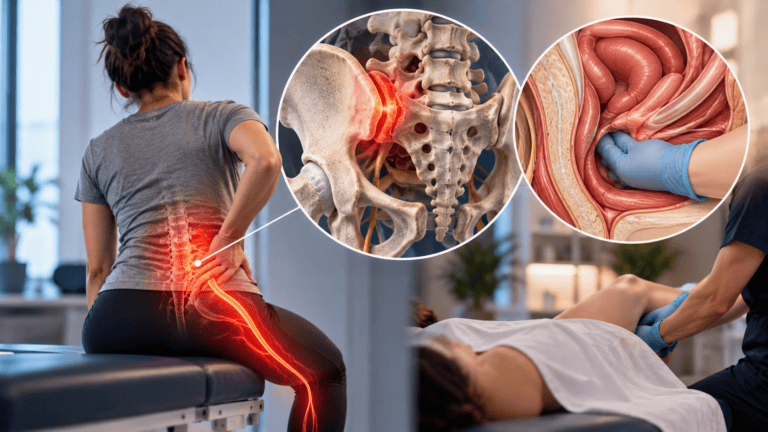
How is sacroiliitis diagnosed if it doesn't show up clearly on a standard spine MRI?
Sacroiliitis is often assessed through specific clinical examination tests targeting the sacroiliac joint directly, alongside imaging specifically focused on the sacroiliac joints themselves (which may require dedicated views beyond a standard lumbar spine MRI), and can be further confirmed through a diagnostic local anaesthetic injection directly into the joint.
Is pelvic floor physiotherapy a recognised treatment for sacroiliac joint pain?
Pelvic floor physiotherapy and internal release techniques are more established in the treatment of specific pelvic floor dysfunction conditions. Their specific role in treating sacroiliac joint-related leg pain, as described in this case, remains an area without strong, established evidence, though individual patient reports of benefit, as described here, are worth noting.
Should I try an internal release technique if I have sciatica that hasn't responded to standard treatment?
This should be discussed directly with your treating specialist, who can advise on the most appropriate evidence-based options for your specific diagnosis and situation, while remaining open to discussing patient experiences and less conventional approaches within an honest, transparent clinical conversation.
What are the standard, evidence-based treatments for sacroiliac joint pain?
Standard treatment typically includes physiotherapy focused on core and pelvic stability, appropriate pain management, and where needed, targeted corticosteroid injections directly into the sacroiliac joint, following similar diagnostic and therapeutic principles to the facet joint injections discussed elsewhere in this blog series.
Can sacroiliac joint pain be confused with a disc-related cause of sciatica?
Yes, as this case illustrates, sacroiliac joint pain can produce a leg pain distribution that closely resembles classic sciatica, making careful clinical assessment, alongside imaging, important for reaching an accurate diagnosis and appropriately targeted treatment.
Why is it important for a doctor to admit when they don't know something?
Honest acknowledgement of clinical uncertainty, rather than confident but unfounded explanation, reflects genuine intellectual integrity and an evidence-based approach to medicine, helping patients understand the actual current state of medical knowledge regarding their specific situation, and building appropriate trust in the clinician’s overall judgement.
Some of the most honest and clinically valuable moments in medicine come when a surgeon openly acknowledges the limits of current evidence, describes a patient’s genuinely unexpected outcome from an unconventional treatment, and admits they cannot fully explain why it worked. This kind of intellectual honesty, rather than undermining clinical credibility, is precisely what distinguishes a genuinely evidence-based practitioner from one simply reciting familiar treatment algorithms.
Dr. Sherief Elsayed, Consultant Spine Surgeon in Dubai, shares exactly this kind of case, and the reasoning process behind it, directly and candidly.
The Case: Sciatica Without a Convincing Disc Cause
Dr. Sherief Elsayed introduces the patient: “I have a 36 year old patient who comes to see me with back pain and right-sided sciatica. She has no convincing disc prolapse causing her sciatic symptoms.”
This immediately establishes a genuinely important clinical scenario, directly relevant to the broader theme explored throughout this blog series, particularly in the earlier article Not All Sciatica Comes From a Slipped Disc. This patient’s imaging did not show the kind of clear, convincing disc herniation that would readily explain her sciatic pain pattern, meaning the underlying cause of her symptoms required further, more careful diagnostic consideration.
The Alternative Diagnosis: Sacroiliitis
Dr. Sherief Elsayed identifies his clinical working diagnosis: “I suspect that her sacroiliitis, a bit of inflammation in the sacroiliac joint, is causing her leg pain.”
The sacroiliac joints, located on either side of the lower spine where the sacrum meets the iliac bones of the pelvis, are a well-recognised alternative source of pain that can genuinely mimic sciatica, producing pain that radiates into the buttock and down the leg, closely resembling the pain distribution more classically associated with lumbar disc herniation and nerve root compression, despite arising from an entirely different anatomical structure. Sacroiliitis, inflammation of this joint, is a recognised cause of exactly this kind of referred leg pain pattern, and represents an important differential diagnosis whenever sciatica presents without a clearly convincing disc-related explanation on imaging.
Initial Treatment Response: A Pattern That Confirms the Diagnosis
Dr. Sherief Elsayed describes the patient’s response to conservative treatment: “She manages well with painkillers and physiotherapy. Whenever she stops them, her pain comes back.”
This specific response pattern, meaningful improvement with appropriate treatment but recurrence when that treatment is discontinued, is itself clinically informative. It suggests an ongoing, active source of inflammation or mechanical irritation, consistent with sacroiliitis, rather than a discrete, self-limiting structural problem that would be expected to resolve more definitively over time. This pattern supports the sacroiliac joint as the genuine, ongoing source of her symptoms, even though it does not, on its own, constitute definitive diagnostic proof.
What the Patient Did Next: An Internal Release
Dr. Sherief Elsayed then describes what the patient pursued independently, outside his own treatment recommendations: “Because she hasn’t had much success with what I’ve offered her, she’s went and had something called an internal release. She’s had this done twice, and she swears by it. She tells me that her leg pain has completely disappeared.”
This represents an important and genuinely interesting clinical development. The patient, having achieved only partial, treatment-dependent relief through the conservative measures initially offered, sought out an alternative therapeutic approach on her own initiative, and reports a dramatically more complete and durable response.
What Is an Internal Release?
Dr. Sherief Elsayed explains the specific technique directly and without euphemism: “An internal release is when the therapist places a gloved hand into the vagina and releases the internal structures.”
This describes a specific manual therapy technique, most commonly performed by specialised pelvic floor physiotherapists, involving internal, transvaginal palpation and manual release of pelvic floor musculature and associated connective tissue structures. This technique is more typically and conventionally used in the management of pelvic floor dysfunction, including conditions such as pelvic pain, certain forms of urinary or bowel dysfunction, and specific gynaecological or postpartum recovery scenarios, rather than as an established, mainstream treatment for sciatica or sacroiliac joint-related leg pain.
The Anatomical Puzzle: Why This Is Genuinely Surprising
Dr. Sherief Elsayed is explicit about the anatomical distance involved, and why this makes the reported outcome genuinely puzzling from a straightforward biomechanical perspective: “Just off the screen is the top of the vagina, and then there’s the uterus. It’s miles away from the spine or the sacroiliac joint.”
This observation reflects sound anatomical reasoning. The structures accessed and manually released during an internal pelvic floor release technique are not in direct anatomical continuity with, or in close physical proximity to, either the lumbar spine or the sacroiliac joint itself, the structures Dr. Sherief Elsayed had identified as the likely source of this patient’s sciatic pain pattern. This creates a genuine puzzle: if the sacroiliac joint was indeed the source of her pain, why would a manual therapy technique targeting entirely different, anatomically distant pelvic floor structures produce such a dramatic and reportedly complete resolution of her symptoms?
The Honest Clinical Admission
Rather than offering a confident but potentially unfounded explanation simply to fill this gap in understanding, Dr. Sherief Elsayed is refreshingly direct: “I can’t really explain why this works.”
This is a genuinely important demonstration of intellectual honesty in clinical practice. It would be entirely possible, and perhaps more conventionally satisfying to some audiences, for a specialist to offer a confident-sounding biomechanical explanation, however speculative, rather than openly acknowledging genuine uncertainty. Dr. Sherief Elsayed instead chooses transparency about the actual limits of current medical and anatomical understanding regarding this specific patient’s outcome.
Openly Requesting Evidence or Further Insight
The transcript concludes with a genuine, open invitation for further information: “If you have any good evidence that this works, I haven’t found any, or if you have some anecdote, I’d love to hear about it.”
This reflects a genuinely evidence-based clinical mindset, actively distinguishing between anecdotal patient report, however compelling and consistent (in this case, reported success on two separate occasions), and the kind of systematic evidence, controlled studies, mechanistic research, or at minimum, a coherent body of similar reported cases, that would be needed to properly understand and validate a novel or unconventional therapeutic mechanism.
Possible Explanations Worth Considering
While Dr. Sherief Elsayed does not claim to have a definitive answer, several possible explanatory frameworks exist within current understanding of pain and musculoskeletal function, none of which have been definitively established for this specific scenario but which illustrate the kind of biological plausibility that might warrant further research.
Myofascial and connective tissue interconnection: The body’s fascial and connective tissue network forms an interconnected system extending well beyond the immediate boundaries of any single anatomical structure, and manual release of tension in one region has, in some contexts, been theorised to produce effects at seemingly distant sites through this connected tissue network, though the evidence for this specific mechanism remains contested and incompletely established within mainstream musculoskeletal medicine.
Pelvic floor and lumbopelvic biomechanical relationships: The pelvic floor musculature has genuine biomechanical and neuromuscular relationships with the broader lumbopelvic region, including the sacroiliac joints, and dysfunction or tension in the pelvic floor has been proposed, in some clinical and research contexts, to contribute to altered pelvic and sacroiliac joint mechanics, offering one possible, though not definitively established, pathway by which this kind of intervention might plausibly influence sacroiliac-related symptoms.
Central pain modulation: Manual therapy techniques generally, regardless of the specific anatomical site targeted, can influence broader central nervous system pain processing and modulation pathways, offering another possible, non-purely-local mechanism that might contribute to the reported symptom improvement, independent of any direct local anatomical effect on the sacroiliac joint itself.
None of these represent confirmed explanations for this specific patient’s experience, and Dr. Sherief Elsayed’s own honest acknowledgement of uncertainty should be respected rather than replaced with an unsubstantiated confident-sounding alternative explanation.
Why This Kind of Clinical Honesty Matters
This case illustrates something valuable about how patients should evaluate the specialists they choose to trust with their care. A Spine Doctor in Dubai who is willing to openly acknowledge the limits of their own certainty, rather than defaulting to confident-sounding but unfounded explanations, demonstrates precisely the kind of genuine, evidence-grounded clinical reasoning that patients should value and actively seek out.
What This Means for Patients With Similar Presentations
For patients experiencing sciatica-like leg pain without a clearly convincing disc-related cause on imaging. A Sciatica Assessment Doctor in Dubai should actively consider sacroiliac joint dysfunction as an important alternative diagnosis. on imaging, this case highlights several important principles: sacroiliac joint dysfunction is a genuine and clinically important alternative diagnosis that should be actively considered; conservative treatment that provides only partial, treatment-dependent relief may indicate the need for further diagnostic reassessment or alternative therapeutic approaches; and patient-reported outcomes from less conventional treatments, while genuinely worth noting and taking seriously, should be evaluated within an appropriately evidence-based framework rather than assumed to establish a definitive causal mechanism.
UAE-Specific Context
Given the significant burden of both disc-related and non-disc-related sciatica presentations seen across Dubai’s spine specialist practices. A Spine Nerve Specialist in Dubai applies exactly this systematic diagnostic approach. seen across Dubai’s spine specialist practices, as discussed extensively throughout this blog series, a thorough, systematic diagnostic approach that actively considers sacroiliac joint pathology, alongside standard disc-related causes, is an important component of comprehensive spine care available to patients across the region.
Expert Summary
This case illustrates both an important alternative diagnosis, sacroiliitis, for patients presenting with sciatica-like symptoms without a convincing disc-related explanation, and a valuable demonstration of intellectual honesty in the face of a genuinely puzzling patient-reported outcome from an unconventional treatment. Dr. Sherief Elsayed’s willingness to openly acknowledge that he cannot fully explain why an internal pelvic floor release technique produced such dramatic reported relief of this patient’s sacroiliac-related leg pain, rather than offering an unfounded confident explanation, reflects exactly the kind of genuinely evidence-based clinical honesty that should characterise good medical practice.
Table of Contents
Recent Articles

How to Request an Affordable Spine Consultation in Dubai
How to Request an Affordable Spine Consultation in Dubai Do I need to prove financial hardship to request a reduced-cost consultation? The specific requirements can vary and should be discussed
Why Sciatica Is Not Always Caused by a Slipped Disc in Dubai
Why Sciatica Is Not Always Caused by a Slipped Disc in Dubai How is sacroiliitis diagnosed if it doesn’t show up clearly on a standard spine MRI? Sacroiliitis is often
Why Bony Overgrowth in the Lower Spine Causes One-Sided Pain
Why Bony Overgrowth in the Lower Spine Causes One-Sided Pain Is Bertolotti syndrome a common cause of back pain? The underlying anatomical variant, lumbosacral transitional vertebra, is relatively common in