
Why Not Every Spinal Cancer Case in the UAE Needs Surgery
If I have cancer in my spine, does that automatically mean I need surgery?
No. As this article explains, the decision depends on multiple factors including the tumour’s stage, extent, and responsiveness to non-surgical treatments such as radiotherapy and chemotherapy. Many patients with spinal metastases are effectively managed without surgery.
What does it mean if my cancer is described as "radiosensitive"?
This means the specific type of cancer responds well to radiotherapy, meaning radiation treatment can effectively shrink or control the tumour without requiring surgical removal. Lymphoma and multiple myeloma are examples of typically radiosensitive cancers.
How is the decision made about which levels need surgery when there are multiple affected areas?
Each affected level is individually assessed for the degree of neurological compression, mechanical stability, and clinical significance. Surgery is directed specifically at levels causing or threatening significant compression or instability, while other levels may be managed with radiotherapy, systemic treatment, or monitoring.
What is the difference between surgery for cure and surgery for symptom relief in spinal cancer?
For some patients with limited, well-controlled cancer, surgery may aim for long-term disease control. For patients with more advanced or widespread cancer, surgery is often focused on relieving symptoms, preserving neurological function, and maintaining quality of life, rather than curing the underlying cancer.
How quickly does spinal cancer surgery need to happen if it is needed?
This depends on the specific indication. Rapidly progressive neurological deficit requires urgent surgical decompression. Spinal instability without acute neurological compromise may be addressed on a more planned, elective basis. Your multidisciplinary team will advise on the appropriate timeframe for your specific situation.
Should I get a second opinion before agreeing to spinal cancer surgery?
Given the complexity and individualised nature of these treatment decisions, seeking a second opinion, particularly from a centre with a dedicated multidisciplinary spinal oncology team, is entirely reasonable and can provide valuable additional perspective on the full range of treatment options available.
A diagnosis of spinal cancer, whether primary or metastatic, generates immediate and understandable fear. Many patients and families assume that surgery is the automatic next step, the decisive intervention that will address the problem. In reality, the decision about whether surgery is appropriate, and if so, what kind, depends on a careful assessment of multiple factors specific to each individual case, and in a meaningful proportion of patients, surgery may not be the most appropriate treatment at all.
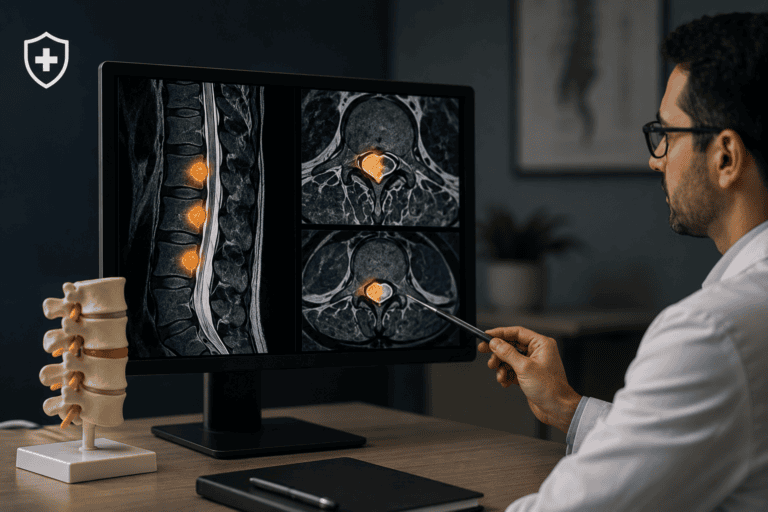
Dr. Sherief Elsayed, Consultant Spine Surgeon in Dubai, illustrates this decision-making process directly using real imaging from a patient with multiple spinal cancer lesions.
The Case: Multiple Lesions With Varying Severity
Dr. Sherief Elsayed describes the imaging: “Here’s an MRI scan of a patient with cancer, and you can see multiple lesions. And if you look at the cross section here, this dot is a nerve coming out of the screen nice and happy. Look over here on the right hand side, it’s completely encased by this tumour.”
This description highlights an important reality of metastatic spinal cancer: the disease is often not confined to a single location. Multiple vertebral levels may be affected simultaneously, and critically, the severity of involvement can vary dramatically between different affected levels within the same patient.
At one level, the nerve exits the spinal canal freely, without any tumour compression, appearing, in Dr. Sherief Elsayed’s words, “nice and happy.” At another level in the same patient, the identical anatomical structure, a nerve, is completely encased and compressed by tumour tissue. This variation in severity between different affected levels is a genuinely important factor in surgical decision-making, because it means that treatment cannot simply be applied uniformly to “the cancer” as a single entity. Each affected level requires individual assessment of its specific clinical significance.
The Three Factors That Determine the Treatment Plan
Dr. Sherief Elsayed identifies the specific variables that shape the surgical decision: “Depending on how advanced this cancer is, how widespread it is, how responsive it is to chemotherapy, to radiotherapy, that will dictate what kind of surgical procedure I can offer this patient, if one is needed at all.”
How Advanced the Cancer Is
The stage of the underlying cancer, encompassing both the extent of the primary tumour and the presence and extent of metastatic spread throughout the body, fundamentally shapes what surgical intervention can reasonably achieve. A patient with a single, isolated spinal metastasis from an otherwise well-controlled primary cancer represents a very different clinical scenario from a patient with widespread metastatic disease affecting multiple organ systems, even if the spinal imaging appearance were similar.
For patients with more limited, oligometastatic disease, aggressive surgical treatment of the spinal lesion, potentially including more extensive resection with curative or long-term disease control intent, may be genuinely appropriate. For patients with widespread, advanced metastatic disease, the treatment goal shifts toward palliation, meaning the relief of symptoms and preservation of function and quality of life, rather than attempting to definitively treat the cancer itself through the spinal surgery.
How Widespread the Disease Is
Beyond the general stage of cancer, the specific pattern and extent of spinal involvement matters significantly. A patient with a single symptomatic vertebral level, even in the context of some additional asymptomatic lesions elsewhere, may be well served by a focused surgical intervention addressing that specific level. A patient with extensive multilevel spinal involvement, as illustrated in this case with multiple lesions of varying severity, requires a more comprehensive assessment of which levels genuinely require intervention and which can be safely monitored or treated with non-surgical modalities.
This directly relates to the underlying principle established in the earlier article Why Spinal Tumour Surgery Can Cause Serious Blood Loss and How UAE Surgeons Manage It: more extensive surgery carries greater risk, and this risk must be justified by a genuine and proportionate clinical benefit.
How Responsive the Cancer Is to Chemotherapy and Radiotherapy
This is perhaps the most decisive factor in many cases, and it is where the multidisciplinary nature of cancer treatment becomes most apparent. Different cancer types have dramatically different sensitivities to non-surgical treatment modalities.
Highly radiosensitive and chemosensitive tumours: Certain cancer types, including lymphoma, multiple myeloma, and some other haematological malignancies, are often highly responsive to radiotherapy and chemotherapy. For these tumour types, even significant spinal cord compression from tumour may be effectively treated with radiotherapy alone, without requiring surgical decompression at all, provided the spine remains mechanically stable and the neurological compromise is not so severe or rapidly progressive that surgery becomes urgently necessary regardless of tumour radiosensitivity.
Less radiosensitive tumours: Other cancer types, including many solid organ cancers such as renal cell carcinoma and certain lung cancers, are less reliably responsive to radiotherapy alone. For these tumour types, surgical decompression and stabilisation, often followed by radiotherapy to address residual disease, becomes a more central part of the treatment approach when spinal cord compression or instability is present.
The multidisciplinary decision: This is why the management of spinal cancer, particularly metastatic spinal cancer, is not a decision made by a spine surgeon in isolation. It requires close collaboration between the spine surgeon, medical oncologist, radiation oncologist, and often other specialists, to determine the specific tumour type’s known sensitivity to available treatments and to construct a coordinated treatment plan that uses each modality where it will be most effective.
When Is Surgery Genuinely Needed?
Despite the emphasis on not every case requiring surgery, there are clear and specific indications where surgical intervention becomes the appropriate primary treatment, as established in the earlier article Why Lung Cancer Can Spread to the Spine, Dr. Sherief Elsayed Explains.
Spinal instability: When tumour destruction of the vertebral body has compromised the mechanical stability of the spine, radiotherapy alone cannot restore structural integrity. A Spinal Reconstruction Surgeon in Dubai provides this structural stabilisation using techniques including bone cement and instrumentation. the mechanical stability of the spine, radiotherapy alone cannot restore structural integrity. Surgical stabilisation, often combined with bone cement as covered in the earlier article on this topic, is needed regardless of the tumour’s radiosensitivity.
Rapidly progressive neurological deficit: When spinal cord or nerve compression is causing rapidly worsening neurological function, the timeframe required for radiotherapy to take effect, typically days to weeks, may be too slow to prevent permanent neurological injury. Surgical decompression provides immediate relief of the compression, buying time for radiotherapy or other treatments to address the underlying tumour.
Radioresistant tumours with significant compression: As discussed above, tumour types known to respond poorly to radiotherapy, combined with significant compression of neural structures, favour a surgical approach.
Need for tissue diagnosis: In some cases, particularly when the primary source of a spinal tumour is unknown, surgical biopsy may be needed to obtain tissue for diagnosis, which then guides all subsequent treatment decisions, including whether further surgery is needed.
Why This Case Illustrates Good Clinical Decision-Making
The value of the case Dr. Sherief Elsayed presents lies specifically in showing multiple lesions of varying severity within a single patient. This is precisely the clinical reality that requires individualised, level-by-level assessment rather than a blanket approach to “treating the cancer” surgically.
A Spine Tumour Surgeon in Dubai reviewing this kind of complex, multilevel case must determine which specific levels are causing or threatening to cause neurological compromise or instability, and therefore require surgical attention, and which levels, despite the presence of tumour, remain mechanically stable and neurologically insignificant, and can therefore be appropriately managed with radiotherapy, systemic treatment, or observation.
This individualised, level-specific decision-making, rather than a uniform surgical response to any spinal cancer diagnosis, reflects the genuinely nuanced and evidence-based approach that characterises modern spinal oncology.
UAE-Specific Context
Cancer care in the UAE has developed significant multidisciplinary infrastructure, with major hospitals maintaining coordinated oncology, radiation oncology, and spine surgery teams capable of exactly this kind of collaborative treatment planning. Patients diagnosed with spinal cancer in Dubai should expect and can reasonably request a multidisciplinary team discussion of their case, ensuring that the full range of treatment options, not surgery alone, has been considered before a treatment plan is finalised.
Expert Summary
Not every spinal cancer case requires surgery, and even within a single patient with multiple affected levels, the appropriate treatment often varies from level to level based on the severity of compression, the tumour’s responsiveness to non-surgical treatment, and the overall stage and extent of the underlying disease. Surgery becomes the clear priority when spinal instability, rapidly progressive neurological deficit, or radioresistant tumour biology with significant compression are present. In other circumstances, radiotherapy, chemotherapy, or careful observation may be entirely appropriate, reflecting genuinely individualised, multidisciplinary decision-making rather than a reflexive surgical response to a cancer diagnosis.
Table of Contents
Recent Articles

Why Eight People Were Needed for One Spine Surgery in Dubai
Why Eight People Were Needed for One Spine Surgery in Dubai Does every spinal surgery require exactly eight team members? No, as Dr. Sherief Elsayed explains directly, the specific team
Three Spine Surgery Myths a Dubai Surgeon Wants You to Forget
Three Spine Surgery Myths a Dubai Surgeon Wants You to Forget Is it really safe to walk on the same day as spine surgery? Yes, for the majority of modern

Why Osteoporosis Is Called the Silent Disease in the UAE
Why Osteoporosis Is Called the Silent Disease in the UAE If osteoporosis doesn’t cause pain, how would I know if I needed a DEXA scan? Given the entirely silent nature