
Why Pain When Leaning Backwards Could Be Coming From Your Facet Joints
How long does relief from a diagnostic facet joint injection typically last?
The local anaesthetic component provides relief lasting several hours, which is the window used to assess the diagnostic response. If a corticosteroid is also included, additional anti-inflammatory relief can last several weeks to a few months, though this is a secondary benefit rather than the primary diagnostic purpose of the injection.
Is the diagnostic injection itself painful?
Most patients describe the procedure as mildly uncomfortable rather than significantly painful. A Spine Doctor in Dubai will explain exactly what to expect before, during, and after the injection. Local anaesthetic is used to numb the skin and deeper tissues before the diagnostic needle is placed. Some soreness at the injection site for a day or two afterwards is normal.
What if the injection does not relieve the pain at all?
This is genuinely useful diagnostic information. It indicates that the facet joint injected was likely not the primary source of the patient’s pain, prompting the clinician to reconsider other potential sources, such as the disc, sacroiliac joint, or another structure, rather than proceeding further with facet-directed treatment.
Can both sides be injected at the same time?
Yes, where clinically indicated, both the left and right facet joints at a given level, or facet joints at multiple levels, can be injected during the same session, depending on the specific pattern of the patient’s pain and the clinical suspicion involved.
Does a positive response to a facet joint injection mean I will need radiofrequency denervation?
Not necessarily immediately. A positive diagnostic response confirms the facet joint as the pain source and opens the door to a range of treatment options, including physiotherapy and repeat therapeutic injections, with radiofrequency denervation reserved as a more definitive option if these initial measures do not provide adequately durable relief.
Are facet joint injections used in the neck as well as the lower back?
Yes, facet joints are present at every level of the spine, including the cervical (neck) region, and similar diagnostic and therapeutic injection techniques can be used to confirm cervical facet joint pain, which often presents with neck pain specifically worsened by tilting the head backwards.
Watching a diagnostic procedure unfold in real time provides a uniquely clear demonstration of how spine specialists confirm exactly where a patient’s pain is coming from before committing to any definitive treatment. A patient whose pain is reliably and severely provoked by leaning backwards offers a textbook clinical picture, and the diagnostic injection that follows is designed specifically to prove, rather than simply assume, what structure is responsible.
Dr. Sherief Elsayed, Consultant Spine Surgeon in Dubai, narrates this exact process from the procedure room, illustrating both the clinical reasoning behind suspecting the facet joints and the precise diagnostic test used to confirm it.
The Clinical Picture: Pain on Extension
Dr. Sherief Elsayed describes the patient’s presentation directly: “I’m reasonably convinced that the patient’s pain is coming from his facet joint because when he leans backwards, or he can’t lean backwards, it’s just excruciatingly painful.”
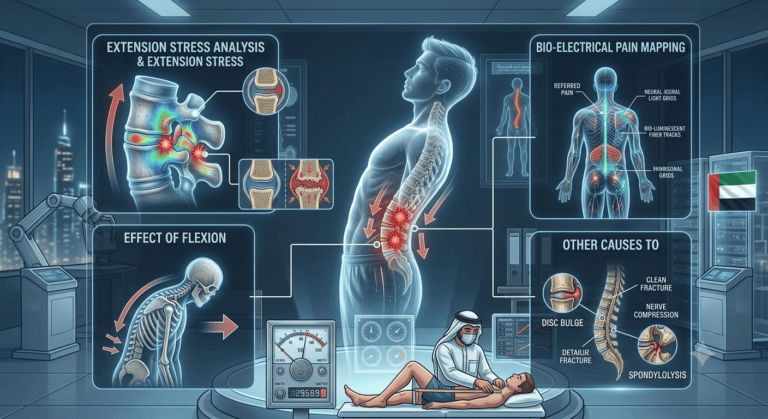
This pattern, severe pain specifically provoked by spinal extension (leaning backwards), is one of the most clinically useful and recognisable signs in the assessment of axial spinal pain. As explored in detail in the published article Why Leaning Backwards Makes Your Back Pain Worse and What It Means for Your Spine, the facet joints, the small paired joints at the back of each vertebral level, are specifically and directly loaded during extension movements.
Why Extension Specifically Targets the Facet Joints
Dr. Sherief Elsayed explains the precise mechanical reason for this pain pattern: “I suspect that’s because he’s forcing his facets down together.”
This is an accurate and intuitive description of facet joint biomechanics. The facet joints sit at the back of the spine, behind the vertebral bodies and discs. During flexion (bending forward), these joints open and separate slightly. During extension (leaning backwards), the opposite occurs: the joints close, with the articulating surfaces compressed directly together.
In a healthy facet joint with normal cartilage, this compression during extension is well tolerated. But when the cartilage has degenerated, when the joint capsule is inflamed, or when bone spurs have developed at the joint margins, this same compressive loading during extension produces significant pain. The patient who cannot lean backwards without excruciating pain is, quite literally, unable to tolerate the compressive force that extension places directly onto an already compromised facet joint.
The Procedure: Lumbar Facet Joint Injection as Both Diagnosis and Treatment
Dr. Sherief Elsayed describes the specific procedure being performed: “Today I’m doing some lumbar facet joint injections and these serve as a diagnostic injection on this occasion.”
This description highlights an important dual purpose that facet joint injections can serve. They can function purely diagnostically, to confirm or refute a suspected source of pain, and in many cases, they also provide therapeutic relief at the same time, particularly when a corticosteroid is included alongside the local anaesthetic.
How the diagnostic logic works:
“If I inject him and his pain disappears, I’ve confirmed the facet joint is the source and then I can do something about that.”
This is the fundamental principle of a diagnostic injection. A precisely targeted dose of local anaesthetic is delivered directly into or immediately around the suspected facet joint, under fluoroscopic or ultrasound guidance to ensure accurate placement. If the patient’s previously reproducible pain, in this case, the severe pain on attempting to lean backwards, is significantly reduced or eliminated shortly after the injection, this is considered strong evidence that the injected joint was indeed the source of the pain.
This diagnostic clarity is genuinely valuable. Without it, a clinician is left inferring the pain source from clinical pattern alone, which, while often accurate, does not carry the same level of certainty as a positive response to a precisely targeted injection that temporarily removes sensation specifically from that joint.
What Happens After a Positive Diagnostic Injection
Once the facet joint has been confirmed as the genuine source of the patient’s pain through a positive response to the diagnostic injection, the treatment pathway becomes clear and targeted, rather than speculative.
The escalating treatment options for confirmed facet joint pain:
- Physiotherapy directed specifically at improving spinal stability and reducing the mechanical load placed on the confirmed problematic joint
- Repeat corticosteroid injections, which can provide more sustained anti-inflammatory relief than the diagnostic local anaesthetic alone, particularly useful for acute flares of facet-related pain
- Radiofrequency denervation, the most durable non-surgical treatment, in which the small medial branch nerves supplying the confirmed facet joint are deliberately disrupted using controlled heat, preventing them from transmitting pain signals from that joint to the brain, often providing relief lasting a year or more
The full detail of this stepped treatment pathway, including how radiofrequency denervation works and what results patients can expect, is covered comprehensively in the published article Spinal Health Doctor in Dubai, which complements this case directly.
Why Diagnostic Certainty Matters Before Definitive Treatment
The careful, staged approach demonstrated in this case, suspecting the facet joint based on a specific clinical pattern, then confirming it definitively with a targeted diagnostic injection before proceeding to more durable treatment, reflects an important principle in spine care generally.
Proceeding directly to a more invasive or longer-lasting treatment, such as radiofrequency denervation, without first confirming the diagnosis through a positive diagnostic block, risks treating the wrong structure. If the patient’s actual pain source were something other than the facet joint, denervation of that joint’s nerve supply would not be expected to provide relief, representing an unnecessary procedure that fails to address the patient’s actual problem.
By contrast, the sequence demonstrated here, clinical suspicion, then targeted diagnostic confirmation, then definitive treatment only once the source is proven, gives both the patient and the treating physician genuine confidence that subsequent treatment decisions are correctly targeted. A Facet Joint Specialist in Dubai applying this same methodical approach ensures that more durable interventions, when eventually used, are directed at a confirmed rather than merely suspected pain source.
What Patients Can Expect From a Diagnostic Facet Joint Injection
For patients who may be offered a similar diagnostic procedure, understanding what to expect can reduce anxiety and improve cooperation with the assessment process.
Before the procedure:
- The patient’s specific pain pattern, in this case pain reliably provoked by leaning backwards, is documented carefully beforehand so that any change can be accurately assessed afterwards
- The target joint is identified based on the clinical examination and any relevant imaging
During the procedure:
- Performed under local anaesthesia, with the patient positioned appropriately, typically lying face down
- Fluoroscopic or ultrasound guidance is used to direct a thin needle precisely to the target facet joint or its associated medial branch nerve
- A small volume of local anaesthetic, sometimes combined with a corticosteroid, is injected
After the procedure:
- The patient is specifically asked to attempt to reproduce their previous pain-provoking movement, in this case leaning backwards, to assess whether the previously severe pain has been significantly reduced or eliminated
- This response is recorded and used to confirm or refute the facet joint as the genuine pain source
- Mild soreness at the injection site for a day or two afterwards is normal and expected
UAE-Specific Context
Facet joint injections of this kind are widely available at specialist spine centres across Dubai and the broader UAE, performed under appropriate imaging guidance by trained specialists. Patients experiencing back or neck pain that is specifically and reliably worsened by leaning backwards should discuss this particular symptom pattern explicitly with their treating specialist, as it carries genuine diagnostic significance and may prompt consideration of exactly this kind of targeted diagnostic approach.
Expert Summary
Pain that is reliably and severely provoked by leaning backwards points strongly towards the facet joints as the underlying source, because extension specifically and directly compresses these posterior spinal joints. Confirming this clinical suspicion with a precisely targeted diagnostic injection, rather than assuming it, provides genuine certainty before proceeding to more definitive treatment. This methodical, evidence-based approach, demonstrated directly in this case, ensures that subsequent treatments such as radiofrequency denervation are applied to a confirmed pain source, maximising the likelihood of genuine, lasting relief.
Table of Contents
Recent Articles
Which Surgeon Should You See for Your Spine Problem in Dubai?
Which Surgeon Should You See for Your Spine Problem in Dubai? Is a neurosurgeon always more qualified than an orthopaedic surgeon for spine conditions? No. Both pathways, when combined with

Can Calcium Supplements Cause Kidney Stones?
Can Calcium Supplements Cause Kidney Stones? If I have osteoporosis, should I take calcium supplements? This should be discussed specifically with your doctor, who will assess your individual dietary calcium

What Precision Medicine Means for Pain Management in Dubai
What Precision Medicine Means for Pain Management in Dubai How accurate is pharmacogenomic testing? Pharmacogenomic testing for well-established genetic variants, including CYP2D6 metaboliser status, is highly accurate and based on