
How to Choose the Right Spinal Surgeon, Dr. Sherief Elsayed Advises
Is a neurosurgeon or an orthopaedic surgeon better for spine surgery?
Both neurosurgeons and orthopaedic surgeons perform spinal procedures. The distinction between them matters less than whether the individual surgeon has completed subspecialty fellowship training specifically in spine, and what their procedural volume and outcomes are for the specific procedure you need. Fellowship-trained spine surgeons from either background are comparably qualified.
How do I find out where a surgeon trained?
Ask directly. A qualified surgeon will have no hesitation telling you where they completed their training, at which institution, and for how long. You can also review their professional biography on their clinic or hospital website, and many fellowship-trained surgeons list their training on professional medical register profiles.
What if I do not like my surgeon but they are technically qualified?
Technical qualification and rapport are both necessary. If you do not feel comfortable with your surgeon, if your questions are not being answered, if you feel pressured, or if the treatment plan is not being explained in a way you can understand, seeking a second opinion is entirely appropriate. Confidence in the plan is a legitimate part of the decision-making process.
Should I look for a surgeon who specialises only in spine?
For complex spinal procedures, a dedicated spine surgeon is preferable to a general orthopaedic or neurosurgical practitioner who performs occasional spinal cases. The volume and focus that come with subspecialty practice produce measurably better outcomes for complex procedures.
Is a higher complication rate always a bad sign?
Not necessarily. A higher complication rate may reflect a more complex caseload, surgeons who accept the cases others decline will naturally have higher raw complication rates. What matters is the rate in context, and whether the surgeon is aware of, transparent about, and engaged with their outcomes data.
How many consultations should I have before agreeing to surgery?
There is no fixed number. What matters is that by the end of your consultations, you understand your diagnosis, the proposed treatment, the alternatives, the risks, and what to expect during recovery. If you do not have this clarity after one or two consultations, further discussion is warranted before any consent is given.
Choosing a spinal surgeon is one of the most consequential healthcare decisions a patient can make. The spine is not a forgiving structure. Surgery on it is not reversible in most cases. And the difference between a well-selected, appropriately trained surgeon and a less qualified one is not merely academic. It can determine whether a patient walks well, whether complications occur, and whether the operation achieves what it was intended to achieve.
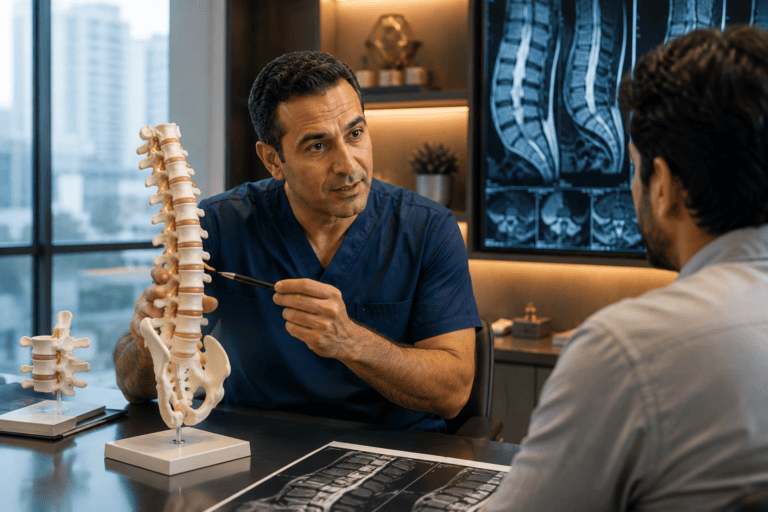
Dr. Sherief Elsayed, Consultant Spine Surgeon in Dubai, reduces the decision to three specific, actionable criteria. Each one reveals something essential about a surgeon’s preparation, their transparency, and their relationship with their patients.
Why Choosing the Right Spinal Surgeon Matters More Than Choosing the Right Hospital
Hospitals provide infrastructure, nursing care, theatre equipment, and post-operative support. They matter. But within a hospital, it is the surgeon’s hands, judgement, and experience that determine the technical outcome of the procedure. A technically excellent surgeon in an adequate facility will generally produce better outcomes than an inadequately trained surgeon in a state-of-the-art one.
This is particularly true in spine surgery, where the complexity of the anatomy, the proximity to the spinal cord and nerve roots, and the variety of pathologies encountered means that experience and specialist training have a measurable impact on outcomes. The question is not just “which hospital” but “which surgeon, and why.”
Criterion One: Fellowship Training
Dr. Sherief Elsayed identifies this as the first and foundational criterion: “Find out if your surgeon is fellowship trained. Fellowship training comes at the end of residency and lasts a minimum of one to two years. It’s dedicated completely to complex spinal surgery.”
Medical training follows a defined pathway. After medical school, doctors complete a foundation programme, then specialty training (residency), which in orthopaedic surgery or neurosurgery typically lasts five to seven years. At the end of residency, a surgeon is qualified to practise general orthopaedic or neurosurgical care.
Fellowship training is the layer that comes after. It is a post-residency period of focused, subspecialty training in which a surgeon spends one to two years working exclusively in spinal surgery under the supervision of an experienced specialist. During this time, the fellow performs high volumes of complex spinal procedures, deformity corrections, tumour resections, revision surgeries, minimally invasive techniques, that a general residency programme does not provide in sufficient number or complexity.
Why fellowship training is a reliable quality indicator:
- It signals that the surgeon made a deliberate commitment to spine as a subspecialty, not simply a general practitioner who performs occasional spinal procedures
- The volume and complexity of cases during fellowship builds technical skills and clinical judgement that cannot be acquired any other way
- Fellowship programmes at reputable institutions (major university hospitals, specialist spinal centres) have selection criteria, so the fact of having been accepted and completed a fellowship at a recognised centre is itself informative
- Post-fellowship surgeons have typically been exposed to the full range of spinal pathology, including the complex and revision cases that test and develop judgement
What to ask:
- Where did you complete your fellowship training?
- What was the focus of your fellowship: deformity, minimally invasive surgery, tumours, trauma?
- How many years of fellowship did you complete?
A Consultant Spine Surgeon in Dubai will have completed fellowship training and should be able to describe it clearly and specifically.
Criterion Two: Complication Rate
This is the criterion most patients do not know to ask about, and most surgeons are not asked. Dr. Sherief Elsayed is direct: “Inquire about their complication rate. Any good surgeon should be able to give you their exact percentage of complications.”
Every surgical procedure carries a risk of complications. No surgeon has a zero complication rate, and any surgeon who claims otherwise is not telling the truth or is not operating on sufficient volume or complexity to have encountered complications. What distinguishes a good surgeon from a poor one is not the absence of complications but how they manage them, what their rate is relative to the complexity of their caseload, and whether they track and know their own outcomes.
Why asking for a complication rate matters:
A surgeon who knows their complication rate is a surgeon who is tracking their outcomes. They are engaged with the feedback loop that tells them whether their practice is producing the results it should. They are aware of their performance and accountable to it.
A surgeon who cannot give you a figure, who responds with vagueness, or says they have never had a complication, or deflects the question, is a surgeon who is not monitoring their outcomes. This is a significant concern.
What constitutes an appropriate complication rate:
Complication rates vary by procedure type and patient complexity. A surgeon performing predominantly straightforward lumbar disc procedures on young, fit patients will have a lower complication rate than one performing complex multilevel fusions, revision surgeries, and tumour cases. Context matters.
General benchmarks for common spinal procedures include:
- Microdiscectomy: major complication rate typically below 2 to 3 percent
- Lumbar fusion: higher complication rate reflecting procedural complexity, typically 5 to 10 percent depending on the definition and patient population
- Cervical procedures: variable depending on the approach and extent
What you are looking for is not a specific number but a surgeon who knows their number, can explain what it includes, and can contextualise it against the complexity of their practice.
What to ask:
- What is your complication rate for this specific procedure?
- What complications does that figure include?
- How does it compare to published benchmarks?
Criterion Three: Rapport and Confidence in the Treatment Plan
The third criterion is perhaps the most undervalued, because it seems less technical than the first two. Dr. Sherief Elsayed is explicit about its importance: “Make sure you build a good rapport with your surgeon. That may not come from the very first visit, but by the time your treatment plan is devised, you need to have the confidence that the plan is going to work.”
Rapport is not a soft quality that is separate from medical outcomes. It is a direct determinant of them. A patient who trusts their surgeon asks questions, discloses information fully, understands the plan they have agreed to, complies with post-operative instructions, and communicates changes in their condition promptly. A patient who does not trust their surgeon does none of these things as reliably.
What good rapport looks like in a spine surgery context:
- The surgeon listens to the history without rushing
- The surgeon explains the findings in language the patient can understand
- The patient leaves the consultation knowing what their diagnosis is, why it has been made, what the treatment plan is, and what the alternatives are
- The patient feels their questions have been genuinely answered, not deflected
- The surgeon is honest about uncertainty and about the limits of what surgery can achieve
The specific qualifier Dr. Sherief Elsayed adds:
“That may not come from the very first visit.” This is an important acknowledgement. A first consultation is partly about information gathering and partly about establishing a clinical relationship. It is entirely normal for a patient to leave a first consultation with residual uncertainty. But by the time a treatment plan has been discussed and agreed, the patient should feel confident in both the plan and the person executing it. If that confidence is not present, it is appropriate, and legitimate, to seek a second opinion or to continue the conversation until it is. The article Why a Second Opinion From a UAE Spine Surgeon Could Prevent Unnecessary Surgery covers this directly.
Additional Considerations for Patients in Dubai
The UAE’s private healthcare market presents patients with a wide range of surgical providers, varying significantly in training background, procedural volume, and subspecialty focus. The three criteria above apply universally, but the Dubai context adds some specific practical dimensions. Patients can verify a surgeon’s credentials and training directly at their consultation with a Fellowship Trained Spine Surgeon Dubai.
International training credentials: Many surgeons practising in Dubai trained in the UK, USA, Europe, or Australia. Fellowship training from established programmes in these countries carries a strong quality signal. It is entirely appropriate to ask where a surgeon trained, at which institution, and under whom.
Procedural volume: High-volume surgical practice is independently associated with better outcomes across virtually all surgical specialties. A spine surgeon who performs a high volume of the specific procedure you need, not just spine surgery in general, has had more opportunity to refine their technique and manage complications.
Sub-subspecialty focus: Spine surgery itself contains subspecialties. A surgeon who focuses primarily on deformity correction and complex reconstruction is differently skilled from one whose practice centres on minimally invasive disc surgery or tumour resections. Ask whether the surgeon’s primary subspecialty aligns with your specific condition.
Access and communication: Post-operative access to your surgical team matters. Before surgery, establish how you will be able to reach the team if concerns develop after you are discharged. A surgeon who is easily contactable and whose team responds promptly is one of the practical markers of well-organised care. A UAE Spine Surgeon whose practice provides clear post-operative communication pathways adds an important layer of safety to the surgical experience.
Expert Summary
Choosing the right spinal surgeon requires asking three specific questions before committing to any procedure: Is the surgeon fellowship trained in spinal surgery? Can they give you their complication rate? And do you have the confidence in them and their plan by the time treatment begins?
These are not unreasonable demands. They are the minimum due diligence for a procedure that is irreversible, performed in close proximity to the structures that control movement and sensation throughout the body, and that has life-altering consequences when it goes wrong. A surgeon who welcomes these questions is one whose recommendation can be trusted. One who does not should prompt further scrutiny.
Table of Contents
Recent Articles

Why Eight People Were Needed for One Spine Surgery in Dubai
Why Eight People Were Needed for One Spine Surgery in Dubai Does every spinal surgery require exactly eight team members? No, as Dr. Sherief Elsayed explains directly, the specific team

Three Spine Surgery Myths a Dubai Surgeon Wants You to Forget
Three Spine Surgery Myths a Dubai Surgeon Wants You to Forget Is it really safe to walk on the same day as spine surgery? Yes, for the majority of modern

Why Osteoporosis Is Called the Silent Disease in the UAE
Why Osteoporosis Is Called the Silent Disease in the UAE If osteoporosis doesn’t cause pain, how would I know if I needed a DEXA scan? Given the entirely silent nature