
Why Most Back Pain in Dubai Resolves Without Surgery in 6 Weeks
Does back pain really go away on its own?
In most cases of acute low back pain, yes, or it improves enough to be a minor nuisance. Studies show the largest improvement occurs within the first month. Some people have lingering or recurring pain and benefit from guided rehabilitation.
Should I rest completely if my back hurts?
Not for long. Staying gently active generally leads to faster recovery than prolonged bed rest. Short rests are fine when needed, but try to keep walking and return to normal activity as pain allows.
What if my pain lasts longer than six weeks?
Persistent pain deserves an assessment. This often involves a clinical examination, a review of previous treatments and, where indicated, imaging. Many people still improve with a structured exercise programme and other non-surgical measures
Do I need an MRI for back pain?
Not usually. Guidelines advise against routine imaging for acute back pain without red flags, because findings are common and often unrelated to symptoms. An MRI is useful when there are neurological features or red flags.
Is recurrence of back pain normal?
Yes. Many people have more than one episode, but each flare is not necessarily worse than the last. Staying active and strong lowers the risk.
When is back pain an emergency?
Go to an emergency department for new bladder or bowel problems, numbness between the legs, rapidly worsening leg weakness, or severe pain after significant trauma.
A sudden flare of back pain can feel like the start of a long ordeal. You wince getting out of the car, cancel a workout, and begin to wonder whether you will need scans, injections or an operation. For the great majority of people, the real answer is much kinder: the pain settles on its own or with simple measures, and usually faster than expected.
This article explains what the evidence says about recovery, how to read the “six weeks” figure honestly, and what to do while the pain settles.
How quickly does most back pain improve?
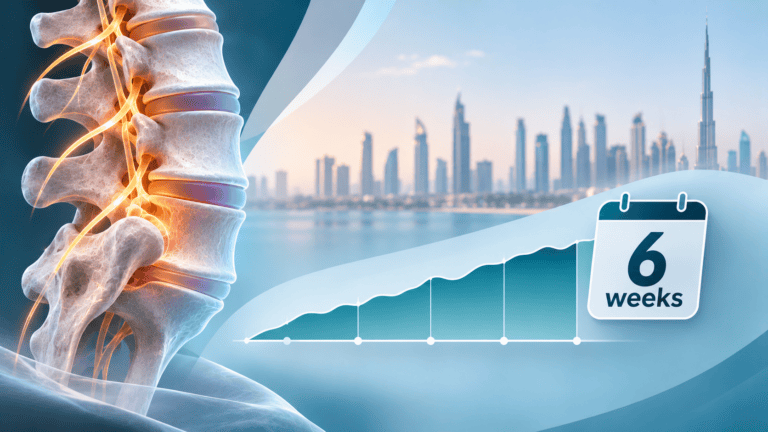
Acute low back pain, meaning an episode that has lasted less than about six weeks, usually improves quickly. A widely cited analysis in the BMJ by Pengel and colleagues found that average pain fell by roughly 58 percent within the first month of an episode, with most of that improvement happening in the first few weeks. Later research from Costa and colleagues, published in the Canadian Medical Association Journal, followed people with acute episodes for a year and found that most recovered, with the steepest improvement early on.
So the phrase “resolves in six weeks” is a fair summary of the typical pattern, with some important qualifications:
- Many people recover well within six weeks, but not all do. A meaningful minority continue to have some pain beyond that.
- “Resolved” often means much better rather than completely gone.
- Recurrence is common. In the same BMJ analysis, about three in four people had another episode within a year.
In other words, the odds favour recovery, but it helps to expect some bumps.
Why does the body recover so well?
Most acute back pain is mechanical, meaning it comes from strained muscles, irritated joints or a temporary disc problem rather than damage to a nerve or bone. These tissues heal. Nerves irritated by a disc herniation often calm down as inflammation settles and, in many cases, the herniated material shrinks over time.
Surgery does not speed up recovery in the typical case. In fact, for most back pain with no red flags, there is no operation that would improve on what time and movement deliver.
What if my MRI shows a bulging disc?
This is where many people become worried. A scan that shows a bulge, a protrusion or “degeneration” sounds alarming, yet these findings are common in people with no pain at all.
A large systematic review of imaging studies in people without back pain, published in the American Journal of Neuroradiology by Brinjikji and colleagues, found that disc degeneration was present in about 37 percent of 20-year-olds without symptoms, and disc bulges in around 30 percent. These numbers rise with age. The point is that a scan finding on its own does not tell you what is causing your pain.
The more useful questions are about symptoms, function and the examination. This is also why a scan report must be interpreted alongside the person, a theme developed in Why Fear-Based Spine Predictions Drive Disability in the UAE.
What should you do in the first few weeks?
The advice has been remarkably consistent across guidelines, and it is more about doing than resting.
- Keep moving. Gentle walking is one of the best things you can do. Rest in bed for long periods tends to slow recovery.
- Return to normal activity gradually. Pain-guided activity is fine. A little discomfort is acceptable, sharp or escalating pain is a signal to ease off.
- Use heat. A warm pack or shower can ease muscle tension for many people.
- Use medicines sensibly. Simple painkillers or anti-inflammatories may help in the short term, but they should be used at the lowest effective dose and for as short a time as possible. A Spine Pain Medication Doctor in Dubai can explain the options and their cautions.
- Stay positive about recovery. Fear and avoidance of movement are linked to worse outcomes. Expecting to recover is not naive; it is supported by the data.
- Protect your sleep. Small adjustments to bedding and position help, as discussed in the guide to sleeping positions that ease lower back pain.
Is it different for people living in Dubai?
The biology is the same, but lifestyle patterns around the UAE can influence both the risk and the recovery:
- Long hours at a desk or in the car. Desk work and commuting are common, and long periods of static sitting often aggravate back pain. Regular short breaks matter.
- Air-conditioned environments. Cold indoor air can leave muscles feeling tight for some people, though the evidence that cold itself causes back pain is limited.
- High-intensity gym culture. Enthusiastic training with poor technique, or doing too much too soon, is a common trigger.
- Heat limiting outdoor activity. In the summer months, walking outdoors can be difficult, so indoor options such as mall walking, treadmills or swimming help maintain activity.
Research from the region suggests that musculoskeletal complaints are common among younger workers. A study of 507 young adults in the UAE reported that around three-quarters had work-related musculoskeletal symptoms, with low back pain the most frequent at roughly 48 percent. This is a cross-sectional study, so it shows how common such complaints are rather than what causes them, but it supports the point that back pain is a normal and widespread problem, not a personal failing.
What are the signs that pain is not following the usual pattern?
Most back pain gets better. A small number of people need a closer look. Consider an assessment if:
- Pain has not meaningfully improved after four to six weeks
- Pain travels below the knee, or there is tingling or numbness in the leg
- You notice leg weakness, or your foot is catching when you walk
- Pain is severe, constant and unaffected by position
- You have had a significant injury, or you have osteoporosis or a history of cancer
- You have unexplained weight loss, fever or night sweats
Urgent care is needed if you develop numbness in the groin or inner thighs, difficulty passing urine, or loss of bowel control. These signs, which can indicate nerve compression at the bottom of the spine, are explained in the emergency signs of cauda equina syndrome.
When does surgery come into the conversation?
Surgery is considered only for a small proportion of people with back or leg pain. Typically, that involves nerve compression with matching scan findings, symptoms that have not responded to a proper trial of non-surgical care, or progressive neurological deficit. Even then, it is a shared decision.
Dr. Sherief Elsayed, Consultant Spine Surgeon in Dubai, describes the decision with a simple checklist: is there true nerve pain, is it limiting walking, is there weakness, does the examination match the story, do the images explain the symptoms, and how has the person responded to treatment so far. If the scan does not match the symptoms, surgery is usually the wrong answer.
The full range of options, from exercise to injections to surgery, is something a Back Pain Surgeon in Dubai can map out for you.
How can you reduce the chance of it coming back?
Because recurrence is common, prevention is worth some effort:
- Build a regular exercise habit, with walking, swimming and core strengthening
- Break up long periods of sitting
- Learn to bend at the hips and knees, and lift with a straight back
- Maintain a healthy weight and avoid smoking, which affects disc health
- Treat early flare-ups sooner, with movement rather than rest
A Spine Rehabilitation Specialist in Dubai can outline practical routines to build strength safely.
A realistic summary
Most acute back pain improves substantially within about a month, and often sooner, without surgery. That does not mean it always vanishes at exactly six weeks, or that it never returns. It does mean that early alarm and early surgery are rarely the right response. Stay active, use simple measures, and seek assessment if the pattern changes or red flags appear.
Table of Contents
Recent Articles

Why Dubai Desk Workers Are Getting Disc Problems at a Younger Age
What Is a Nerve Root Block and How Does It Help Back Pain in UAE? Does sitting all day cause herniated discs? Not directly. Studies show a modest association between

What Is a Nerve Root Block and How Does It Help Back Pain in UAE?
What Is a Nerve Root Block and How Does It Help Back Pain in UAE? Is a nerve root block painful? Most people describe pressure and a brief sharp sting

Why Long Flights From Dubai Can Trigger Sciatica and Back Pain
Why Long Flights From Dubai Can Trigger Sciatica and Back Pain Can sitting on a plane cause a slipped disc? A long flight does not usually cause a disc to