
What Is an Open Book Pelvis Fracture and Why Is It So Dangerous?
How quickly does a pelvic binder need to be applied after injury?
As soon as possible, ideally at the scene of the accident by paramedics or immediately on arrival at the emergency department. Every minute of delay allows further blood loss into the pelvic and retroperitoneal space, so this is considered one of the most time-critical interventions in trauma care.
Is O negative blood always safe to give in an emergency?
O negative blood is the safest option when a patient’s own blood group is not yet known, as it does not trigger the major ABO or Rh-related transfusion reactions. However, once the patient’s blood group is confirmed and a full cross-match is completed, transfusion is switched to properly matched blood for ongoing management.
Can someone survive a major open book pelvis fracture?
Yes, with prompt and appropriate emergency management, including rapid mechanical stabilisation and resuscitation, survival rates have improved significantly over recent decades. The injury remains serious and carries genuine mortality risk, particularly when associated with other major trauma, but modern trauma systems are specifically designed to address this exact scenario effectively.
How long does recovery from a pelvic fracture take?
Recovery depends on the severity of the fracture, the surgical fixation required, and any associated injuries. Most patients require several months of restricted weight-bearing and rehabilitation, with a return to full function often taking six months to a year for more severe injury patterns.
Does every pelvic fracture cause life-threatening bleeding?
No. Many pelvic fractures, particularly stable fracture patterns without significant displacement, do not cause major haemorrhage. Open book (anteroposterior compression) and vertical shear fracture patterns carry the highest risk of major bleeding because of the degree of vascular disruption involved.
Are spinal injuries common alongside pelvic fractures?
Given that both injuries typically result from high-energy trauma affecting the axial skeleton, concurrent spinal injury is a recognised association that trauma teams specifically assess for in any patient with a significant pelvic fracture.
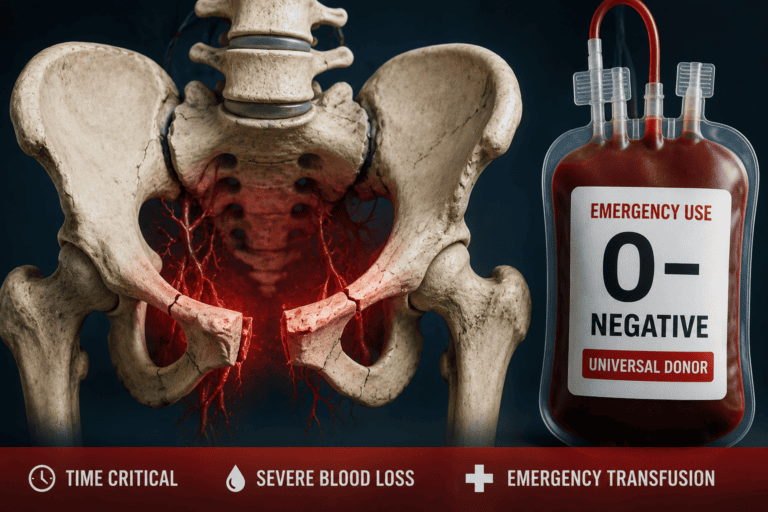
Some injuries are dangerous because of what they damage directly. An open book pelvis fracture is dangerous largely because of what it does indirectly: the catastrophic blood loss that can follow from the disruption of the rich vascular network surrounding the pelvic ring. Understanding this injury, and the emergency measures used to control it before a formal blood transfusion can even be arranged, illustrates one of the most time-critical scenarios in trauma medicine.
Dr. Sherief Elsayed, Consultant Spine Surgeon in Dubai, explains the mechanism of this injury and the specific emergency response it demands.
What Is an Open Book Pelvis Fracture?
Dr. Sherief Elsayed introduces the injury with a relatable scenario: “If you’re a cyclist, you get knocked over by a car, you sustained an open book pelvis fracture, for example, you’re going to lose a lot of blood.”
The pelvis is a ring-shaped bony structure, formed by the two hip bones joined at the front (the pubic symphysis) and connected to the sacrum at the back (the sacroiliac joints). An open book fracture, more formally called an anteroposterior compression injury, occurs when a significant force, typically a direct impact from the front or side, pushes the two halves of the pelvis apart at the front, like opening the front cover of a book. This widens the pubic symphysis and, in more severe injuries, also disrupts the posterior sacroiliac joints.
The mechanism is common in high-energy trauma, including road traffic accidents, motorcycle collisions, and pedestrian or cyclist impacts, exactly the scenario Dr. Sherief Elsayed describes.
Why This Fracture Pattern Causes Such Severe Bleeding
The pelvis contains an extensive network of blood vessels, including large venous plexuses that run along its internal surface, as well as major arteries in close proximity to the bony structures. When the pelvic ring is disrupted in an open book pattern, this vascular network is stretched and torn.
Unlike a fracture of a long bone such as the femur, where bleeding is contained to some degree by the surrounding muscle compartments, pelvic fracture bleeding occurs into the retroperitoneal space, a large potential space behind the abdominal cavity that can accommodate several litres of blood before any external sign of swelling or bruising becomes obvious. This is part of why pelvic fracture haemorrhage can be so severe and so difficult to recognise from external examination alone.
The open book pattern is particularly dangerous because the widening of the pelvic ring increases the volume of this retroperitoneal space, allowing even more blood to accumulate before the natural tamponade effect (pressure from surrounding tissue that helps limit ongoing bleeding) can take hold.
The Blood Transfusion Problem: Why O Negative Matters
Dr. Sherief Elsayed explains a critical piece of trauma logistics: “O negative blood is a universal donor. Everybody can accept O negative blood. That’s why it’s always kept in the emergency room in case patients come in with a major bleed.”
Blood group compatibility is determined by antigens present on the surface of red blood cells. The ABO system and the Rhesus (Rh) system are the two most clinically significant. O negative red blood cells lack the A, B, and Rh antigens, meaning they do not trigger an immune reaction in a recipient regardless of the recipient’s own blood group. This makes O negative blood the only type that can be safely given to any patient in an emergency, without knowing their blood group in advance.
Because O negative blood is universally compatible, hospitals maintain a stock of it specifically for exactly this scenario: a patient arriving with life-threatening haemorrhage before there is time to determine their own blood group and arrange matched blood.
Why a Full Cross-Match Cannot Happen Instantly
Dr. Sherief Elsayed clarifies why this emergency blood is necessary in the first place: “To get a blood transfusion, it’s not enough just to know that you’re A, B, or O. You need a full cross match, which can take 30, 45 minutes.”
A full cross-match is a laboratory process that goes beyond simply identifying a patient’s ABO and Rh blood group. It involves mixing a sample of the patient’s blood plasma with a sample of the donor red blood cells to confirm, in the laboratory, that no adverse reaction occurs before that donor blood is given to the patient. This process detects rarer blood group incompatibilities beyond the basic ABO and Rh systems that could still cause a dangerous transfusion reaction if missed.
This process, while essential for safety in non-emergency transfusions, takes time. In a patient who is haemorrhaging life-threatening volumes of blood from a pelvic fracture, thirty to forty-five minutes is an unacceptable delay. This is precisely the gap that O negative emergency blood fills: it can be given immediately, safely, without waiting for the cross-match process to complete, buying the time needed to prepare properly matched blood for ongoing resuscitation.
What Happens Before the Blood Arrives: Immediate Measures
While emergency blood is being accessed and definitive cross-matched blood is being prepared, several immediate measures are used to control the mechanical source of the bleeding and support the patient’s circulation.
Dr. Sherief Elsayed describes these directly: “Until then, we have other measures. We use a sheet to close the pelvis, we use external fixators to close the pelvis, and we use different fluids to keep your blood pressure up.”
Pelvic binding with a sheet:
This is one of the simplest and most immediately effective interventions in trauma medicine. A sheet, or a purpose-designed pelvic binder, is wrapped tightly around the pelvis at the level of the greater trochanters (the bony prominences at the top of the thighs) and secured firmly. This closes the open book deformity, reducing the volume of the pelvic and retroperitoneal space and applying compression that helps to reduce ongoing venous bleeding. This can be applied within seconds by paramedics at the scene or by the trauma team immediately on arrival, making it one of the fastest life-saving interventions available.
External fixation:
For patients whose pelvic instability requires more definitive stabilisation than a binder alone can provide, an external fixator can be applied. This involves inserting pins into the pelvic bones through the skin, connected to an external frame that holds the pelvis in a reduced, stable position. This is typically performed once the patient reaches the operating theatre or a dedicated resuscitation area, and it provides more durable stability than a temporary binder while definitive management is planned.
Fluid resuscitation:
Intravenous fluids, and as soon as available, blood products, are given to maintain circulating volume and blood pressure while the mechanical bleeding source is being addressed. Modern trauma resuscitation protocols favour early use of blood products over large volumes of crystalloid fluid alone, as this better replaces what has actually been lost and avoids diluting the blood’s clotting factors.
Why This Matters for Spine Surgeons
Pelvic fractures are frequently associated with concurrent spinal injuries in high-energy trauma. A Spinal Cord Surgeon in Dubai is often part of the multidisciplinary trauma team assessing these complex cases. in high-energy trauma, given the shared mechanism of significant force transmission through the axial skeleton. A Spine Trauma Surgeon in Dubai assessing a patient with a major pelvic fracture will systematically evaluate the entire spine for associated injury, recognising that the same high-energy mechanism that disrupted the pelvic ring may have also affected the lumbar spine or sacrum.
The emergency management principles described here, controlling haemorrhage first, stabilising the mechanical injury, and supporting circulation while definitive treatment is arranged, apply broadly across major trauma involving the pelvis and spine together.
What Happens After Initial Stabilisation
Once the patient is haemodynamically stable, definitive management of the pelvic fracture is planned. A Spinal Reconstruction Surgeon in Dubai will coordinate spinal assessment alongside the orthopaedic and trauma teams managing the pelvic injury. This typically involves surgical fixation with plates and screws to restore the normal anatomical alignment of the pelvic ring and provide the stability needed for healing and eventual return to weight-bearing function.
The timing of definitive surgery depends on the patient’s overall condition, associated injuries, and the specific fracture pattern. In severely unstable patients, staged management, initial temporary stabilisation followed by definitive surgery once the patient has been fully resuscitated and any life-threatening issues addressed, is the standard approach.
UAE-Specific Context
Major trauma centres across Dubai and the UAE maintain the emergency blood stocks, pelvic binding equipment, and rapid-access operating facilities necessary to manage exactly this kind of time-critical injury. The UAE’s road traffic environment, including significant numbers of pedestrian, cyclist, and motorcycle-related trauma, means that pelvic fracture management protocols are a genuinely important part of the region’s trauma care infrastructure. A Consultant Spine Surgeon in Dubai working within this trauma infrastructure understands the urgency this injury pattern demands.
Expert Summary
An open book pelvis fracture is dangerous primarily because of the massive, often concealed retroperitoneal blood loss that can follow the disruption of the pelvic vascular network. Emergency management prioritises immediate mechanical stabilisation, using a pelvic binder or external fixator to close the open book deformity and reduce ongoing bleeding, alongside fluid and blood product resuscitation, with O negative universal donor blood used as a bridge while a full cross-match for properly matched blood is completed. This combination of rapid mechanical and physiological intervention is what allows patients with this life-threatening injury pattern to survive the critical first hour after trauma.
Table of Contents
Recent Articles

Why Eight People Were Needed for One Spine Surgery in Dubai
Why Eight People Were Needed for One Spine Surgery in Dubai Does every spinal surgery require exactly eight team members? No, as Dr. Sherief Elsayed explains directly, the specific team
Three Spine Surgery Myths a Dubai Surgeon Wants You to Forget
Three Spine Surgery Myths a Dubai Surgeon Wants You to Forget Is it really safe to walk on the same day as spine surgery? Yes, for the majority of modern
Why Osteoporosis Is Called the Silent Disease in the UAE
Why Osteoporosis Is Called the Silent Disease in the UAE If osteoporosis doesn’t cause pain, how would I know if I needed a DEXA scan? Given the entirely silent nature