
What Is Minimally Invasive Spine Surgery and Who Qualifies in UAE?
Is minimally invasive spine surgery always better than open surgery?
No. It often means less blood loss and a shorter hospital stay, but long-term pain and function results are similar in many comparisons. The best approach depends on your diagnosis, anatomy and the surgeon’s experience.
Does minimally invasive mean no scar?
No. You will have one or more small scars, which are typically shorter than those from open surgery. The incisions are smaller, but the operation still addresses the same structures inside.
Can a fusion be done minimally invasively?
In suitable cases, yes. Techniques such as MIS TLIF place screws and a spacer through small incisions. Complex or multilevel cases may still need an open approach.
How soon can I go home after minimally invasive spine surgery?
For procedures like microdiscectomy, many people go home the same day or the next day. After fusion, a stay of a few days is more usual. Your surgeon will estimate this for your specific operation.
Is minimally invasive surgery safer?
It can reduce some risks, such as wound infection and blood loss, but it has its own technical challenges. Safety depends heavily on appropriate patient selection and surgeon experience, not just the size of the incision.
Will insurance cover minimally invasive spine surgery in the UAE?
Coverage varies by plan and by the procedure. Check with your insurer in advance, and ask the hospital for a pre-authorisation estimate. Honest disclosure of your medical history when applying for cover avoids problems later.
“Minimally invasive” is one of the most appealing phrases in modern surgery, and also one of the most loosely used. It suggests smaller cuts, less pain and a faster return to normal life. Sometimes that is exactly what it delivers. But it is a technique, not a guarantee, and the real question is whether it is the right approach for your particular problem.
This guide explains what minimally invasive spine surgery (MISS) actually means, what the evidence says about its benefits, and how surgeons decide who is a good candidate.
What does minimally invasive spine surgery mean?
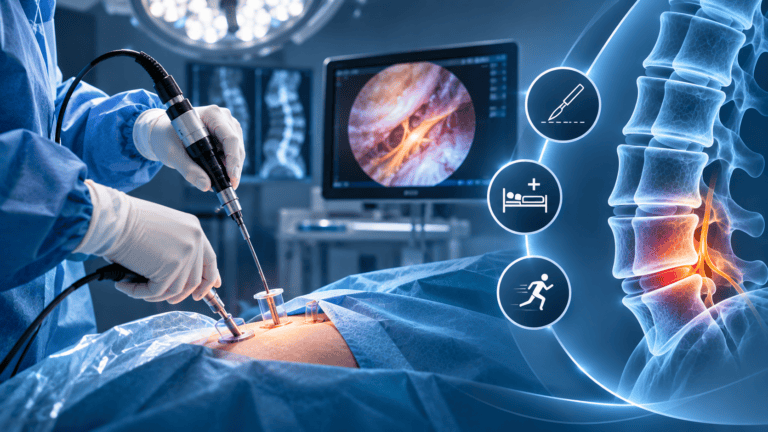
Minimally invasive spine surgery is an approach that reaches the spine through smaller incisions and with less disruption to the surrounding muscles and tissues than traditional open surgery. Instead of stripping the back muscles away from the bone through one long incision, the surgeon works through narrow tubes or small channels, often guided by a microscope, an endoscope or live X-ray imaging.
The goal of the operation is exactly the same as in open surgery. It might be to relieve pressure on a nerve, remove a herniated disc, or stabilise a segment of the spine. What changes is the route, not the aim.
Which operations can be done this way?
Not every spine operation has a minimally invasive version, but many do. Common examples include:
- Microdiscectomy, removing the part of a herniated disc pressing on a nerve, usually through a small incision using a microscope or tubular retractor
- Endoscopic discectomy, which uses a thin camera and instruments passed through a very small opening
- Decompression for spinal stenosis, widening the canal through a limited approach
- Minimally invasive fusion, such as MIS TLIF, in which screws and a spacer are placed through small incisions
- Percutaneous procedures, such as certain vertebral augmentation techniques for fractures
Larger deformity corrections and some tumour operations typically still need a more extensive approach. A TLIF Surgeon in Dubai can explain how a fusion can be performed through either a conventional or a less invasive route.
What does the research actually show?
The marketing sometimes outpaces the evidence, so it is worth being precise.
A 2025 meta-analysis published in Scientific Reports pooled studies comparing minimally invasive (tubular) and open decompression for lumbar spinal stenosis. Across the studies, minimally invasive techniques were associated with less blood loss, shorter hospital stays and lower rates of wound infection. Longer-term outcomes for pain and function were broadly similar between the two approaches in many comparisons.
An earlier systematic review in the European Spine Journal reached a similar conclusion for minimally invasive fusion (TLIF): perioperative advantages for the minimally invasive route, with comparable clinical results over time.
In plain terms, this suggests:
- The recovery in hospital is often easier with minimally invasive methods
- The long-term result depends far more on the diagnosis and surgical decision than on the incision size
- Minimally invasive surgery can be technically demanding, with a learning curve for the surgeon, which is why experience matters
It would be misleading to say that smaller is always better. A well-performed open operation can be the safer choice when the anatomy is complex.
Who typically qualifies?
Good candidates are usually people with a clearly identified structural problem that matches their symptoms, and who have either tried conservative care or have features that make surgery appropriate sooner. Typical scenarios include:
- A herniated disc causing persistent sciatica or arm pain, with matching findings on MRI, that has not improved after an adequate period of non-surgical treatment
- Spinal stenosis causing leg pain or heaviness on walking, where symptoms limit daily life
- Progressive weakness from nerve compression
- Instability or spondylolisthesis, where a vertebra has slipped forward and is causing nerve symptoms
- Select fractures or tumour-related problems, where a limited approach can stabilise or decompress the spine
What these cases share is a diagnosis that is clear, a symptom pattern that fits it, and a procedure designed for it. A Microdiscectomy Surgeon in Dubai will stress why the match between scan and symptoms is so important.
Who may not be a suitable candidate?
There are situations where a minimally invasive approach is less suitable, or where surgery of any kind is not the answer:
- Back pain alone without nerve symptoms, where the pain generator is unclear. Fusion for non-specific back pain has a mixed evidence base and is approached cautiously.
- Scans that do not match symptoms. Degenerative changes are common even in people with no pain, so imaging alone is a poor reason to operate.
- Extensive or multilevel problems that need wide exposure to correct safely
- Severe deformity or complex revision surgery, where open access gives better control
- Active infection or unstable medical conditions that need optimisation first
Importantly, a person who is not suited to a minimally invasive approach may still be an excellent candidate for a standard operation, or may simply not need an operation.
How does the assessment work?
Dr. Sherief Elsayed, Consultant Spine Surgeon in Dubai, approaches the decision in a sequence. The first questions are about the person rather than the technique: where is the pain, is there true nerve pain, how far can you walk, is there any weakness, and what has been tried so far. A physical examination follows, checking whether the findings fit the story.
Only then do the images come in. The scan should explain the symptoms. If it does, and non-surgical treatment has not helped enough, surgery is discussed along with the options for how it can be done. If the scan does not fit, the more honest advice is often to avoid surgery.
Before any operation, preparation matters. Patients benefit from understanding fitness for anaesthesia, medications, smoking and what recovery involves, topics a Spine Pre-Surgery Doctor in Dubai should walk you through.
What are the risks?
Every operation carries risk, and minimally invasive surgery is no exception. Possible complications include infection, bleeding, nerve injury, a tear in the covering of the nerves (dural tear), incomplete relief of symptoms, and the need for further surgery. Because the working corridor is smaller, visibility can be limited, and in less experienced hands a minimally invasive approach can raise the chance of difficulties such as incomplete decompression.
A Spine Surgeon in Dubai for surgical complications should discuss these possible problems with you in detail. A good surgeon talks openly about these before you consent.
What can recovery look like?
Recovery depends on the operation and the person. After a microdiscectomy, many people are walking the same day and go home within a day or so. After a fusion, hospital stays are longer and the return to heavy activity is slower because the bone needs time to unite.
Typical principles include:
- Walking from the first day, in line with your surgeon’s advice
- Avoiding heavy lifting, bending and twisting for a period
- A graded return to work depending on the demands of the job
- Physiotherapy to rebuild strength and movement
For desk-based work, return can be relatively quick. For physical jobs, expect a longer and more cautious return. A Post-Operative Spine Doctor in Dubai can give you the recovery details for your own operation.
Questions to ask your surgeon
If surgery has been recommended, these questions can help you judge whether the plan is right for you:
- What exactly is the diagnosis, and how does it match my scan?
- What happens if I do not have surgery?
- Is a minimally invasive approach suitable for me, and why or why not?
- How many of these procedures do you perform each year?
- What are your complication rates?
- What will recovery look like for my job and lifestyle?
A thoughtful answer to these questions is more valuable than any single technique.
The takeaway
Minimally invasive spine surgery is a genuinely useful option for the right patients, with advantages in blood loss, hospital stay and wound healing. It is not a shortcut, and it does not change the fundamental rule of spine surgery: the diagnosis must be right before the technique matters. If you are unsure whether surgery of any kind is appropriate, a second opinion costs little and can bring clarity.
Table of Contents
Recent Articles
Why Dubai Desk Workers Are Getting Disc Problems at a Younger Age
What Is a Nerve Root Block and How Does It Help Back Pain in UAE? Does sitting all day cause herniated discs? Not directly. Studies show a modest association between
What Is a Nerve Root Block and How Does It Help Back Pain in UAE?
What Is a Nerve Root Block and How Does It Help Back Pain in UAE? Is a nerve root block painful? Most people describe pressure and a brief sharp sting

Why Long Flights From Dubai Can Trigger Sciatica and Back Pain
Why Long Flights From Dubai Can Trigger Sciatica and Back Pain Can sitting on a plane cause a slipped disc? A long flight does not usually cause a disc to