
What Do Degenerative Disc Changes and Canal Stenosis on an MRI Actually Mean?
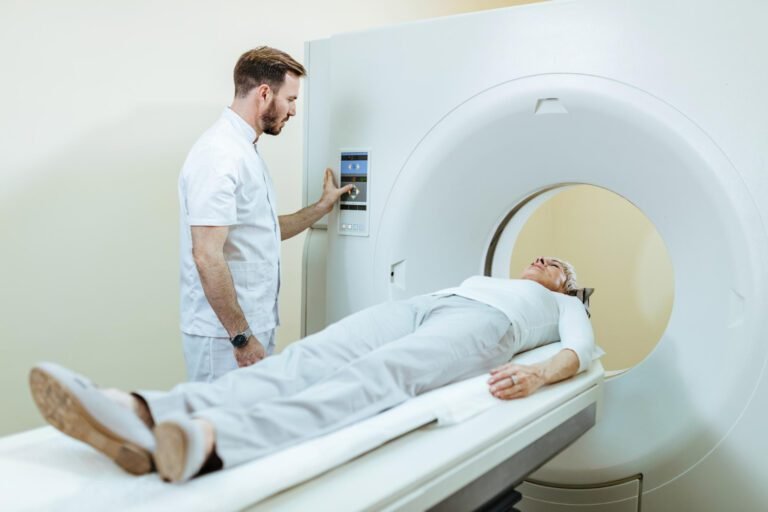
Should I be worried if my MRI report shows multiple findings?
Not necessarily. Multiple findings on a lumbar MRI are common, particularly in patients over 40, and many are incidental and age-appropriate. What matters is whether the findings correlate with your actual symptoms. A specialist assessment will clarify which findings are clinically relevant.
What is the difference between a disc bulge and a disc protrusion?
A disc bulge involves the outer disc ring expanding symmetrically beyond normal margins without rupture. A protrusion involves the inner disc material pushing focally through a weakened area of the outer ring. Protrusions are more likely to compress nearby nerves than generalised bulges.
Does canal stenosis always need surgery?
No. Mild to moderate canal stenosis without significant neurological symptoms or significant functional limitation can often be managed conservatively with physiotherapy, activity modification, and medication. Surgery is considered when conservative management has been insufficient and symptoms significantly impair quality of life.
Can Modic changes be treated?
Treatment for Modic changes focuses on managing the associated pain rather than reversing the changes. Type 1 Modic changes associated with significant discogenic pain may respond to targeted anti-inflammatory treatment or, in selected cases, minimally invasive procedures. The changes themselves do not regress reliably with any current intervention.
Do I need a follow-up MRI after my initial scan?
A follow-up MRI is warranted if your symptoms change significantly, particularly if they worsen or if new neurological features develop. Routine repeat MRI for stable symptoms without clinical change does not alter management and is generally not necessary.
Can I have my MRI report explained during a phone or video consultation?
A general discussion of MRI findings is possible remotely, but a full clinical assessment, which includes examination, history, and imaging review together, requires an in-person consultation. Remote review of reports alone, without clinical context, can be misleading.
Receiving an MRI report is a common experience for anyone with persistent back pain. What is far less common is receiving a proper explanation of what that report actually means, in clinical terms, not just anatomical ones. The language of radiology reports is precise but impersonal, and for patients without a medical background, a list of findings that includes “degenerative changes,” “Modic changes,” and “canal stenosis” can be genuinely alarming.
Dr. Sherief Elsayed, Consultant Spine Surgeon in Dubai, addresses exactly this scenario. He describes reviewing an MRI report sent to him by a patient via social media: “I see a lot of worrying findings in this report. Degenerative changes in the discs, there are Modic changes, which is inflammation within the bone itself. There is a disc protrusion causing canal stenosis, which would explain narrowing around the nerves and leg symptoms.”
And then, critically, what the patient actually needs to do: not panic, but act.
The First Problem: MRI Findings Without Clinical Context
Dr. Sherief Elsayed is clear about what he does not know from a scan report alone: “I don’t know what symptoms they have, whether it’s back pain, leg symptoms, weakness, bladder or bowel dysfunction.”
This is the core principle that runs through every serious spine assessment. An MRI report is a description of anatomy. It is not a diagnosis. It is not a pain score. It tells you what the spine looks like at one moment in time, it cannot tell you which findings are causing symptoms, whether symptoms will worsen or resolve, or what treatment is needed.
Many of the findings commonly seen on lumbar MRI are age-related and present in people with no pain at all. Understanding what each finding actually means, structurally and clinically, is the starting point for making sense of a report.
If your MRI shows disc height loss and you want to understand what can actually be done about it structurally, How Disc Height Is Restored to Relieve Nerve Compression explains the full range of conservative and surgical options available.
What Are Degenerative Disc Changes?
Degenerative disc changes refer to the gradual deterioration of the intervertebral discs that occurs with age, mechanical stress, and sometimes accelerated by injury or genetic factors.
On MRI, disc degeneration typically appears as:
- Reduced signal on T2-weighted images (the disc appears darker than a healthy, hydrated disc)
- Reduced disc height compared to adjacent levels
- Loss of the distinct boundary between the nucleus pulposus and annulus fibrosus
- Disc bulging beyond the normal margins of the disc space
What this means clinically:
Disc degeneration is normal with ageing. Studies of asymptomatic adults, people with no back pain, consistently show significant rates of disc degeneration on MRI across all age groups, increasing progressively from the 30s onward. By the age of 60, the majority of people have visible disc degeneration on MRI regardless of whether they have pain.
This does not mean degenerative changes are irrelevant, they can contribute to pain in specific circumstances. But the presence of degeneration on a scan does not confirm it is causing a patient’s symptoms. The clinical assessment determines whether the disc changes are clinically significant.
What Are Modic Changes?
Modic changes are a specific MRI finding named after the radiologist who first described them. They represent changes in the vertebral end plates, the bony surfaces at the top and bottom of each disc, and in the adjacent bone marrow. Dr. Sherief Elsayed describes them accurately: “inflammation within the bone itself.”
There are three types:
Modic Type 1: Bone marrow oedema, increased fluid signal in the bone adjacent to the disc on MRI. This represents active inflammation and is associated with the most significant pain response. Type 1 changes suggest that the disc-vertebra interface is currently inflamed and metabolically active.
Modic Type 2: Fat replacement of the bone marrow adjacent to the disc. This represents a more chronic, stable phase of the inflammatory response. It is the most common type seen on routine lumbar MRI.
Modic Type 3: Sclerosis, dense, reactive bone. Seen less commonly, it represents a late stage of the degenerative process.
What this means clinically:
Modic changes, particularly Type 1, are associated with discogenic low back pain, pain arising from the disc and vertebral end plate complex itself. They are more likely to be clinically relevant than simple disc degeneration without end plate changes. Patients with Type 1 Modic changes alongside back pain may have a specific discogenic pain component that can influence treatment selection.
What Is a Disc Protrusion?
A disc protrusion occurs when the outer fibres of the disc bulge outward beyond the normal disc margins. It is distinct from a disc extrusion (where disc material pushes through the outer ring) and a sequestration (where a fragment of disc breaks free entirely).
In the report Dr. Sherief Elsayed reviews, a disc protrusion is causing canal stenosis, narrowing around the spinal canal and its nerve contents.
What this means clinically:
A disc protrusion that is causing canal stenosis and correlates with a patient’s leg symptoms is clinically significant. This is a different finding from a disc protrusion that is present on imaging but not pressing on anything important. The same anatomical change, a protrusion, has completely different clinical implications depending on its size, direction, and whether it is compressing a nerve.
What Is Canal Stenosis?
Canal stenosis means narrowing of the spinal canal, the channel through which the spinal cord and nerve roots travel. When this channel narrows sufficiently to compress the neural structures within it, symptoms develop.
In the lumbar spine, canal stenosis typically causes:
- Leg pain, heaviness, or numbness that worsens with walking and standing
- Neurogenic claudication, the need to stop and rest, often relieved by bending forward or sitting
- Bilateral leg symptoms in severe central stenosis
- In significant cases, weakness of the legs or changes in bladder function
Canal stenosis can result from a disc protrusion (as in this patient’s report), from bone spur (osteophyte) formation, from thickening of the ligamentum flavum, from facet joint hypertrophy, or from a combination of these factors acting together.
What the Patient Actually Needs to Do
Dr. Sherief Elsayed gives clear and practical guidance: “What this patient needs to do is get the images of his MRI scan, see his local doctor who will ask him a series of questions and then depending on his symptoms, you’ll either guide him towards non-operative measures or if he has a lot of leg symptoms, for example, he may be a candidate for surgical intervention.”
This advice contains several important layers.
Get the images, not just the report. A radiology report is a written summary. The actual MRI images carry far more information and allow a clinician to assess the specific levels, the degree of compression, and the relationship between the structural findings and the anatomy of that individual patient. Always obtain the image CD or digital file, not just the report.
See a clinician who will take a history. The scan findings must be interpreted against the clinical picture. A clinician who reviews the images without asking about symptoms, examining the patient, and mapping the findings to the clinical presentation is not providing a complete assessment.
Treatment follows the symptoms, not the scan. If the patient has no neurological deficit, no significant functional limitation, and manageable pain, conservative management is the appropriate pathway, physiotherapy, activity modification, and medication as needed. The scan does not change this. A Nerve Compression Specialist in Dubai will map imaging findings against your clinical symptoms to determine what is actually generating your discomfort.
Surgical candidacy requires clinical correlation. “If he has a lot of leg symptoms, he may be a candidate for surgical intervention.” The threshold for surgery is not a scan finding, it is a combination of clinical severity, failure of appropriate conservative management, and imaging confirmation of a surgically treatable structural problem. A Spine Doctor in Dubai who follows this approach will not recommend surgery based on an MRI report alone.
Common Findings That Sound Alarming But Usually Are Not
Broad-based disc bulge: A generalised, symmetric expansion of the disc beyond its normal margins. Very common with age. Often asymptomatic. Not the same as a herniation or protrusion.
Mild foraminal narrowing: Slight reduction in the space through which the nerve root exits. Extremely common. Only clinically relevant if it correlates with specific nerve root symptoms.
Facet joint hypertrophy: Enlargement of the facet joints from degenerative arthritis. Common over 50. May contribute to stenosis if severe, but mild hypertrophy without canal compromise is typically an incidental finding.
Loss of disc height at L5/S1: The lowest lumbar disc is the most commonly degenerated in the general population. In the absence of nerve compression or significant symptoms, this is often an incidental and age-appropriate finding.
Schmorl’s nodes: Impressions of disc material into the vertebral end plates, usually from minor historical injury. Typically asymptomatic and clinically insignificant.
Red Flags: When an MRI Report Does Demand Urgent Action
Most lumbar MRI findings can be assessed in a routine outpatient setting. However, certain findings require prompt, and in some cases emergency, clinical review.
Seek urgent assessment if your MRI report shows:
- Severe canal stenosis with bilateral lower limb symptoms or bladder/bowel involvement
- Epidural abscess or discitis (infection)
- Vertebral fracture with canal compromise
- Spinal cord compression (particularly in the cervical or thoracic spine)
- Vertebral lesions suspicious for metastatic disease
These findings on imaging, particularly when combined with relevant clinical symptoms, should not wait for a routine appointment. A UAE Spine Surgeon who can correlate imaging with clinical findings is the most direct route to a clear plan. The article When Is Back Pain an Emergency? sets out clearly which presentations need same-day assessment.
Expert Summary
An MRI report full of technical findings is not a crisis. It is information, and information that becomes useful only when it is placed in the context of what the patient actually experiences. Degenerative changes are normal with age. Modic changes suggest an active inflammatory component. A disc protrusion causing canal stenosis is relevant if it correlates with clinical symptoms.
Dr. Sherief Elsayed’s advice to any patient holding an unfamiliar scan report is practical and correct: get the images, see a clinician who asks you about your symptoms, and follow the clinical findings rather than the anatomical ones. The scan shows your spine. Your symptoms, your examination, and your history tell the doctor what that spine is doing to you. Both together lead to the right treatment decision. A Back Pain Doctor in Dubai is the right specialist to provide that integrated assessment.
Table of Contents
Recent Articles
Why Eight People Were Needed for One Spine Surgery in Dubai
Why Eight People Were Needed for One Spine Surgery in Dubai Does every spinal surgery require exactly eight team members? No, as Dr. Sherief Elsayed explains directly, the specific team
Three Spine Surgery Myths a Dubai Surgeon Wants You to Forget
Three Spine Surgery Myths a Dubai Surgeon Wants You to Forget Is it really safe to walk on the same day as spine surgery? Yes, for the majority of modern
Why Osteoporosis Is Called the Silent Disease in the UAE
Why Osteoporosis Is Called the Silent Disease in the UAE If osteoporosis doesn’t cause pain, how would I know if I needed a DEXA scan? Given the entirely silent nature