
How New Spine Surgery Technology Reduces Risk for Patients in UAE
Are these technologies available at all hospitals in Dubai?
Major spinal surgical centres in Dubai have access to O-arm, navigation, and neuromonitoring technology. Not all hospitals offering spinal surgery have invested in these systems. Patients planning complex procedures, particularly deformity correction, tumour surgery, or revision procedures, should confirm that their surgical centre has this capability and that it is routinely used.
Does navigation guarantee correct screw placement?
Navigation significantly improves screw placement accuracy but does not eliminate all risk of misplacement. The accuracy of navigation depends on the quality of the reference imaging, correct registration of the navigation system, and the surgeon’s experience interpreting and using the navigation data. The O-arm’s ability to verify screw position immediately after placement provides an additional safety check.
Does intraoperative monitoring guarantee no neurological complications?
No. Monitoring provides early warning of neural compromise, allowing the team to respond before an injury becomes established. However, it cannot prevent all complications, particularly those that are very rapid in onset. The combination of good surgical technique, adequate blood pressure maintenance, and neuromonitoring is more protective than any single element alone.
Will my surgeon tell me if they plan to use these technologies?
Yes, a thorough surgeon will describe the tools and techniques they plan to use during the consent process. If this is not discussed, it is an entirely appropriate question to ask: will navigation and intraoperative monitoring be used in my procedure?
Do these technologies make surgery longer?
Setting up navigation and O-arm imaging adds some time to the overall operative setup, and intraoperative O-arm scans pause the surgery briefly while the imaging is acquired. For complex procedures where these technologies are most beneficial, the additional time is a worthwhile investment in safety and quality assurance.
Is robotic spine surgery available in Dubai?
Robotic spine surgery, which uses robotically guided arms to execute pre-planned screw trajectories, is available at some centres internationally and is beginning to be adopted in the UAE. It shares some principles with navigation but provides a higher degree of mechanical precision for screw placement. It is an evolving technology with growing evidence, but it is not yet as universally available as O-arm and navigation systems.
The operating theatre that a patient’s surgeon works in today is fundamentally different from the one their parents’ generation experienced. This is not simply a matter of incremental improvement. In spinal surgery specifically, the technologies that have emerged over the past two decades have changed what is achievable, what is safe, and what recovery looks like for patients. For patients in the UAE, where access to advanced surgical technology is available at major centres, understanding what these technologies do and why they matter is part of making an informed choice about where and how to seek surgical care.
Dr. Sherief Elsayed, Consultant Spine Surgeon in Dubai, identifies three specific technological advances that have changed his practice, and explains directly how each one improves safety and outcomes.
Technology One: The O-Arm
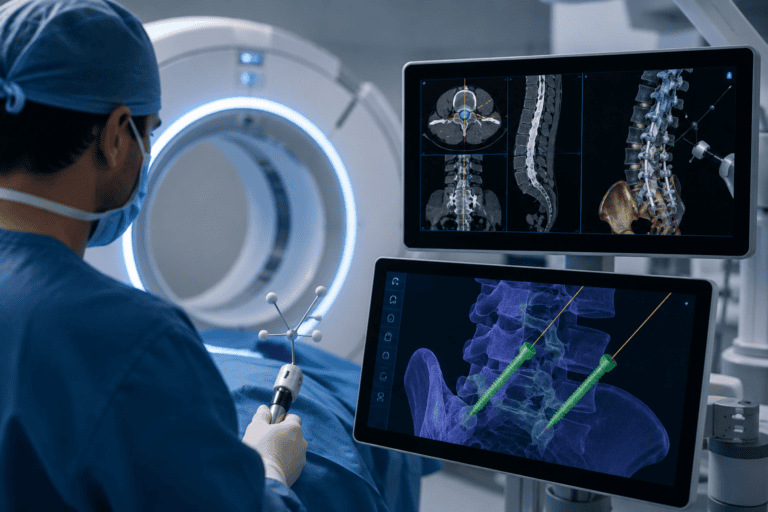
Dr. Sherief Elsayed describes the first advance: “The O-arm is essentially a CT scanner on wheels. We can do a CT scan of the spine during an operation and this allows us to check screw placement and check any residual compression and ensure that we’ve done a good job before we close the patient.”
What it is and how it works:
The O-arm is a mobile, intraoperative imaging system that can acquire CT-quality three-dimensional images of the spine while the patient is on the operating table. Unlike standard fluoroscopy (live X-ray), which provides two-dimensional images in a single plane at a time, the O-arm generates a full volumetric dataset that can be viewed in axial, sagittal, and coronal planes simultaneously.
Why this matters for pedicle screw placement:
Pedicle screws, used in spinal fusion procedures to anchor rods to the vertebrae, pass through the pedicle, a narrow bony bridge connecting the posterior elements of each vertebra to the vertebral body. The pedicle is in close proximity to the spinal canal and nerve roots. A screw that is misplaced, deviating into the spinal canal or the foramen, can compress a nerve root, produce immediate neurological deficit, and require revision surgery to correct.
With conventional fluoroscopy, screw position is confirmed in two planes, which provides reasonable but imperfect assurance of correct placement. With the O-arm, the surgeon can acquire a three-dimensional dataset immediately after screw placement and review every screw in cross-section, confirming that all screws are correctly within the pedicle and have not breached any critical boundary. Screws that are borderline can be revised before the patient is closed, rather than being discovered on post-operative CT and requiring a return to theatre.
Why this matters for checking decompression:
After a decompressive procedure, the O-arm allows the surgeon to confirm that the canal and foramina have been adequately opened before closing, rather than relying on tactile feedback and two-dimensional fluoroscopic views. Residual compression that might otherwise require a return to theatre can be identified and addressed in the same operative session.
Technology Two: Navigation
Dr. Sherief Elsayed describes the second advance: “Navigation is essentially GPS for the spine. This allows me to be precise in placing my screws.”
How spinal navigation works:
After an O-arm scan is acquired, the imaging dataset is loaded into a navigation software platform. A reference tracker is attached to a fixed bony landmark on the patient, and navigated surgical instruments are equipped with trackers that the navigation system can locate in real time, displayed against the pre-acquired or intraoperatively acquired CT dataset.
As the surgeon moves an instrument in the operative field, its precise position and trajectory are displayed simultaneously on the navigation screen, showing exactly where the instrument is relative to the patient’s individual spinal anatomy. The surgeon can plan a screw trajectory digitally, confirm it is safe, and then execute it with confidence that the instrument is following the planned path.
Why GPS matters for spine surgery:
The spinal anatomy varies significantly between patients. Pedicle dimensions, angles, and the proximity of critical structures differ at every level and in every individual. What is safe in one patient may breach the pedicle in another. Navigation allows the surgeon to account for these individual differences precisely, rather than applying standardised technique derived from population averages.
Studies comparing navigated versus non-navigated pedicle screw placement consistently demonstrate improved accuracy with navigation. A Spine Fusion Surgeon in Dubai incorporating these technologies applies them specifically in the complex cases where they provide the greatest safety benefit. consistently demonstrate improved accuracy with navigation, particularly in difficult anatomical locations, revision procedures, and deformity corrections where normal anatomical landmarks may be distorted. A Spinal Stability Surgeon in Dubai incorporating navigation into complex fusion and deformity cases reduces the risk of screw misplacement and the revision surgery that may otherwise follow.
Technology Three: Intraoperative Monitoring
Dr. Sherief Elsayed describes the third advance: “Intraoperative monitoring, which monitors the function of the spinal cord and the nerves during an operation, and if there’s any change in function, we can pick that up early and act on it.”
How intraoperative neuromonitoring works:
As discussed in the earlier article on spinal cord protection during surgery (also in this blog series), intraoperative neuromonitoring uses continuous electrical recordings from the nervous system throughout the procedure.
Somatosensory evoked potentials (SSEPs) assess the ascending sensory pathways, and motor evoked potentials (MEPs) assess the descending motor pathways. A dedicated monitoring technician and neurophysiologist observe these signals throughout the procedure, alerting the surgical team to any change that may indicate neural compromise.
Why it changes what is safely achievable:
Before intraoperative monitoring became standard, the only way to know whether the spinal cord or nerve roots had been compromised during a procedure was the Stagnara wake-up test, in which patients were briefly allowed to emerge from anaesthesia during the operation and asked to move their feet, confirming that motor pathways were intact. This was stressful for the patient, limited in what it could assess, and provided information only at the point of testing rather than continuously.
Modern intraoperative neuromonitoring is continuous, highly sensitive, and specific. A Cervical Spine Surgeon in Dubai operating near the spinal cord relies on this technology as a continuous safety net throughout the most demanding procedures. Changes in signal can precede any clinical manifestation of neural compromise by minutes, allowing the team to respond, reverse the provoking action, adjust blood pressure, or modify the surgical approach before an injury becomes established.
The practical consequence:
This technology has made ambitious deformity corrections, extensive cord-proximity decompressions, and complex tumour resections significantly safer than they were a decade ago. Procedures that previously carried a meaningful risk of neurological complication from surgery itself can now be performed with much greater confidence because the monitoring provides a continuous safety net throughout.
How These Three Technologies Work Together
The O-arm, navigation, and intraoperative monitoring are complementary rather than competing technologies. In a complex case, they are typically all active simultaneously.
Navigation uses the O-arm’s imaging dataset to provide real-time guidance. The O-arm is used periodically to verify navigation accuracy and to check surgical outcomes intraoperatively. Neuromonitoring runs throughout the entire procedure, detecting any change in neural function that imaging and navigation cannot reveal, because it measures physiological function rather than anatomical position.
Together, they provide the surgeon with a level of intraoperative information that was completely unavailable to earlier generations of spinal surgeons and that directly reduces the risk of the specific complications (misplaced screws, residual compression, undetected neurological change) that most commonly drive re-operation and poor outcomes.
The Cost-Benefit Reality for Patients
These technologies are not universally available at all surgical facilities, and they add cost and procedural complexity. For straightforward, single-level procedures in patients with normal anatomy, the benefit of full navigation and O-arm guidance may not justify the additional resources compared to standard fluoroscopic technique. Experienced surgeons achieve excellent outcomes in these cases with conventional methods.
However, for complex multilevel procedures, revision surgery, deformity correction, tumour reconstruction, and any case where anatomy is distorted or access is limited, the availability of these technologies has a meaningful impact on surgical safety and precision. Patients considering these procedures in Dubai should ask directly whether navigation and intraoperative neuromonitoring are available and routinely used at the centre where their surgery is planned. A UAE Spine Surgeon who incorporates these technologies as a matter of routine practice, rather than exceptional addition, is one whose surgical infrastructure matches the complexity of the cases being undertaken.
Expert Summary
The O-arm, spinal navigation, and intraoperative neuromonitoring represent three genuinely significant advances in spinal surgical technology that improve safety and precision for patients undergoing complex spinal procedures. The O-arm provides real-time three-dimensional imaging that confirms surgical quality before the wound is closed. Navigation provides GPS-guided precision for screw placement in individual anatomy. Neuromonitoring provides continuous real-time assessment of neural function, catching compromise before it becomes established injury. Together, they have changed what is safely achievable in spinal surgery and represent the standard of care that patients undergoing complex procedures in Dubai should expect.
Table of Contents
Recent Articles
Why Eight People Were Needed for One Spine Surgery in Dubai
Why Eight People Were Needed for One Spine Surgery in Dubai Does every spinal surgery require exactly eight team members? No, as Dr. Sherief Elsayed explains directly, the specific team
Three Spine Surgery Myths a Dubai Surgeon Wants You to Forget
Three Spine Surgery Myths a Dubai Surgeon Wants You to Forget Is it really safe to walk on the same day as spine surgery? Yes, for the majority of modern
Why Osteoporosis Is Called the Silent Disease in the UAE
Why Osteoporosis Is Called the Silent Disease in the UAE If osteoporosis doesn’t cause pain, how would I know if I needed a DEXA scan? Given the entirely silent nature