
How Disc Height Is Restored to Relieve Nerve Compression, Explained by a UAE Spine Surgeon
Can disc height be restored without surgery?
Not structurally, but symptoms caused by disc height loss can often be resolved without surgery. Conservative treatment, including physiotherapy and injections, reduces nerve irritation and allows the body to compensate. Many patients recover fully without needing to restore the disc itself
How long does recovery take after disc height restoration surgery?
This depends on the approach and the number of levels involved. Minimally invasive procedures often allow patients to return to light activity within a few weeks. More extensive fusion surgery may require three to six months before full activity is resumed. Dr. Sherief Elsayed discusses realistic recovery timelines individually with each patient.
Will a disc that has lost height always cause nerve compression?
No. Many people have disc height loss on imaging without any nerve compression or pain. Whether compression occurs depends on the anatomy of the foramen, the degree of height loss, whether bone spurs have formed, and individual variation in nerve sensitivity.
Is disc replacement better than fusion for restoring disc height?
Both achieve disc height restoration, but they serve different purposes. Disc replacement preserves movement at the treated level and may reduce stress on adjacent segments over time. Fusion provides definitive stability, particularly when there is significant spinal instability or deformity. The choice depends on the patient’s age, anatomy, and clinical situation.
Can disc height loss affect the neck as well as the lower back?
Yes. Cervical disc height loss is common, particularly at the lower levels of the neck, and can cause arm pain, hand numbness, and in more severe cases, difficulty with balance or coordination if the spinal cord is involved. The assessment and treatment principles are the same, though the specific surgical approaches differ from those used in the lumbar spine.
Is it safe to exercise with disc height loss?
In most cases, appropriate exercise is not only safe but beneficial. Strengthening the muscles that support the spine reduces mechanical load on the discs. The key is choosing the right type of exercise for your specific level of disc involvement, ideally guided by a physiotherapist working alongside your spine specialist.
Spinal discs are under constant pressure. Every hour you spend sitting at a desk, driving through Dubai traffic, or lifting at work, your discs are absorbing load. Over time, or after injury, that load takes a toll. Discs flatten, nerves lose the space they need, and pain follows. But understanding why this happens, and what can actually be done about it, puts you in a far stronger position when it comes to making decisions about your health.
Dr. Sherief Elsayed, Consultant Spine Surgeon in Dubai with over 20 years of specialist experience, explains that disc height loss is one of the most common structural findings in patients presenting with persistent back pain, leg pain, or arm pain. The key, he emphasises, is not treating the scan but treating the person.
What Is a Spinal Disc and Why Does Its Height Matter?
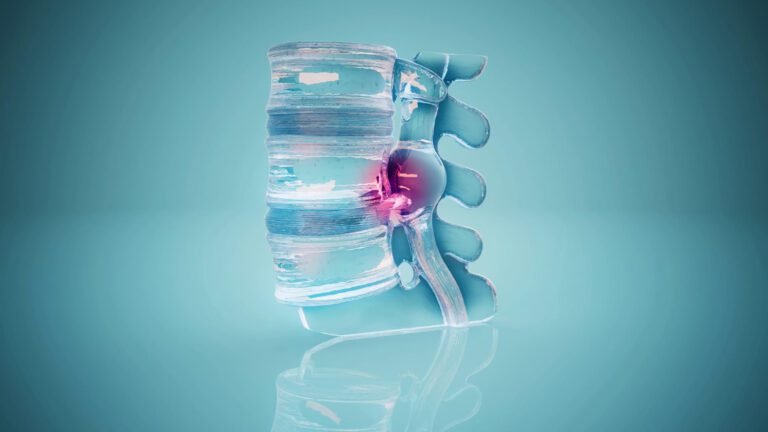
A spinal disc is a tough, fibrous cushion that sits between each pair of vertebrae in your spine. It has a firm outer ring called the annulus fibrosus and a soft, gel-like centre called the nucleus pulposus. Together, these layers act as a shock absorber and spacer, keeping the bones apart and maintaining the correct opening for spinal nerves to pass through.
When a disc loses height, that spacing narrows. The small openings on the sides of the spine, called foramina, through which nerve roots exit, become restricted. The result is nerve compression, which can produce:
- Pain, burning, or tingling that travels into the leg or arm
- Numbness in the foot, toes, hand, or fingers
- Muscle weakness in a limb
- Localised back or neck pain that worsens with certain positions
The disc height itself is not the pain generator. It is what height loss does to the surrounding structures, particularly the nerves, that causes symptoms.
What Causes a Disc to Lose Height?
Disc height loss rarely has a single cause. In most patients, it is a combination of factors that build up over time.
Common causes include:
- Age-related degeneration, where the disc gradually dries out and loses its ability to absorb load
- A disc prolapse or herniation, where the inner gel pushes outward and the disc collapses inward
- Repetitive mechanical stress from poor posture, prolonged sitting, or heavy lifting
- A previous disc injury that altered the structural integrity of the disc
- Post-surgical changes following an earlier spinal procedure
- In rare cases, infection of the disc space (discitis)
It is important to understand that disc degeneration is not always painful. Many patients have significant height loss on imaging and no symptoms at all. Dr. Sherief Elsayed consistently reminds patients that a scan finding alone is never a diagnosis. The clinical picture, the patient’s reported symptoms, and a thorough physical examination must all come together before any conclusions are drawn.
How Does a Collapsed Disc Compress a Nerve?
The mechanism is largely mechanical. The spine relies on precise spacing to protect its nerves. When a disc collapses:
- The foramen narrows, reducing the space available for the nerve root
- The vertebrae may shift slightly, altering spinal alignment
- Bone spurs can develop in response to instability, further crowding the nerve space
- Surrounding ligaments may thicken and buckle inward
This combination is what produces the characteristic symptoms of nerve compression. A Spine Doctor in Dubai for disc-related nerve compression will map symptoms carefully against imaging findings to confirm which nerve is involved and at which level of the spine.
Can the Body Restore Disc Height on Its Own?
In short, no. Once a disc loses structural height, it does not regenerate. However, this does not mean the symptoms are permanent.
Dr. Sherief Elsayed explains it plainly: “If the patient has no neurological deficit, no weakness, bladder or bowel dysfunction, by and large it just goes away. Doesn’t mean you’re going to have leg pain forever. Most of the time the body throws white cells at the prolapse, they eat their way through it, your leg pain disappears. It’s not ever going to look normal on the MRI scan, but that doesn’t mean it’s going to continue to cause symptoms.”
This is an important distinction. The disc may remain flattened on imaging long after the pain has resolved. The goal of treatment is not always to restore the disc structurally, but to relieve the nerve compression and allow function to return.
What Are the Treatment Options for Disc Height Loss and Nerve Compression?
Treatment is chosen based on the severity of symptoms, how long they have been present, whether there is neurological involvement, and the patient’s overall health and lifestyle.
Conservative Treatment: The First Step in Almost Every Case
Unless there are urgent red flags, conservative management is always the starting point.
Conservative options include:
- Physiotherapy targeting posture correction, core stability, and spinal unloading
- Anti-inflammatory medication to reduce swelling around compressed nerves
- Activity modification to reduce mechanical load on the affected disc
- Epidural steroid injections to calm nerve irritation and support recovery
These approaches do not restore disc height structurally, but they address the inflammation and muscle imbalance that amplify nerve compression. The majority of patients improve meaningfully with conservative care alone.
Minimally Invasive Procedures
When conservative management provides insufficient relief, minimally invasive options can offer targeted help.
- Intradiscal procedures: Reduce pressure within the disc, which may allow a small degree of height recovery and reduce bulging onto nearby nerves
- Targeted nerve root injections: Useful for both diagnosis and pain relief when a specific nerve level is suspected
Surgical Options to Restore Disc Height
When conservative and minimally invasive methods have not been adequate, and imaging confirms structural collapse with clear nerve involvement, surgery to restore disc height becomes appropriate.
Anterior Cervical Discectomy and Fusion (ACDF)
Used for the neck, this procedure removes the collapsed disc, decompresses the affected nerve root, and inserts a structural spacer (cage) to restore correct height between the vertebrae. A small titanium plate is added to stabilise the segment while it fuses.
Lumbar Interbody Fusion (TLIF, PLIF, ALIF, XLIF)
For the lower back, various fusion approaches achieve the same result through different entry points. The collapsed disc is removed, the nerve is decompressed, a structural cage restores disc height, and screws and rods stabilise the segment.
Disc Replacement (Arthroplasty)
In carefully selected younger patients or at levels where motion preservation is important, a prosthetic disc implant replaces the degenerated disc. This restores height while maintaining movement at that spinal level, unlike fusion which locks the segment permanently.
Anterior Lumbar Interbody Fusion (ALIF): What the Surgery Actually Involves
The ALIF approach is one of the most effective ways to restore lumbar disc height. Dr. Sherief Elsayed describes the procedure directly: “I make an incision and move the rectus muscle out of the way. Next I use my fingers to carefully peel away the intestines and the ureter, moving them to one side to expose the spine. I then use a complex retractor to hold large blood vessels out of the way while I do my work. Next I cut the disc out from the front, prepare the end plate, making sure the bone is nice and fresh, before I put my ALIF cage in place. The end result is a beautifully restored disc height, which allows the nerve to escape without being compressed, and the patient’s back pain and leg symptoms are markedly improved.”
This approach, accessing the spine from the front of the abdomen, allows for placement of a larger cage than posterior approaches permit, achieving superior height restoration and indirect nerve decompression.
Indirect Decompression via Lateral Approaches
Modern lateral techniques place a large structural cage into the disc space through a flank incision, significantly restoring disc height and indirectly opening up the foramen without directly touching the nerve. This is particularly useful in multilevel lumbar degenerative disc disease.
If you are exploring this topic further, When Does a Disc Bulge Become a Problem? covers the progression from disc changes to clinically significant compression in detail.
What Does Dr. Sherief Elsayed Assess Before Recommending Restoration?
Dr. Sherief Elsayed’s approach goes well beyond reviewing a scan. Before recommending any intervention, his assessment includes:
- A thorough history of symptom onset, duration, and behaviour
- A detailed neurological examination to map weakness, reflex changes, and sensory loss
- Assessment of how symptoms respond to posture, movement, and rest
- Review of imaging in the context of the clinical findings, not in isolation
- Discussion of the patient’s lifestyle, work demands, and personal goals
This root-cause approach ensures that any intervention, conservative or surgical, is targeted at the right problem for the right patient.
When Is Surgery Urgent?
Most disc height loss and nerve compression can be managed without emergency surgery. However, certain signs require prompt assessment.
Seek urgent review if you experience:
- Loss of bladder or bowel control
- Progressive weakness in a leg or arm that is worsening over hours or days
- Numbness in the groin or inner thighs (saddle anaesthesia)
- Severe pain following a significant fall or accident
- Symptoms in both legs simultaneously
These may indicate cauda equina syndrome or acute spinal cord compression, both of which require urgent surgical evaluation. They are uncommon, but they must not be missed. The article When Is Back Pain an Emergency? covers these red flags in full.
Real-World Scenarios: Disc Height Loss in UAE Patients
Office workers: Prolonged desk sitting in a flexed posture increases intradiscal pressure and accelerates disc dehydration. Combined with a sedentary lifestyle, this is one of the most common contributors to early lumbar disc height loss in younger working adults in the UAE.
Drivers: Long commutes and frequent driving in fixed positions load the lumbar spine repetitively. Vibration from the road surface adds mechanical stress that healthy discs can absorb but degenerated ones cannot.
Manual workers: Heavy and repetitive lifting with poor technique places enormous compressive and rotational forces on lumbar discs. Height loss at L4/5 and L5/S1 is particularly common in this group.
Post-surgical patients: Patients who have had previous spinal surgery may experience disc height loss at adjacent levels over time. Careful monitoring and early physiotherapy can help manage this.
Expert Summary: Treating the Person, Not the Scan
Disc height loss is a structural finding. It explains why nerve compression occurs, but it does not determine how severe the symptoms will be or how long they will last. Many patients improve significantly without restoring the disc at all. For those who do need surgical intervention, the goal is targeted decompression of the affected nerve, with disc height restoration as the means to achieve that, not the end in itself.
Dr. Sherief Elsayed’s philosophy is consistent across every stage of assessment and treatment: start with a correct diagnosis, try conservative care where it is appropriate, and escalate only when genuinely needed. Surgery is never the first answer, but when it is indicated, modern techniques can achieve excellent outcomes with far less disruption than traditional open approaches.
If you are dealing with persistent back pain, leg pain, or neurological symptoms and have been told you have disc height loss, a proper clinical assessment is the most valuable step you can take. To book a consultation with a Consultant Spine Surgeon in Dubai start with a full specialist review. A scan is not a sentence, and a diagnosis is not a treatment plan until a specialist has reviewed both together.
Table of Contents
Recent Articles

Why Eight People Were Needed for One Spine Surgery in Dubai
Why Eight People Were Needed for One Spine Surgery in Dubai Does every spinal surgery require exactly eight team members? No, as Dr. Sherief Elsayed explains directly, the specific team

Three Spine Surgery Myths a Dubai Surgeon Wants You to Forget
Three Spine Surgery Myths a Dubai Surgeon Wants You to Forget Is it really safe to walk on the same day as spine surgery? Yes, for the majority of modern
Why Osteoporosis Is Called the Silent Disease in the UAE
Why Osteoporosis Is Called the Silent Disease in the UAE If osteoporosis doesn’t cause pain, how would I know if I needed a DEXA scan? Given the entirely silent nature