
Dr. Sherief Elsayed on Why AI Is a Useful Guide but Not a Replacement for Your Doctor
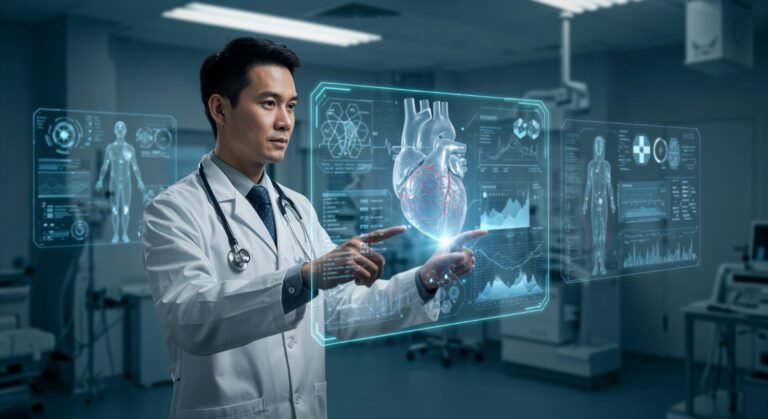
Can AI diagnose my back pain without me seeing a doctor?
AI tools can provide information about conditions that match your symptoms, but they cannot examine you, correlate your imaging with your clinical findings, or weigh the full context of your individual situation. For significant or progressive back pain, a clinical assessment with a specialist remains essential.
Should I trust an AI chatbot's medical advice?
AI health chatbots can provide useful general information and help you prepare for a consultation. They should not be trusted as a final authority on diagnosis or treatment, and their outputs should always be discussed with a qualified clinician before acting on them.
Is AI being used in Dr. Sherief Elsayed's practice?
Dr. Sherief Elsayed is actively involved in developing AI tools for medicine and integrates AI-assisted documentation and analytical tools into his practice where they enhance patient care. All clinical decisions remain with the clinician.
Will AI eventually replace spine surgeons?
It is unlikely that AI will replace surgeons in the foreseeable future for the manual, judgement-intensive elements of surgical care. It will continue to enhance surgical planning, navigation, and outcome prediction. The surgical craft and the clinical relationship between surgeon and patient are not replicable by current or near-future AI.
How can I use AI responsibly to manage my spine health?
Use AI tools to inform yourself, to understand your diagnosis and treatment options, and to prepare better questions for your specialist. Use them to supplement, not replace, the clinical assessment and advice of your treating physician.
Is there a risk that AI could lead to over-diagnosis in spine conditions?
Yes, this is a genuine concern. AI screening tools that are overly sensitive may flag age-related changes as pathological findings, prompting unnecessary anxiety, investigation, and potentially treatment. This reinforces the importance of AI outputs being interpreted within a clinical context by an experienced clinician.
Artificial intelligence is changing medicine at a pace that few expected even five years ago. It is present in radiology, pathology, drug discovery, clinical documentation, and increasingly in the direct interface between patients and the healthcare system. The question that follows every advance is the same one: will AI replace doctors?
Dr. Sherief Elsayed, Consultant Spine Surgeon in Dubai and someone who is actively involved in developing AI tools for medicine, has a clear and measured answer.
What Dr. Sherief Elsayed Actually Thinks About AI in Medicine
His position is not the dismissive scepticism of someone threatened by new technology. Nor is it the uncritical enthusiasm of someone selling a product. It is the considered view of a clinician who works with AI and understands both what it can do well and where it falls short.
“I’m certainly one of the guys developing AI for medicine. I think AI is very useful. If you had come to see me as a patient and AI is in the background taking notes, I can focus on you and not look at my computer screen, not be typing. That’s really useful. You should see it as a guide. It is still not a doctor. I don’t think it can be 100% trusted in anything just yet.”
This framing, AI as a guide, not a doctor, is the most clinically honest position currently available.
Where AI Is Genuinely Useful in Medicine Right Now
Clinical Documentation
One of the most immediate and impactful applications of AI in clinical practice is exactly what Dr. Sherief Elsayed describes: freeing the clinician from the administrative burden of documentation so they can focus on the patient in front of them.
A surgeon or physician who spends a consultation typing notes or looking at a computer screen is not fully present with their patient. The eye contact, the observation of how the patient holds themselves, the subtle changes in their expression when describing certain symptoms, these are lost when attention is divided between the patient and a keyboard. AI ambient documentation tools listen to the clinical encounter and generate a structured note automatically, allowing the clinician to remain fully engaged with the patient throughout.
For patients, this is directly beneficial. A doctor who is listening to you, examining you, and thinking about your problem produces a better clinical outcome than one who is half-occupied with documentation.
Medical Imaging Analysis
AI systems trained on large medical imaging datasets can detect patterns in MRI scans, X-rays, and CT scans with accuracy that matches or exceeds experienced radiologists for specific tasks. In spine radiology specifically:
- AI can flag significant findings such as cord compression, large disc herniations, or vertebral fractures
- It can measure canal dimensions and disc heights with precision that is consistent and reproducible
- It can screen large volumes of imaging for priority findings, ensuring that urgent cases are reviewed promptly
The key word is “flag.” AI identifies candidate findings for human review. The clinical decision about what those findings mean for a specific patient, in the context of their symptoms, their history, and their examination, remains with the clinician.
Pattern Recognition in Diagnosis
AI models trained on large clinical datasets can assist with differential diagnosis generation, flagging conditions that match a patient’s symptom profile and prompting consideration of diagnoses that might otherwise be missed. This is particularly useful in rare conditions or in settings where specialist expertise is not immediately available.
Triage and Risk Stratification
In emergency and primary care settings, AI can assist with triage, helping to identify patients who need urgent review versus those who can be managed in routine time. For spine patients, this could mean flagging red flags for cauda equina syndrome or spinal cord compression in patient-reported symptom data before they even arrive at the clinic.
Where AI Falls Short in Clinical Medicine
Dr. Sherief Elsayed’s caution, “I don’t think it can be 100% trusted in anything just yet”, reflects genuine and specific limitations in current AI systems.
It Cannot Examine a Patient
Clinical examination is irreplaceable. A Spine Doctor in Dubai applies physical examination findings that no AI tool can replicate remotely. The way a patient walks into the room, the way they hold their spine, the specific distribution of their pain on palpation, the subtlety of a slight foot drop on walking, the firmness of an abdominal mass, the asymmetry of a reflex, none of these can be captured by an AI system that interacts through text or images.
For spine surgery in particular, the correlation between imaging findings and clinical examination is the core of accurate diagnosis. An MRI can show a disc herniation at L4/5. Whether that herniation is causing the patient’s pain requires a clinician to examine the patient, reproduce the symptoms, and confirm the neurological level. AI cannot do this.
It Can Hallucinate
Current large language model AI systems are capable of generating plausible-sounding but factually incorrect information. In medicine, this is not a minor inconvenience, it is a patient safety issue. An AI that confidently states incorrect drug dosages, incorrect diagnostic criteria, or incorrect contraindications can cause direct harm if its output is trusted without verification.
This is not a solved problem. It is an active area of research and one of the most important reasons why AI outputs in clinical contexts must always be reviewed by a qualified human.
It Lacks Clinical Intuition Developed Through Experience
Experienced clinicians develop pattern recognition that goes beyond what is codified in guidelines or captured in training datasets. The sixth sense that something about this patient’s story does not add up, or the recognition that a presentation that looks straightforward is actually atypical, comes from years of seeing patients and reflects a depth of contextual learning that current AI does not replicate.
It Cannot Account for the Whole Person
For patients who want to understand what the full surgical pathway looks like – from the decision to operate through to recovery – From Diagnosis to Operating Table: How Discectomy Surgery Works in the UAE walks through every step of the process in detail.
Medical decisions are not made in isolation from the patient’s life. A decision about whether to recommend surgery for a 55-year-old airline pilot is different from the same imaging findings in a 55-year-old retired teacher. Work demands, family circumstances, personal values, risk tolerance, prior experiences, all of these legitimately influence clinical decisions. An AI system interacting with scan data and symptom scores cannot weigh these factors the way a clinician who knows the patient can.
How Should Patients Use AI Health Tools?
Many patients now use AI health tools before, after, and sometimes instead of consulting a doctor. This is a reality that medicine needs to engage with honestly rather than dismissively.
AI tools are useful for patients to:
- Understand medical terminology in reports and letters
- Research the meaning of a diagnosis or treatment option
- Prepare questions to ask at a consultation
- Get a general overview of what a condition involves
- Identify whether their symptoms warrant seeking medical attention
AI tools are not appropriate for patients to:
- Make a final diagnosis based on their own symptom input
- Make decisions about medication, dosing, or stopping prescribed treatments
- Decide whether to proceed with or decline recommended surgery
- Interpret their own MRI report without clinical context
- Replace a consultation with a specialist for significant or progressive symptoms
The value of AI in patient-facing applications is in empowering patients to engage more actively and more informedly with their healthcare. The risk is when it substitutes for the clinical assessment that properly interpreting symptoms and imaging requires. A UAE Spine Surgeon who uses AI tools as part of their practice does so in a way that augments their clinical judgement, not replaces it.
The Future of AI in Spine Surgery Specifically
AI has several emerging applications in the surgical field that are moving from research to clinical adoption.
Surgical planning: AI can assist with pre-operative planning for complex spinal procedures, calculating optimal implant sizing, screw trajectory planning in deformity surgery, and predicting outcomes based on patient anatomy and prior surgical data.
Intraoperative navigation: AI-enhanced imaging and navigation systems assist with real-time surgical guidance, improving implant placement accuracy and reducing the risk of misplacement.
Outcome prediction: Machine learning models trained on large outcome datasets can predict, with increasing accuracy, which patients are likely to benefit most from specific interventions, helping to refine patient selection and set realistic expectations.
Post-operative monitoring: AI-powered remote monitoring tools can flag early warning signs of complications, fever patterns, wound changes, neurological deterioration, in patients recovering at home, allowing earlier intervention.
These applications all share the same structure: AI enhances, supports, and assists the clinician, it does not replace the decision-making, the examination, or the surgeon’s hands. As a Back Pain Doctor in Dubai involved in AI development, Dr. Sherief Elsayed is positioned to integrate these advances thoughtfully as they mature.
Expert Summary
AI is changing medicine meaningfully and for the better in specific, well-defined applications. It is not changing the fundamental nature of what a good clinician does: listen carefully, examine thoroughly, reason systematically, and treat the person in front of them, not just the data about them.
Dr. Sherief Elsayed’s position is that of a clinician who both embraces the technology and maintains a clear-eyed view of its current limits. As a Dubai Spine Surgeon developing AI tools for medicine, his perspective is grounded in real clinical practice. AI as a guide is valuable. AI as a replacement for clinical judgement is not ready, and may never be appropriate for the human dimensions of medicine that cannot be reduced to data. The doctor-patient relationship, built on trust, presence, and the application of accumulated clinical wisdom, remains the foundation of good care.
Table of Contents
Recent Articles

Why Eight People Were Needed for One Spine Surgery in Dubai
Why Eight People Were Needed for One Spine Surgery in Dubai Does every spinal surgery require exactly eight team members? No, as Dr. Sherief Elsayed explains directly, the specific team
Three Spine Surgery Myths a Dubai Surgeon Wants You to Forget
Three Spine Surgery Myths a Dubai Surgeon Wants You to Forget Is it really safe to walk on the same day as spine surgery? Yes, for the majority of modern
Why Osteoporosis Is Called the Silent Disease in the UAE
Why Osteoporosis Is Called the Silent Disease in the UAE If osteoporosis doesn’t cause pain, how would I know if I needed a DEXA scan? Given the entirely silent nature