
What Is a Nerve Root Block and How Does It Help Back Pain in UAE?
Is a nerve root block painful?
Most people describe pressure and a brief sharp sting from the local anaesthetic, followed by a dull ache or reproduction of their usual leg pain as the medication spreads. The procedure itself is short, and discomfort is usually modest.
How long does it take to work?
The local anaesthetic works within minutes but wears off in hours. The steroid usually takes two to five days to reach full effect. It is common to feel relief, then some return of pain, then gradual improvement.
How long does the relief last?
It varies widely. Some people have relief for weeks or months, others for less. The injection treats inflammation rather than the structural cause, so its main value is giving time for recovery.
Is a nerve root block the same as an epidural?
They are related but not identical. An epidural places medication in the space around the spinal sac, while a selective nerve root block targets a single nerve as it exits. Both can use similar medicines and imaging guidance.
Can a nerve root block help me avoid surgery?
In some people, yes, particularly when it settles nerve irritation enough for natural recovery to continue. It does not remove a herniated disc or widen a narrow canal, so it will not suit everyone.
How many injections can I have?
There is no fixed number, but repeated steroid exposure carries cumulative effects. Doctors usually limit the number and space them out, and avoid repeating if there was no benefit.
When leg or arm pain refuses to settle with tablets and physiotherapy, the next question is often whether an injection could help. A nerve root block is one of the most commonly discussed options, and also one of the most misunderstood. It is neither a cure nor a gimmick. It is a targeted tool, and it works best when used for the right problem.
This guide explains what the procedure is, what it can and cannot do, what the research says, and what to expect on the day.
What is a nerve root block?
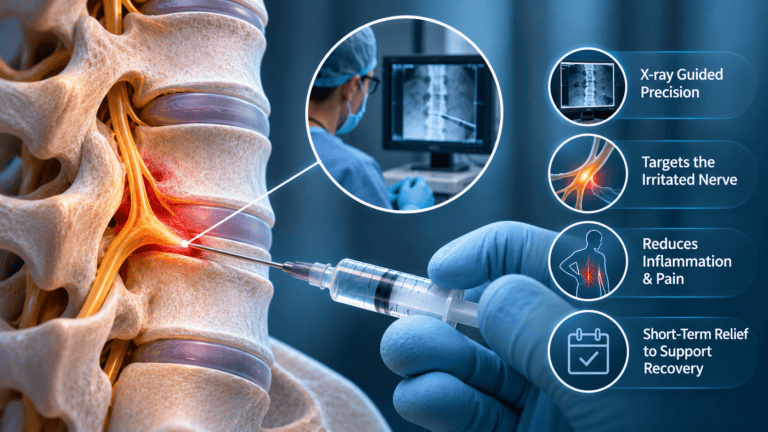
A nerve root block, also called a selective nerve root injection, is a procedure in which a small amount of local anaesthetic, often combined with a corticosteroid, is injected next to a spinal nerve root. The nerve root is the part of the nerve that leaves the spinal canal through a small opening on each side of the spine.
The injection is guided by X-ray (fluoroscopy), and sometimes CT, so that the needle can be placed accurately beside the nerve. A small amount of contrast dye is often used to confirm the position before the medication is delivered.
The procedure serves two purposes:
- Diagnostic: If numbing a specific nerve root removes your leg pain, it supports the conclusion that the nerve is the pain source
- Therapeutic: The steroid reduces inflammation around an irritated nerve, which can ease pain and give a window for recovery
When is it used?
Nerve root blocks are used mainly for radicular pain, meaning pain that travels along the path of a nerve. Typical examples include:
- Sciatica from a disc herniation pressing on a lumbar or sacral nerve root
- Cervical radiculopathy, with pain shooting from the neck into the arm
- Foraminal stenosis, where the opening for the nerve is narrowed by bone spurs or disc material
- Unclear cases where scans show several possible sources and the surgeon needs to identify the culprit
- Pain after previous surgery, when it is unclear which nerve is involved
It is not a treatment for general back pain without nerve involvement. For pain that arises from the small joints at the back of the spine, other injections are used, and a different assessment applies.
How does it work?
A disc herniation or narrowed opening does two things to a nerve root: it presses on it mechanically and it irritates it chemically through inflammation. The steroid in a nerve root block acts on the inflammatory side. By calming the nerve, it can reduce pain, and in many cases that relief allows rehabilitation to progress.
The local anaesthetic gives rapid but short-lived numbness, which is why you may feel relief within minutes and then notice the pain return later the same day. The steroid effect usually builds over two to five days. This difference is worth knowing, because an early return of pain on the day of the injection does not mean it has failed.
What does the research show?
The evidence is more modest than patients sometimes expect, which is a reason to approach injections with realistic goals.
A Cochrane review published in 2020 examined epidural corticosteroid injections for sciatica and found that, compared with placebo, injections gave a small reduction in leg pain in the short term, with a mean difference of about 5 points on a 100-point scale, and a small improvement in disability of around 4 points. The effect was small to moderate, and benefit beyond the short term was less clear. In plain terms, injections can provide temporary relief that helps some people through a painful phase, but they do not reliably change the long-term course.
For many people, though, short-term relief matters. A few weeks of reduced pain can allow better sleep, activity and rehabilitation while the natural healing of a disc herniation proceeds. For others, an injection that fails to help is useful information too, because it can guide decisions about surgery.
Patient selection matters a great deal. Injections work best when the symptoms, examination and scan all point to the same nerve.
What happens on the day?
Procedures vary slightly, but the sequence is usually similar:
- Consent and preparation. You will discuss the benefits and risks, and be asked about allergies, blood-thinning medicines, diabetes and pregnancy.
- Positioning. You lie on your front, or sometimes your side, on an X-ray table.
- Skin cleaning and local anaesthetic. The area is cleaned and numbed.
- Needle placement. Using live X-ray, the needle is guided to the nerve root. Contrast dye confirms the position.
- Injection. The medication is delivered slowly. You may feel pressure or a brief reproduction of your usual pain, which is a helpful clue.
- Recovery. You rest briefly and are observed before going home, usually the same day.
The whole procedure typically takes around 15 to 30 minutes. As the provider explains during the procedure, speaking you through each step is part of good practice: telling you when you will feel a sharp scratch or pressure means there are no surprises.
A Spinal Injection Specialist in Dubai can explain the types of injections used for spinal pain in more detail.
What are the risks and side effects?
Most people tolerate the procedure well, but it is not risk-free. Possible effects include:
- Temporary soreness at the injection site
- A short-term increase in pain before the steroid takes effect
- Facial flushing, sleeplessness or mood changes for a day or two after steroid
- Raised blood sugar in people with diabetes
- Infection or bleeding, which are uncommon
- Temporary numbness or weakness from the local anaesthetic
- Allergic reaction to the contrast dye, anaesthetic or steroid
Rare but serious neurological complications have been reported with injections near the spine, including spinal cord or brain injury and stroke, mainly associated with injections in the neck. The United States Food and Drug Administration has issued a warning about these rare events with epidural steroid injections. This is why the procedure should be performed by an experienced clinician, with imaging guidance and careful technique.
Repeated steroid exposure also carries cumulative effects, such as bone thinning, so injections are used sparingly rather than as a regular routine. For people at risk of osteoporosis, this is another reason to consider the overall picture, which an Osteoporosis Spine Specialist in Dubai will consider.
Who should avoid it, or take extra care?
Tell your doctor in advance if you:
- Take blood thinners such as warfarin, rivaroxaban, apixaban or clopidogrel
- Have an active infection or a fever
- Are pregnant or may be pregnant
- Have poorly controlled diabetes
- Have allergies to contrast dye, local anaesthetics or steroids
- Have had previous reactions to injections
Blood thinners often need to be stopped for a period before the procedure, but only under the guidance of the doctor who prescribed them. Never stop them on your own.
How does it fit into a treatment plan?
An injection is rarely a standalone treatment. It is one step in a sequence that typically looks like this:
- Education and reassurance, plus activity and physiotherapy
- Medication to settle nerve irritation, used carefully
- A nerve root block if pain remains significant despite those measures
- Reassessment, and surgical discussion if pain is severe, persistent or accompanied by weakness
Dr. Sherief Elsayed, Consultant Spine Surgeon in Dubai, describes the broader aim for treatments around the nerve as physiotherapy, injections around the nerve, or surgery to open up the space, chosen according to the cause and severity. When the injection gives clear relief, it helps confirm the diagnosis. When it does not, it prompts a rethink rather than repetition.
Which combination suits each condition is something a Radiculopathy Doctor in Dubai will work out with you. A Spine Pain Management Doctor in Dubai can describe the wider range of non-surgical options.
What results can you realistically expect?
Responses vary. Broadly:
- Some people get significant relief lasting weeks to months, enough for the nerve to settle and rehabilitation to progress
- Some people get partial or short-lived relief
- Some people get no meaningful benefit, which suggests the pain source or mechanism may be different
If the first injection helps, a second is sometimes considered, but repeated injections without lasting benefit are not advisable. The aim is a bridge to recovery, not indefinite pain control.
How to prepare and recover
- Arrange for someone to accompany you home, particularly if you receive sedation
- Eat normally unless told otherwise
- Continue regular medications unless instructed
- Rest for the remainder of the day, and return to normal activity gradually the next day
- Keep a pain diary for the first week, which helps your doctor judge the effect
- Contact your clinic urgently if you develop fever, severe worsening pain, new weakness or loss of bladder or bowel control
For persistent symptoms, a consultation can review whether the injection helped and what comes next. You can arrange a visit with a Spine Surgeon for Nerve Pain in Dubai to discuss your options.
Table of Contents
Recent Articles

Why Dubai Desk Workers Are Getting Disc Problems at a Younger Age
What Is a Nerve Root Block and How Does It Help Back Pain in UAE? Does sitting all day cause herniated discs? Not directly. Studies show a modest association between

What Is a Nerve Root Block and How Does It Help Back Pain in UAE?
What Is a Nerve Root Block and How Does It Help Back Pain in UAE? Is a nerve root block painful? Most people describe pressure and a brief sharp sting

Why Long Flights From Dubai Can Trigger Sciatica and Back Pain
Why Long Flights From Dubai Can Trigger Sciatica and Back Pain Can sitting on a plane cause a slipped disc? A long flight does not usually cause a disc to