
Why Long Flights From Dubai Can Trigger Sciatica and Back Pain
Can sitting on a plane cause a slipped disc?
A long flight does not usually cause a disc to slip on its own, but prolonged sitting can aggravate a disc that is already vulnerable. Lifting or twisting with heavy luggage is a more common trigger.
How do I tell sciatica from a blood clot?
Sciatica typically causes shooting or tingling pain from the buttock down the leg, often with back pain. A clot usually causes a swollen, warm, tender calf or thigh. If you are unsure, or have breathlessness or chest pain, seek urgent medical care.
How often should I move on a long flight?
Aim to stand and walk every one to two hours where conditions allow, and move your legs and ankles in between. Even small movements help circulation and reduce stiffness.
Does a lumbar cushion really help?
For many people, yes. Supporting the natural curve of the lower back reduces slumping and may improve comfort. Rolled towels or small cushions work as well as specialised products.
Is it safe to fly with a herniated disc?
Most people can fly with a disc problem, but comfort varies. Plan for movement, lumbar support and sensible luggage handling. If you have severe or worsening symptoms, discuss travel with your doctor first.
Should I take painkillers before a flight?
Some people find this helpful, but medication should be appropriate for your health and used as advised by a doctor or pharmacist. Do not rely on medicines instead of moving regularly.
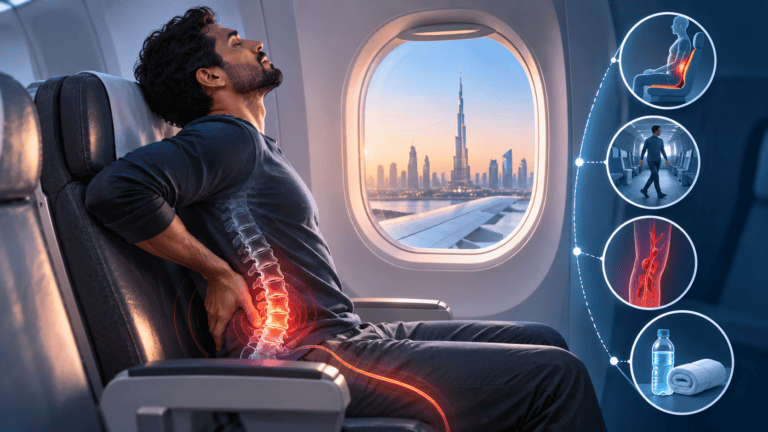
Dubai is a departure point for some of the longest flights in the world. A route to London, New York, Sydney or Los Angeles can mean eight to sixteen hours in a seat that was designed more for efficiency than for your lumbar spine. It is no surprise that many people land with a stiff, aching back, and some with leg pain that was not there when they boarded.
This article looks at why flights can aggravate the spine, what the evidence does and does not show, and practical ways to travel more comfortably. It also covers one point that matters more than back pain itself: leg symptoms after a flight are not always sciatica.
Does flying actually cause back pain or sciatica?
The honest answer is that sitting for long periods can provoke back pain in people who are susceptible, but there is limited high-quality evidence showing that flying itself causes sciatica. What we do know is that the factors involved in a long flight, namely prolonged static sitting, a fixed posture and reduced movement, are all well known to aggravate an existing spinal problem.
Sciatica refers to leg pain caused by irritation or compression of a spinal nerve, usually originating from the lower back. If you already have a disc bulge or narrowing of the nerve canal that has been quiet, a long period of sitting can be enough to bring it to life. For someone with no underlying problem, a stiff and sore back after a flight is common and usually settles within a day or two.
Why do long flights stress the spine?
Several things combine on a long-haul flight:
Prolonged sitting
When you sit, the lumbar curve flattens and pressure inside the discs rises compared with standing. Sitting for hours without a break loads the same structures continually. Muscles that normally share the work become fatigued, and joints stiffen.
Seat design and posture
Economy seats often provide little lumbar support. Many people slump forward, which flexes the lower spine, or stretch awkwardly to reach a screen or a bag under the seat. Overhead lockers also create a lifting risk for the unwary: twisting while lifting a heavy carry-on bag is a classic way to strain the back.
Limited movement
On a long flight you may stay in one position for hours, partly because you are strapped in and partly because the aisle is busy. Staying still reduces the pumping action of the muscles that supports circulation and nourishes the discs.
Airport logistics
The journey is more than the flight. Carrying luggage, standing in queues, lifting bags onto scales and conveyor belts, and dragging cases through long terminals all add load before you even board.
Dehydration and cabin conditions
Cabin air is dry, and many travellers drink less water than usual. The direct effect on discs is small, but dehydration and fatigue can make muscles tighter and pain feel worse.
Could my leg pain be something else?
This is the most important section of the article. Leg symptoms after a long flight are not always from the spine. One serious alternative is deep vein thrombosis (DVT), a clot in the deep veins of the leg.
The risk of travel-related blood clots is increased after flights of four hours or more, and rises with longer duration. A DVT typically causes a swollen, warm, tender or painful calf or thigh, often in one leg. Sciatica, by contrast, usually causes shooting or burning pain that travels from the buttock down the back of the leg, often with tingling or numbness, and may be linked to bending or sitting.
A clot in the leg can break off and travel to the lungs, causing a pulmonary embolism. Warning signs include sudden shortness of breath, chest pain, a fast heartbeat or coughing blood. This needs emergency care.
Seek urgent medical help if you notice:
- A swollen, painful or red calf or thigh, particularly on one side
- Sudden breathlessness or chest pain
- Coughing up blood
- Fainting or feeling unusually unwell after a flight
If your symptoms are a typical nerve pattern, such as pain down the back of the leg with tingling, that points more towards the spine, although only an assessment can sort it out.
Which signs suggest a spine problem?
After a flight, consider a spine cause if you have:
- Pain starting in the lower back and travelling down one leg
- Tingling, numbness or pins and needles in the foot or leg
- Pain that worsens with sitting, coughing or bending
- Relief when you stand or walk, or when you change position
- A previous history of disc problems or sciatica
Sciatica from a disc herniation is something a Sciatica Specialist in Dubai assesses routinely, with a clear treatment pathway.
Seek urgent assessment if back or leg pain is accompanied by leg weakness, numbness between the legs, or any change in bladder or bowel control. These are emergency signs, described under cauda equina red flags.
How can you protect your back on a long flight?
A few practical measures reduce the load:
- Choose your seat thoughtfully. An aisle seat makes it easier to stand and stretch. Seats with extra legroom help if you can get them.
- Support your lumbar curve. A small rolled towel or a lumbar cushion placed in the hollow of your lower back keeps the spine in a more natural position.
- Sit well back in the seat. Slumping towards the front of the seat flexes the spine and increases strain.
- Move regularly. Aim to get up and walk the aisle every one to two hours if the seatbelt sign allows, and do seated movements in between.
- Do simple in-seat exercises. Ankle circles, calf raises and gentle knee lifts support circulation. Subtle pelvic tilts help to mobilise the lower back.
- Pack light and handle bags carefully. Ask for help lifting luggage into overhead lockers, keep the weight close to your body, and avoid twisting while lifting.
- Stay hydrated. Drink water regularly and be cautious with alcohol.
- Wear comfortable clothing and supportive footwear.
- Consider compression stockings if you have risk factors for clots, after discussion with your doctor.
For people with known spine problems, some pre-flight preparation is worthwhile, such as a short walk before boarding and a discussion with your doctor about pain relief. A Spine Exercise Specialist in Dubai can set out the general principles of strengthening the back.
What if you have recently had spine surgery?
If you have had spine surgery, the question of when it is safe to fly deserves an individual answer. Recovery times vary with the operation, your healing and your risk of blood clots, and there is no single rule that applies to everyone. After some procedures, flying is possible within days or weeks. After others, your surgeon may advise longer. Do not rely on general numbers: ask your own surgeon, in advance, for guidance based on your operation and your health.
Blood clot prevention is a particular consideration after surgery, because surgery itself raises clot risk. Movement, hydration and, in some cases, medication or compression stockings are used. A Post-Surgery Spine Surgeon in the UAE can cover the wider recovery picture with you.
What should you do if your back hurts after landing?
For most people, back pain after a flight eases within a few days. Helpful steps include:
- Walking regularly, even short distances
- Gentle stretching, avoiding forceful or sudden movements
- A warm shower or heat pack for muscle tension
- Simple pain relief if suitable for you, used briefly
- Keeping active rather than resting in bed
If pain is severe, spreading into the leg, accompanied by weakness or numbness, or not improving after a week or two, arrange an assessment. Early review usually leads to simpler treatment.
When should you see a spine specialist?
Consider an assessment if:
- Leg pain continues for more than a couple of weeks
- You have recurring pain every time you fly or sit for long
- There is numbness, tingling or weakness
- You have a known disc problem and want guidance on travelling
You can book a visit with a Back Pain Surgeon in the UAE if you want a plan tailored to your own back, especially if you travel often.
Table of Contents
Recent Articles
Why Dubai Desk Workers Are Getting Disc Problems at a Younger Age
What Is a Nerve Root Block and How Does It Help Back Pain in UAE? Does sitting all day cause herniated discs? Not directly. Studies show a modest association between
What Is a Nerve Root Block and How Does It Help Back Pain in UAE?
What Is a Nerve Root Block and How Does It Help Back Pain in UAE? Is a nerve root block painful? Most people describe pressure and a brief sharp sting
Why Long Flights From Dubai Can Trigger Sciatica and Back Pain
Why Long Flights From Dubai Can Trigger Sciatica and Back Pain Can sitting on a plane cause a slipped disc? A long flight does not usually cause a disc to