
When Back Pain Wakes You at Night, What Could It Mean in Dubai?
Is back pain at night more serious than daytime pain?
Not by itself. Many mechanical problems feel worse at night simply because you are lying still. It becomes more concerning when it is constant, getting worse, or comes with other red flags such as weight loss, fever or neurological symptoms.
Why does my back hurt more in the early morning?
Stiffness after hours of inactivity is common in degenerative conditions and usually eases within half an hour. Stiffness lasting longer, particularly in younger people, may point towards an inflammatory cause and is worth discussing with a doctor.
Can a mattress really cause back pain?
A poor match between you and your mattress can certainly aggravate pain. Evidence suggests that medium-firm surfaces are often more comfortable than very firm ones for people with low back pain, but personal comfort is the best guide.
Should I take painkillers before bed?
Short-term use can help some people, but it should be guided by a doctor or pharmacist, particularly if you have stomach, kidney or heart concerns. Medicines treat the symptom rather than the cause, so they are best combined with other measures.
Does night pain mean I need an MRI?
Not necessarily. An MRI is helpful when pain is persistent, progressive or associated with red flags. For typical mechanical pain that improves over a few weeks, imaging often adds little.
Can sciatica cause pain only at night?
Yes. Disc-related nerve irritation can flare when you lie in certain positions. If the pain travels down the leg or is accompanied by tingling or weakness, a spine assessment is advisable.
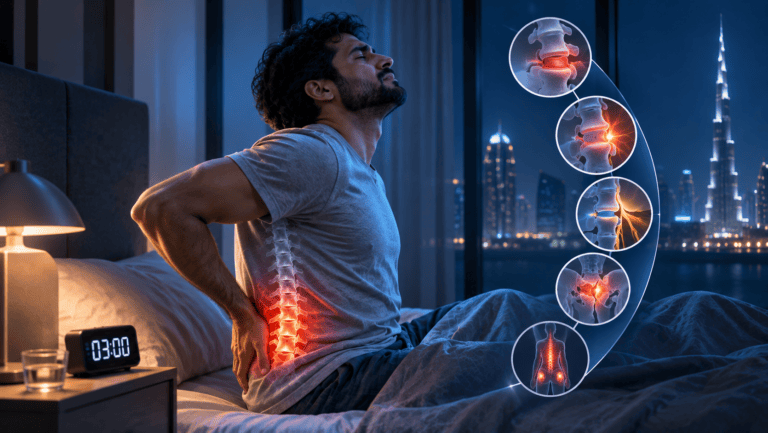
You roll over at 3 a.m., a sharp ache pulls you out of sleep, and you spend the next hour staring at the ceiling wondering whether this is normal. It is a surprisingly common experience, and the honest answer is that night-time back pain has many possible meanings, most of them ordinary and a few that deserve attention.
The useful question is not “does it hurt at night?” but “how does it behave?” Pain that eases when you change position tells a very different story from pain that is relentless whatever you do.
Why does back pain feel worse at night?
Back pain can feel worse at night for several reasons that have nothing to do with anything sinister:
- Fewer distractions. During the day, work, screens and conversation compete for your attention. At night, pain gets the stage.
- Staying in one position. Hours without movement can stiffen joints and muscles, especially if the mattress or pillow is unsuited to you.
- Posture while sleeping. Lying on your stomach, or with the hips twisted, can load the facet joints and the lower back.
- Cooler rooms. Air conditioning is a fact of life in Dubai. Running it cold overnight can leave muscles tense by morning, which some people notice.
- Sleep itself. Poor sleep lowers pain tolerance, and pain disturbs sleep, which creates a frustrating loop.
Pain from these causes usually eases once you shift position or get up and walk for a few minutes.
What are the common mechanical causes?
Mechanical back pain means pain that arises from the movement and loading of the spine’s structures. Typical sources include:
- Muscle strain or spasm, often after unaccustomed activity, heavy lifting or a long drive
- Facet joint irritation, the small joints at the back of the spine, which can ache when you arch or lie flat
- Disc problems, including a bulge or herniation, which may cause pain that shifts with position and may travel into the leg
- Spinal stenosis, narrowing of the canal, which is more common with age and may cause leg heaviness
- Sacroiliac joint pain, felt low on one side near the buttock
Mechanical pain tends to fluctuate. Some positions are comfortable, others are not, and it usually improves with movement or a change in posture. A Thoracic and Lumbar Spine Surgeon in Dubai separates these sources through history and examination.
When is night pain a warning sign?
Night pain becomes more significant when it has a specific character. Two patterns are worth knowing about.
Pain that is constant and unrelenting
If the pain is present most of the night regardless of what position you try, and does not ease in the morning, doctors become more cautious. Constant, progressive pain that does not behave mechanically can occasionally be linked to infection, a tumour, or a fracture. This is uncommon, but it is the reason night pain appears on lists of red flags.
Inflammatory back pain
A second pattern is inflammatory back pain, usually caused by conditions such as axial spondyloarthritis (including ankylosing spondylitis). Here the pain is typically worse at night or in the early morning, causes stiffness lasting more than 30 minutes, and improves with exercise rather than rest. It often starts before the age of 40 and develops gradually over months.
The widely used ASAS criteria help to identify this pattern. They look at features such as onset before age 40, gradual onset, improvement with exercise, no improvement with rest, and pain at night with improvement on getting up. In the expert study that set these criteria, meeting four of five had a sensitivity of about 77 percent and a specificity of about 92 percent for inflammatory back pain. In practice, that means the pattern is a useful clue, not a diagnosis on its own.
What other symptoms should you pay attention to?
The number of symptoms that go together matters more than any single one. Take note if night pain comes with:
- Unexplained weight loss, fever or night sweats
- A history of cancer
- Pain after a fall or injury, especially in older adults or people with osteoporosis
- New weakness or numbness in the legs
- Changes in bladder or bowel control, or numbness between the legs
- Pain that is steadily worsening over weeks
Some of these features, particularly unexplained weight loss, are discussed in Why Weight Loss With Back Pain Is a Red Flag in the UAE. Bladder, bowel and saddle changes are emergencies and should not wait until morning.
What does a spine surgeon look for?
A thorough assessment is built around the story. Dr. Sherief Elsayed, Consultant Spine Surgeon in Dubai, usually asks questions such as:
- When exactly does the pain wake you, and what time of night?
- Does changing position or getting up help?
- Is morning stiffness present, and how long does it last?
- Does exercise make it better or worse?
- Has there been any injury, illness, weight change or fever?
- Where does the pain travel, and is there any numbness or weakness?
Then comes a physical examination, which checks posture, movement, tenderness, nerve function and, where relevant, the hips and sacroiliac joints. Pain that seems to come from the back sometimes originates elsewhere, so the examination covers more than the spine.
Imaging is requested when the story and examination justify it. An MRI is typically the most informative scan for night pain with red flags, while X-rays can be helpful for bony structure and alignment. Blood tests may be added when inflammation or infection is a concern.
Can your sleeping setup be part of the problem?
Often, yes. The evidence on mattresses is more modest than the marketing suggests, but it points consistently away from very firm beds. A frequently cited Spanish randomised trial in people with chronic low back pain found that those sleeping on a medium-firm mattress did better than those on a firm mattress. More recent reviews agree that comfort, rather than a specific brand or type, is what matters.
A few practical adjustments are worth trying for a couple of weeks:
- If you sleep on your side, place a pillow between your knees
- If you sleep on your back, a small pillow under the knees can ease tension
- Avoid sleeping on your stomach where possible, which tends to arch the lower back
- Keep the bedroom cool but not cold, and avoid direct airflow onto your back
- Take a short walk or gentle stretch before bed if stiffness is the issue
If you would like more detail on positions and pillows, the article on How to Sleep With Lower Back Pain, A UAE Spine Surgeon Advises covers this in depth.
What treatment helps?
Treatment depends on the cause, which is why a diagnosis comes first. For most people with mechanical night-time pain, the first steps are straightforward:
- Staying active, with walking and gentle movement
- Physiotherapy and a graded exercise programme
- Short-term pain relief, used sensibly and under medical advice
- Adjusting sleep position and bedding
A Non-Surgical Spine Doctor in Dubai will usually start with these approaches. When inflammatory back pain is suspected, the pathway involves rheumatology input and sometimes specific anti-inflammatory medicines. When a structural cause such as a fracture, infection or tumour is found, treatment is tailored accordingly.
When should you get checked?
Consider booking an assessment if:
- Night pain has lasted more than a few weeks
- It is getting steadily worse
- It does not ease with position change or movement
- It comes with any of the red-flag features above
- You are under 40 and have prolonged morning stiffness
Seek urgent care if you have new weakness, loss of bladder or bowel control, numbness in the saddle area, or severe pain after an injury.
The bottom line
Waking with back pain is common and usually mechanical, and often improves once the cause is identified and sleep habits are adjusted. The pattern matters: pain that eases when you move is reassuring, while pain that is constant, progressive or accompanied by other symptoms deserves a timely review. If you are unsure which pattern you have, a visit to a Spinal Surgeon in Dubai can sort that out and give you a clear plan.
Table of Contents
Recent Articles

Why Dubai Desk Workers Are Getting Disc Problems at a Younger Age
What Is a Nerve Root Block and How Does It Help Back Pain in UAE? Does sitting all day cause herniated discs? Not directly. Studies show a modest association between

What Is a Nerve Root Block and How Does It Help Back Pain in UAE?
What Is a Nerve Root Block and How Does It Help Back Pain in UAE? Is a nerve root block painful? Most people describe pressure and a brief sharp sting

Why Long Flights From Dubai Can Trigger Sciatica and Back Pain
Why Long Flights From Dubai Can Trigger Sciatica and Back Pain Can sitting on a plane cause a slipped disc? A long flight does not usually cause a disc to