
Why Eight People Were Needed for One Spine Surgery in Dubai
Does every spinal surgery require exactly eight team members?
No, as Dr. Sherief Elsayed explains directly, the specific team size varies according to the complexity of the individual procedure being performed, with more complex operations generally requiring a larger, more extensive team.
What is the difference between a scrub nurse and a circulating nurse?
The scrub nurse works directly within the sterile surgical field alongside the surgeon, managing and providing instruments throughout the procedure, while the circulating nurse works outside this sterile field, sourcing any additional equipment or supplies needed from elsewhere within the facility.
Will I meet all of these team members before my surgery?
This varies by facility and specific procedure, though patients typically meet their surgeon and anaesthetist directly during pre-operative consultations, while other team members are generally encountered, if at all, only briefly on the day of surgery itself.
Why does the anaesthetist need their own dedicated assistant?
Given the extensive, continuous physiological monitoring and management responsibilities held by the anaesthetist throughout a procedure, discussed extensively in earlier articles on anaesthesia and intraoperative patient safety, having dedicated assistance allows this critical, continuous role to be performed safely and effectively throughout the entire procedure.
Is a radiographer present for every type of spinal surgery?
This depends on whether the specific procedure requires intraoperative imaging, which, as discussed extensively in earlier articles on modern spine surgery technology, is genuinely common across many types of spinal surgery, though not universally required for every possible procedure.
Does having a larger surgical team mean a procedure is more dangerous?
No, a larger team generally reflects the specific complexity and technical requirements of a given procedure, and represents appropriate, thorough clinical support and coordination rather than any indication of increased inherent danger.
Patients preparing for spinal surgery understandably focus their attention primarily on the surgeon who will be performing their operation. What is far less visible, and far less commonly explained, is the full team of professionals who work together throughout that same procedure, each contributing a specific, essential role without which the surgery simply could not proceed safely or effectively. A single operation frequently depends on the coordinated work of a considerably larger team than most patients ever realise.
Dr. Sherief Elsayed, Consultant Spine Surgeon in Dubai, walks through exactly who makes up this team, using a specific, detailed real-world example.
The Variable Nature of Theatre Staffing
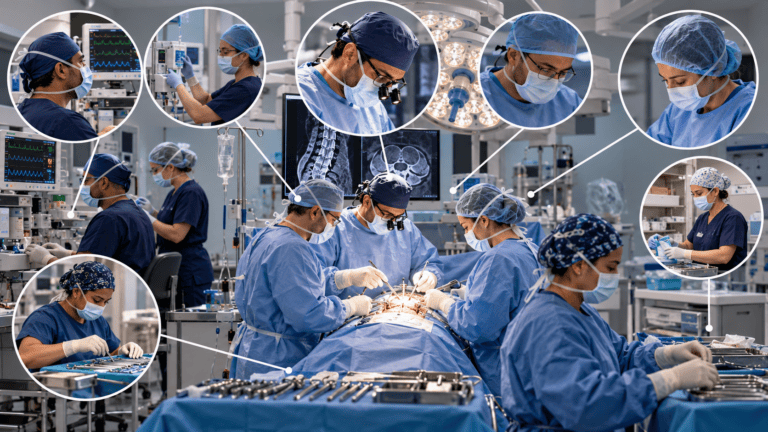
Dr. Sherief Elsayed establishes the general principle before detailing the specific example: “Depending on the complexity of an operation, we have varying numbers of staff in the operating theatre. Today we have eight.”
This immediately clarifies an important point: operating theatre staffing is not a fixed, one-size-fits-all number applied identically to every procedure. More complex operations, requiring more extensive surgical exposure, more specialised equipment, or additional technical support, generally require a larger coordinated team than simpler, more routine procedures. The specific team of eight described here represents the staffing appropriate to a particular procedure’s complexity, rather than a universal standard applied to every spinal operation.
Person One: The Surgeon
Dr. Sherief Elsayed begins with his own role: “First there’s the surgeon, myself.”
The surgeon holds primary responsibility for the technical execution of the procedure itself, applying the specific expertise, training, and judgement discussed extensively throughout this blog series, including the fellowship training and complication-rate transparency covered in the earlier article on choosing the right spinal surgeon.
Person Two: The Surgical Assistant
The second team member is identified specifically: “There’s my assistant who will help me by holding your retractor by sucking blood away, for example.”
The surgical assistant, frequently a fellow surgeon, surgical trainee, or specifically trained surgical assistant, provides direct, hands-on support throughout the procedure. The specific tasks described, holding retractors (the instruments used to maintain surgical exposure by gently holding tissue aside, as discussed in earlier articles on surgical technique) and suction (removing blood and fluid from the surgical field to maintain clear visualisation), are essential, continuous tasks that free the primary surgeon to focus entirely on the precise technical steps of the procedure itself, rather than needing to simultaneously manage these supporting functions independently.
Person Three: The Anaesthetist
Dr. Sherief Elsayed identifies the next essential role: “There’s the anaesthetist, who also needs his own assistant.”
The anaesthetist holds responsibility for the entire physiological management of the patient throughout the procedure, precisely the extensive scope of responsibility discussed in detail in the earlier articles on general anaesthesia, blood pressure management during spinal cord surgery, and the specific management of complications such as vasovagal reactions to needle phobia. This includes inducing and maintaining anaesthesia, continuously monitoring and managing the patient’s vital signs and overall physiological status, and managing pain control both during and immediately following the procedure.
Person Four: The Anaesthetic Assistant
Dr. Sherief Elsayed’s specific mention that the anaesthetist “also needs his own assistant” highlights a role that is easily overlooked but genuinely essential. The anaesthetic assistant, often a specifically trained anaesthetic nurse or technician, provides direct, continuous support to the anaesthetist throughout the procedure, assisting with medication preparation and administration, helping to manage the various monitoring equipment continuously tracking the patient’s physiological status, and providing an additional set of hands during any critical moments requiring rapid intervention.
Person Five: The Scrub Nurse
Dr. Sherief Elsayed describes this role directly: “Then there’s a scrub nurse who will help me to drape the patient or hand me the instruments that I require throughout the surgery.”
The scrub nurse, working in the sterile field directly alongside the surgeon and surgical assistant throughout the procedure, maintains the sterile surgical setup, prepares and organises the full range of surgical instruments that may be required, and anticipates and provides the specific instruments the surgeon needs at each precise stage of the operation, a role requiring detailed knowledge of the specific procedure being performed and the sequence of instruments it will require throughout.
Person Six: The Circulating Nurse
Dr. Sherief Elsayed describes the distinct role of the sixth team member: “There’s a circulating nurse running around that will get things from other theatres or from stores or what have you, as and when we need them.”
Unlike the scrub nurse, who remains within the sterile surgical field throughout the procedure, the circulating nurse operates outside this sterile field, serving as the essential link between the immediate surgical team and the broader resources of the hospital or surgical facility. This role involves retrieving any additional equipment, instruments, or supplies that become necessary during the procedure, whether from elsewhere within the same theatre complex or from central hospital stores, ensuring the surgical team has continuous, uninterrupted access to everything genuinely required throughout the operation without needing to pause the procedure itself to source these items.
Person Seven: The Radiographer
Dr. Sherief Elsayed identifies this specific, technically essential role: “The seventh person will be the radiographer. He’s the person that positions the X-ray machine for me, different planes that I require throughout the surgery.”
The radiographer operates the intraoperative imaging equipment, whether standard fluoroscopy or the more advanced O-arm three-dimensional imaging technology discussed extensively in the earlier article on new spine surgery technology, ensuring the surgeon has continuous, accurate access to the specific imaging views required at each stage of the procedure, whether confirming correct surgical level, guiding precise implant placement, or verifying the final surgical outcome before the procedure is complete. Given the extensive discussion throughout this blog series of exactly how central intraoperative imaging is to precise, safe spinal surgery, this role represents a genuinely essential, technically skilled contribution to the overall surgical team.
Person Eight: The Lead Nurse
Finally, Dr. Sherief Elsayed identifies the overall coordinating role: “There’s the lead nurse in the operating theatres, taking care of everybody really.”
The lead nurse holds overall responsibility for the coordination and smooth functioning of the entire operating theatre environment throughout the procedure, ensuring that each of the other team members has what they need to perform their specific role effectively, that appropriate safety protocols and checklists are followed throughout, and that the overall procedure runs smoothly from a whole-team coordination perspective, beyond the specific technical contribution of any single individual role.
Why Understanding This Team Matters for Patients
There is genuine value for patients in understanding the full scope and structure of this team, extending well beyond simple curiosity about “what happens” during their surgery. A Spine Surgeon in UAE works within exactly this kind of coordinated, multi-professional structure for every procedure.
Reassurance about safety and preparation:
Understanding that a spinal procedure is supported by a full, specifically skilled, coordinated team of professionals, each contributing an essential and specific function, provides genuine reassurance about the thoroughness and safety infrastructure surrounding the procedure, directly relevant to the broader discussion throughout this blog series of why modern spinal surgery, performed within an appropriately resourced setting, carries a genuinely low risk profile when performed by an appropriately trained team.
Understanding the complexity behind “straightforward” descriptions:
When a surgeon describes a procedure as being technically “straightforward,” as Dr. Sherief Elsayed did in the earlier article regarding decompression surgery for spinal stenosis in elderly patients, this description refers specifically to the technical demands placed on the surgeon’s own particular skill set, rather than suggesting the overall surgical process involves a minimal or simplified level of overall clinical support and coordination. Even a technically “straightforward” procedure, from the surgeon’s specific perspective, still benefits from and typically requires this full, coordinated team structure to be performed safely and effectively.
Context for why surgical scheduling and resources matter:
Understanding the genuine scale of the coordinated team required for spinal surgery provides useful context. A Consultant Spine Surgeon in Dubai relies on this full team for consistently safe outcomes. provides useful context for why appropriate hospital and surgical facility resourcing, discussed indirectly throughout earlier articles in this series regarding access to specific technologies such as intraoperative navigation and neuromonitoring, is genuinely important for supporting consistently safe, high-quality surgical outcomes.
UAE-Specific Context
Major spinal surgical centres across Dubai and the wider UAE maintain the comprehensive, appropriately staffed operating theatre teams described here. A Spine Trauma Surgeon in Dubai operates within this well-resourced surgical environment. the comprehensive, appropriately staffed operating theatre teams described here, reflecting the region’s substantial investment in high-quality surgical infrastructure. A Spine Surgery Specialist in Dubai operating within this kind of well-resourced, appropriately staffed surgical environment is supported by exactly the coordinated, multi-professional team structure that underlies the consistently good outcomes and genuinely low risk profile discussed throughout this blog series.
Expert Summary
A single spinal surgical procedure frequently depends on the coordinated work of a team considerably larger than the surgeon alone, in this specific example extending to eight distinct professionals: the surgeon, a surgical assistant, the anaesthetist and their own assistant, a scrub nurse, a circulating nurse, a radiographer managing intraoperative imaging, and a lead nurse coordinating the overall theatre environment. Each role contributes a specific, essential function without which the procedure could not be performed safely or effectively, and understanding this full team structure provides genuine, valuable context for patients about the depth of professional support and coordination underlying modern spinal surgery.
Table of Contents
Recent Articles

Why Eight People Were Needed for One Spine Surgery in Dubai
Why Eight People Were Needed for One Spine Surgery in Dubai Does every spinal surgery require exactly eight team members? No, as Dr. Sherief Elsayed explains directly, the specific team
Three Spine Surgery Myths a Dubai Surgeon Wants You to Forget
Three Spine Surgery Myths a Dubai Surgeon Wants You to Forget Is it really safe to walk on the same day as spine surgery? Yes, for the majority of modern

Why Osteoporosis Is Called the Silent Disease in the UAE
Why Osteoporosis Is Called the Silent Disease in the UAE If osteoporosis doesn’t cause pain, how would I know if I needed a DEXA scan? Given the entirely silent nature