
Which Surgeon Should You See for Your Spine Problem in Dubai?
Is a neurosurgeon always more qualified than an orthopaedic surgeon for spine conditions?
No. Both pathways, when combined with dedicated spine fellowship training, produce highly qualified spine surgeons. The relevant question is the surgeon’s specific fellowship training and experience with your particular condition, not simply their original residency background.
How do I know if my condition specifically needs a neurosurgeon rather than an orthopaedic surgeon?
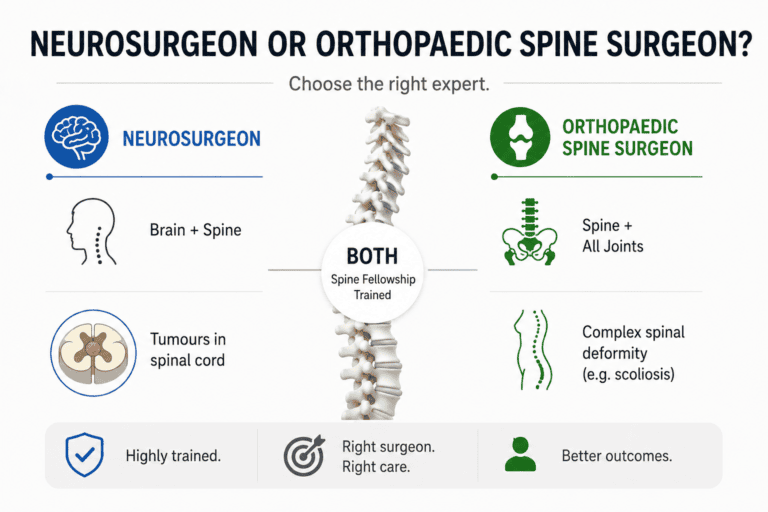
For the majority of common spinal conditions, either background is typically appropriate. Specific scenarios such as tumours within the spinal cord itself may particularly favour neurosurgical expertise, while complex spinal deformity correction may particularly favour orthopaedic expertise, though experienced fellowship-trained surgeons from either background can often manage these conditions as well.
Can an orthopaedic surgeon perform brain surgery?
No, orthopaedic surgical training does not include brain surgery, which remains within the specific domain of neurosurgical training and practice.
Can a neurosurgeon perform hip or knee replacement surgery?
No, neurosurgical training does not typically include the broader joint replacement and reconstruction expertise that orthopaedic surgical training encompasses. A neurosurgeon’s musculoskeletal surgical expertise is specifically focused on the spine, not the broader range of joints that orthopaedic surgeons are trained to treat.
Does it matter which type of surgeon performs a routine disc herniation surgery?
For routine, common procedures such as standard lumbar microdiscectomy, fellowship-trained surgeons from either background typically achieve comparable outcomes, and the choice should be guided more by the individual surgeon’s specific experience and other selection factors rather than their original training pathway.
Should I ask my surgeon directly about their training background?
Yes, this is entirely appropriate and a reasonable question to ask during your initial consultation, alongside the other important questions about fellowship training, complication rates, and specific procedural experience discussed in the earlier article on choosing a spinal surgeon.
Patients seeking spine care in Dubai frequently encounter a specific point of confusion before they even reach their first consultation: should they be seeing a neurosurgeon or an orthopaedic spine surgeon? Both specialties treat spinal conditions, both perform spinal surgery, and from a patient’s perspective, the distinction between them can seem entirely opaque. Understanding the genuine difference in training, and how this translates into different areas of particular expertise, helps patients navigate this decision with more confidence.
Dr. Sherief Elsayed, Consultant Spine Surgeon in Dubai, explains the fundamental difference between these two training pathways and how it shapes what each type of surgeon is typically best positioned to treat.
The Fundamental Training Difference
Dr. Sherief Elsayed frames the distinction clearly: “What’s the difference between a neurosurgeon and an orthopaedic spine surgeon? So a neurosurgeon is trained in brain surgery as well as spine surgery. Orthopaedic surgeon is trained in spine surgery as well as all of the joints of the body.”
This captures the essential structural difference between the two training pathways that ultimately produce a spine surgeon.
The neurosurgical pathway:
Neurosurgery training encompasses the entire nervous system, including the brain, spinal cord, and peripheral nerves. A neurosurgeon’s residency training involves extensive experience with cranial (brain) surgery, spinal surgery, and peripheral nerve surgery, developing particular expertise in working with and around neural tissue itself, given the extensive time spent operating directly on brain and spinal cord tissue throughout their training.
The orthopaedic pathway:
Orthopaedic surgery training encompasses the entire musculoskeletal system, including all of the body’s joints (hip, knee, shoulder, and others), bones, and the spine. An orthopaedic surgeon’s residency training develops broad expertise in musculoskeletal biomechanics, joint replacement and reconstruction, and bone healing and fixation, with the spine representing one component of this much broader musculoskeletal training.
Both pathways then typically continue into a dedicated spine fellowship, as discussed in the earlier article How to Choose the Right Spinal Surgeon, Dr. Sherief Elsayed Advises, during which surgeons from both original training backgrounds develop focused, high-volume experience specifically in spinal surgery. It is this fellowship training, more than the original residency pathway, that ultimately determines a surgeon’s competence and experience in treating spinal conditions broadly.
Where the Original Training Background Still Matters
Despite both pathways ultimately producing highly capable spine surgeons through fellowship training, the foundational residency experience does continue to shape areas of particular expertise and comfort for individual surgeons, particularly for specific, less common categories of spinal pathology.
Tumours Within the Spinal Cord Itself
Dr. Sherief Elsayed identifies a specific scenario where neurosurgical training background is particularly relevant: “If I had a tumour in the middle of my spinal cord, that would be very appropriate for a neurosurgeon to do. They’re very skilled at operating inside the spinal cord.”
Intramedullary spinal cord tumours, meaning tumours located within the substance of the spinal cord itself rather than compressing it from outside, represent a particularly demanding category of neurosurgical pathology. Operating within the spinal cord requires an extremely detailed, granular understanding of the cord’s internal anatomy and the specific functional pathways running through different regions of its cross-sectional structure, precisely the kind of expertise that develops through extensive neurosurgical training focused on operating within neural tissue itself, whether in the brain or spinal cord.
This is a specific and relatively uncommon category of spinal pathology, but it illustrates a genuine area where a neurosurgeon’s foundational training in working directly within neural tissue provides a particular advantage, beyond what fellowship training in spine surgery alone might provide to a surgeon from a different original background.
Complex Spinal Deformity
Dr. Sherief Elsayed identifies the corresponding scenario favouring orthopaedic training background: “If I had a big scoliosis, then it’s usually an orthopaedic surgeon that would do that.”
Complex spinal deformity correction, including significant scoliosis correction as discussed extensively in earlier articles in this series, draws heavily on exactly the kind of biomechanical and structural expertise that orthopaedic training specifically develops: understanding how forces are distributed through the skeleton, how instrumentation and fixation constructs behave mechanically under load, and how to plan and execute complex, multi-level structural corrections, all skills with direct parallels to the broader orthopaedic expertise in joint reconstruction and complex bone fixation developed throughout orthopaedic residency training.
The Important Caveat: Increasing Overlap
Dr. Sherief Elsayed adds an important and honest qualification to this general pattern: “Though more and more neurosurgeons are doing it as well.”
This reflects a genuine and ongoing evolution within the field of spine surgery. As dedicated spine fellowship training has become increasingly comprehensive and standardised, regardless of a surgeon’s original residency background, the practical distinction between what a fellowship-trained neurosurgeon and a fellowship-trained orthopaedic spine surgeon can competently and safely perform has narrowed considerably over recent decades.
Many neurosurgeons who complete dedicated spine fellowship training develop extensive expertise in complex deformity correction, traditionally considered an area of orthopaedic strength. Similarly, many orthopaedic spine surgeons develop significant comfort and expertise working around, though generally not directly within, neural tissue, given the extensive exposure to nerve root and spinal cord decompression that is central to virtually all spine fellowship training regardless of original background.
What This Means for Patients Choosing a Surgeon
Given this genuine overlap and the increasing convergence of expertise between the two original training pathways, what should actually guide a patient’s choice of surgeon?
Fellowship training and specific procedural experience matter more than original residency background alone. As established in the earlier article on choosing a spinal surgeon, asking specifically about a surgeon’s fellowship training, their experience with the specific procedure or condition relevant to your case, and their complication rates for that specific procedure, provides more genuinely useful information than simply noting whether their original training background was neurosurgical or orthopaedic.
For specific, less common pathologies, original training background may still be relevant. For the specific scenarios Dr. Sherief Elsayed identifies, intramedullary spinal cord tumours particularly favouring neurosurgical background, and complex deformity correction particularly favouring orthopaedic background, it remains reasonable for patients with these specific conditions to seek out a surgeon whose training and experience particularly aligns with their specific pathology. A Spinal Cord Surgeon in Dubai with this specific training is best placed for tumours within the cord itself.
For the majority of common spinal conditions, either background is typically appropriate. For the much more common conditions covered extensively throughout this blog series, including disc herniation, spinal stenosis, and routine degenerative conditions, fellowship-trained surgeons from either an orthopaedic or neurosurgical background are typically equally well-positioned to provide excellent care, and the choice between them should be guided more by the individual surgeon’s specific experience, communication style, and the other selection criteria discussed elsewhere in this blog.
How to Have This Conversation With a Potential Surgeon
Patients uncertain about which type of surgeon is most appropriate for their specific condition can reasonably ask directly during an initial consultation or even before booking one.
Questions worth asking:
What is your training background, and what did your spine fellowship focus on specifically? How much experience do you have with my specific condition or the procedure being considered? If my condition falls outside your particular area of focused expertise, would you refer me to a colleague with more specific experience?
A genuinely patient-centred Spine Surgery Specialist in Dubai, regardless of their original training background, should be willing and able to answer these questions honestly, including acknowledging when a patient’s specific condition might be better served by a colleague with more particular expertise in that specific area, whether that colleague shares their own training background or comes from the alternative pathway.
UAE-Specific Context
Dubai and the broader UAE have developed a genuinely robust spine surgery infrastructure. A Scoliosis Specialist in Dubai with orthopaedic fellowship training is often well placed for complex deformity correction specifically, with both fellowship-trained orthopaedic spine surgeons and fellowship-trained neurosurgeons practising across major hospitals and specialist centres. Patients in the UAE have access to specialists from both training backgrounds, and given the genuine overlap in expertise discussed above, the most important consideration remains identifying a surgeon with specific, relevant experience in the patient’s particular condition, rather than prioritising the original training pathway label alone.
Expert Summary
The distinction between neurosurgeons and orthopaedic spine surgeons reflects genuinely different foundational training pathways, with neurosurgery encompassing broader neural tissue expertise including brain surgery, and orthopaedic surgery encompassing broader musculoskeletal expertise including all joints of the body. This foundational difference continues to shape particular areas of expertise, with neurosurgical background particularly suited to pathology within the spinal cord itself, and orthopaedic background particularly suited to complex structural deformity correction. However, increasing convergence through comprehensive spine fellowship training means that for the majority of common spinal conditions, fellowship-trained surgeons from either background provide excellent, comparable care, and patients are best served by focusing their selection criteria on specific fellowship training, procedural experience, and communication rather than original residency background alone.
Table of Contents
Recent Articles

Why Eight People Were Needed for One Spine Surgery in Dubai
Why Eight People Were Needed for One Spine Surgery in Dubai Does every spinal surgery require exactly eight team members? No, as Dr. Sherief Elsayed explains directly, the specific team
Three Spine Surgery Myths a Dubai Surgeon Wants You to Forget
Three Spine Surgery Myths a Dubai Surgeon Wants You to Forget Is it really safe to walk on the same day as spine surgery? Yes, for the majority of modern

Why Osteoporosis Is Called the Silent Disease in the UAE
Why Osteoporosis Is Called the Silent Disease in the UAE If osteoporosis doesn’t cause pain, how would I know if I needed a DEXA scan? Given the entirely silent nature