
How a Rear End Collision Causes Whiplash in the UAE
How long does whiplash typically take to heal?
Most whiplash injuries improve significantly within a few weeks with appropriate conservative management, including early, gentle movement rather than prolonged rest. A smaller proportion of patients experience more prolonged symptoms extending over several months.
Should I rest completely after a whiplash injury?
Current evidence and clinical guidance generally favours early, gentle movement and return to normal activity as tolerated, rather than prolonged immobilisation or complete rest, which has been shown to potentially delay recovery in whiplash injuries.
Can whiplash cause long-term problems?
While most whiplash injuries resolve fully, a proportion of patients develop more persistent symptoms, sometimes referred to as chronic whiplash-associated disorder. Risk factors for more prolonged symptoms are an area of ongoing research and include factors such as the severity of the initial injury and certain psychosocial factors.
Is whiplash only caused by rear-end collisions?
While rear-end collisions are the classic and most commonly discussed cause, similar extension-flexion neck injury mechanisms can occur in other types of collisions, including side impacts, and in other contexts entirely unrelated to vehicle collisions, such as certain sporting injuries.
Does a low-speed collision mean whiplash is unlikely?
Not necessarily. While higher-speed collisions generally carry greater injury risk, whiplash injuries have been documented even in relatively low-speed collisions, particularly when headrest positioning or other protective factors were suboptimal.
Should I see a doctor after a rear-end collision even if I feel fine initially?
Given that whiplash symptoms often develop over the hours or days following a collision rather than being immediately apparent, seeking medical assessment after any significant collision, even in the absence of immediate symptoms, is a reasonable precaution, particularly for documenting the incident and establishing a baseline should symptoms develop later.
Will my whiplash show up on X-rays?
Often no. X-rays are excellent for detecting bone fractures and gross alignment problems, but the soft tissue injuries that cause most whiplash symptoms, including muscle strains, ligament sprains, and minor disc injuries, do not show on X-rays. This does not mean your injury is not real or significant. Clinical examination findings are often more important than imaging in diagnosing and guiding treatment of whiplash. MRI scans may be ordered if symptoms persist or if nerve involvement is suspected, as they visualise soft tissues much better than X-rays.
Can children get whiplash injuries, and do their headrests need special positioning?
Yes, children can sustain whiplash injuries, though their injury patterns may differ from adults due to anatomical differences. Children should always be in age-appropriate car seats or booster seats that provide proper head and neck support. These restraint systems have built-in head protection designed for children’s size and weight. Once children are large enough to use standard vehicle seats and headrests, the same positioning rules apply: top of the headrest level with the top of the head, minimal gap to the back of the head.
Whiplash is one of the most commonly discussed but frequently misunderstood injuries in road traffic medicine. Almost everyone has heard the term, associates it with rear-end car collisions, and understands vaguely that it involves the neck. Fewer people understand the specific biomechanical sequence of movement that produces the injury, or the surprisingly effective and simple piece of standard vehicle safety equipment specifically engineered to prevent it.
Dr. Sherief Elsayed, Consultant Spine Surgeon in Dubai, explains both the mechanism of whiplash injury and a personal habit he has developed, born directly from his clinical understanding of this injury.
A Surgeon’s Habit at the Traffic Light
Dr. Sherief Elsayed opens with a genuinely revealing personal observation: “Don’t laugh at me, but whenever I’m crossing the road, I’m at a traffic light for example, I always look at the drivers and I see where their headrest is and I see what position it’s at.”
This habit, checking the headrest position of stationary vehicles as a pedestrian, reflects a specific and well-founded clinical understanding of exactly how whiplash injuries occur and precisely what determines whether a given rear-end collision produces a mild, self-limiting injury or a more severe and prolonged one.
Why Headrest Position Matters So Much
Dr. Sherief Elsayed explains the underlying reasoning: “It’s really important to have it at the correct position because it’s there to prevent a whiplash injury.”
This is a genuinely important piece of practical safety knowledge that many drivers overlook. The headrest built into every modern vehicle seat is not simply a comfort feature for resting the head during a journey. It is a specifically engineered safety device, designed and positioned to limit the range of motion the head and neck can travel through during exactly the kind of rapid, forceful movement that occurs in a rear-end collision.
The Biomechanics of Whiplash: What Actually Happens to the Neck
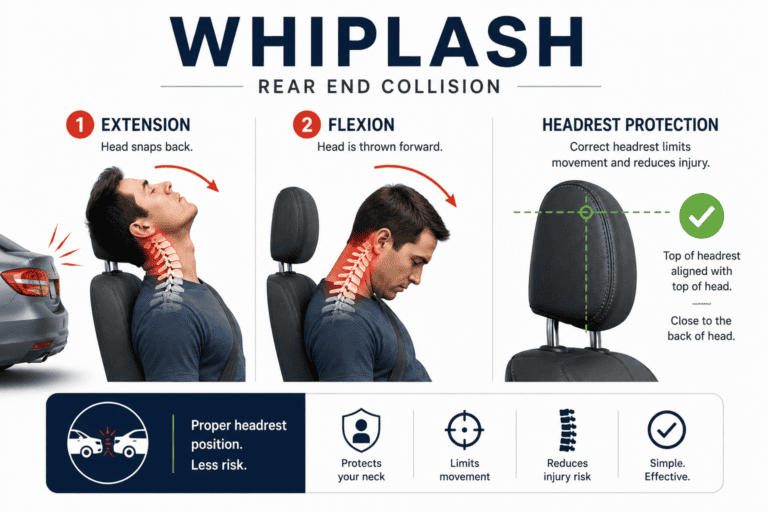
Dr. Sherief Elsayed describes the precise sequence of movement: “If you’re stationary at a traffic light and a car comes in from behind, smashes into you, then your head is forcibly extended really hard and then flung forwards, and that’s what we mean by whiplash.”
This description captures the two-phase biomechanical sequence that defines a whiplash injury.
Phase one: forced hyperextension
When a vehicle is struck from behind, the impact force is transmitted through the car’s structure to the seat, which accelerates forward rapidly. Because the torso is generally well supported by the seat back and, ideally, a properly worn seatbelt, the torso accelerates forward along with the vehicle. However, the head, being a relatively heavy structure connected to the torso only by the comparatively slender and flexible cervical spine, lags behind this forward acceleration momentarily due to its own inertia. This creates a relative backward movement of the head compared to the now-forward-accelerating torso, producing forced extension (backward bending) of the cervical spine, often to an extent well beyond the normal comfortable range of motion.
Phase two: rapid forward flexion
Almost immediately following this forced extension, as the torso’s forward motion begins to decelerate (whether from the seatbelt restraining further forward movement, the vehicle’s own deceleration, or the driver’s braking response) the head, having built up its own momentum during the extension phase, is then thrown forward with significant force, producing rapid flexion of the neck, again often beyond the range and speed that the neck’s soft tissues are well adapted to tolerate without injury.
This rapid, forceful sequence, extension followed immediately by flexion, all occurring within a fraction of a second, is what produces the characteristic pattern of soft tissue injury, affecting the muscles, ligaments, and other supporting structures of the cervical spine, that constitutes a whiplash injury.
Why the Headrest Directly Interrupts This Sequence
Understanding this two-phase mechanism explains precisely why headrest position is so clinically significant. Dr. Sherief Elsayed explains: “If you have your headrest in the correct position, it will reduce the range of motion that your head is going through, and so there’s less likely or less severe a risk of serious neck injury.”
A correctly positioned headrest, meaning one that is adjusted to sit close behind the head (not several centimetres away) and at a height that supports the back of the head rather than only the lower neck or upper back, physically limits how far backward the head can travel during the initial extension phase of a rear-end collision. By reducing the distance and therefore the speed and force involved in this backward head movement, a well-positioned headrest directly reduces the mechanical stress placed on the cervical spine’s soft tissues during exactly the phase of the injury sequence where the most significant tissue strain occurs.
Why incorrect positioning fails to provide this protection:
A headrest that is positioned too low, supporting only the neck rather than the back of the head, or one that is positioned too far back from the head with a significant gap, provides substantially reduced protection. In the case of a headrest positioned too low, the head can still extend backward over the top of the headrest before making contact, allowing much of the dangerous range of motion to occur before any restraining contact is made. In the case of excessive gap distance, the head builds up significant speed and momentum during its initial backward travel before finally contacting the headrest, at which point the sudden deceleration on contact can itself contribute to injury, in addition to the injury already sustained during the unrestrained portion of the movement.
What Structures Are Injured in Whiplash
The rapid extension-flexion sequence described above places significant strain on several structures within the cervical spine.
Muscles: The muscles of the neck, including both the deeper stabilising muscles and the more superficial muscles, can be strained beyond their normal capacity, producing the muscular pain, stiffness, and spasm that are among the most common whiplash symptoms.
Ligaments: The ligaments that connect and stabilise the cervical vertebrae can be stretched or, in more severe cases, partially torn, contributing to pain and, in some cases, a degree of segmental instability.
Facet joints: As discussed in the earlier articles on facet joint pain in this series, the facet joints, which normally guide and limit spinal movement within a controlled range, can be forced beyond their normal range of motion during a whiplash event, producing facet joint-related pain that can persist well beyond the acute injury period.
Intervertebral discs: In more severe whiplash injuries, the rapid and forceful movement can also affect the intervertebral discs, though disc injury is a less consistent finding compared to the muscular, ligamentous, and facet joint involvement that characterises the majority of whiplash presentations.
What Are the Different Grades of Whiplash Injury?
Not all whiplash injuries are equal in severity. The Quebec Task Force classification system, widely used by medical professionals, categorises whiplash-associated disorders into grades:
Grade 0: No neck complaints and no physical signs
Grade 1: Neck pain, stiffness, or tenderness only, with no physical signs of injury detected by examination
Grade 2: Neck complaints plus musculoskeletal signs including decreased range of motion and point tenderness over specific areas
Grade 3: Neck complaints plus neurological signs such as decreased or absent reflexes, weakness, or sensory changes indicating nerve involvement
Grade 4: Neck complaints with fracture or dislocation requiring immediate surgical evaluation
Most rear-end collision victims experience Grade 1 or Grade 2 injuries, which typically resolve with conservative treatment over weeks to months. However, even these seemingly minor grades can cause significant disability during the acute phase.
Grade 3 injuries involving nerve compression may require more intensive intervention, potentially including spinal injections or, in rare cases, surgical decompression if symptoms persist despite conservative management.
Grade 4 injuries represent true emergencies requiring immediate hospital assessment and often surgical stabilisation to prevent permanent spinal cord damage.
Symptoms and Typical Course
Whiplash symptoms often do not appear immediately at the scene of the collision, sometimes developing over the following hours to days as the inflammatory response to the soft tissue injury develops. Common symptoms include neck pain and stiffness, headache (often originating from the base of the skull), pain radiating into the shoulders or upper back, and in some cases, dizziness or difficulty concentrating.
The majority of whiplash injuries follow a self-limiting course, with symptoms gradually improving over weeks with appropriate conservative management, including early, gentle movement rather than prolonged immobilisation, appropriate pain management, and physiotherapy where needed. A Cervical Spine Surgeon in Dubai can assess more persistent or severe presentations that do not follow this typical pattern. A smaller proportion of patients experience more prolonged symptoms, sometimes persisting for months, a pattern sometimes referred to as chronic whiplash-associated disorder, which may require more comprehensive multidisciplinary management. A Spine Doctor in Dubai can guide this multidisciplinary approach.
How Do You Know If Your Whiplash Injury Is Serious?
Most whiplash injuries are self-limiting, meaning they improve naturally over time with appropriate symptom management. However, certain warning signs indicate the need for urgent medical evaluation.
Seek immediate assessment if you experience:
- Severe or worsening neck pain despite rest and medication
- Numbness, tingling, or weakness in your arms or hands
- Difficulty walking or coordinating movements
- Loss of bladder or bowel control
- Severe headache that differs from your usual headaches
- Visual disturbances or dizziness that persists
- Confusion or altered consciousness
- Pain that radiates into your shoulders, arms, or between your shoulder blades
These red flags may indicate complications beyond simple soft tissue strain, including disc herniation, vertebral fracture, or in very rare cases, arterial injury.
It is important to note that whiplash symptoms often have delayed onset. You might feel relatively normal immediately after the collision, only to develop significant pain and stiffness over the following 24 to 72 hours. This delay occurs because initial adrenaline release masks pain, and inflammation takes time to develop fully.
If symptoms develop or worsen after initially seeming minor, do not dismiss them. Proper assessment can identify issues requiring specific treatment and prevent chronic problems from developing.
UAE-Specific Context: Why This Matters on Dubai’s Roads
The UAE’s road network includes significant volumes of high-speed traffic, and rear-end collisions, whether at traffic lights, in congested traffic conditions, or on faster-moving highways, are a recognised and significant cause of whiplash injury presenting to spine and emergency medicine specialists across the region. A Spine Trauma Surgeon in Dubai treats the resulting whiplash and more severe cervical injuries regularly.
Given this context, Dr. Sherief Elsayed’s specific habit of checking headrest positioning as a road safety observation reflects a genuinely practical piece of advice that every driver in the UAE can act on immediately and at no cost: ensuring their own vehicle’s headrest is correctly positioned, close behind the head and at an appropriate height, provides meaningful protection against one of the most common road traffic-related spinal injuries, entirely independent of any other safety feature the vehicle may have.
Practical Guidance: How to Correctly Position Your Headrest
Height: The top of the headrest should be level with the top of your head, or at minimum, level with the top of your ears. A headrest positioned significantly lower than this, supporting only the neck, provides substantially reduced protection.
Distance: The headrest should sit as close as comfortably possible behind the back of your head, ideally within a few centimetres, rather than several centimetres of gap. Modern vehicles typically allow both height and, in many cases, forward-backward distance adjustment specifically to achieve this correct positioning.
Check regularly: Headrest position can shift over time or be altered by different drivers using the same vehicle. Making a habit of checking and adjusting headrest position, in the same way Dr. Sherief Elsayed describes observing other drivers’ headrest positions from outside the vehicle, is a simple but genuinely protective habit.
A Cervical Spine Doctor in Dubai treating whiplash injuries regularly sees the direct clinical consequence of this preventable injury pattern and consistently emphasises headrest positioning as one of the simplest, most accessible protective measures available to every driver.
Distance from your head:
- The back of your head should be no more than 5 to 7 centimetres from the headrest surface
- Closer is generally better, ideally within 2 to 3 centimetres
- Many modern vehicles have active headrests that automatically move forward during rear impacts to close this gap
Angle adjustment:
- The headrest should be as vertical as possible or tilted slightly forward
- Avoid angling it backward, which increases the distance to your head
- Some sports car seats have fixed-angle headrests integrated into the seat design
After adjustment, test the position. Sit normally with your back against the seat and your head in a neutral driving position. Your head should be close to or lightly touching the headrest without forcing you to crane your neck forward.
Beyond the Headrest: Other Prevention Strategies
While correct headrest positioning is crucial, comprehensive whiplash prevention involves several factors:
Vehicle selection: Vehicles with higher safety ratings typically have better seat and headrest designs. Some manufacturers incorporate active safety features that detect impending rear collisions and automatically adjust headrests or pre-tension seatbelts.
Seat position: Your seat back should be relatively upright, around 100 to 110 degrees from the seat base. More reclined positions increase the distance between your head and headrest and can worsen whiplash severity.
Posture awareness: Drivers who habitually lean forward away from their seat back position themselves poorly for impact protection. Maintain contact with your seat back while driving.
Defensive driving: Maintaining awareness of vehicles behind you, particularly when stopped at traffic lights or in heavy traffic, gives you precious seconds to brace if you perceive an imminent collision. While bracing cannot prevent whiplash entirely, it may reduce severity.
Physical conditioning: Strong neck muscles provide some protection by better controlling head motion during impact. Regular neck strengthening exercises, which you can discuss with a physiotherapist, may offer modest protective benefit.
Expert Summary
Whiplash injury results from a rapid, forceful extension-flexion sequence of the cervical spine during a rear-end collision, with the head briefly lagging behind the torso’s forward acceleration before being thrown forward again as the torso decelerates. A correctly positioned headrest, sitting close behind and at an appropriate height relative to the back of the head, directly limits the range of motion the head travels through during the critical extension phase of this sequence, meaningfully reducing both the likelihood and severity of the resulting soft tissue injury. This makes headrest positioning one of the simplest, most immediately actionable pieces of road safety guidance available to any driver.
Table of Contents
Recent Articles

Why Eight People Were Needed for One Spine Surgery in Dubai
Why Eight People Were Needed for One Spine Surgery in Dubai Does every spinal surgery require exactly eight team members? No, as Dr. Sherief Elsayed explains directly, the specific team

Three Spine Surgery Myths a Dubai Surgeon Wants You to Forget
Three Spine Surgery Myths a Dubai Surgeon Wants You to Forget Is it really safe to walk on the same day as spine surgery? Yes, for the majority of modern
Why Osteoporosis Is Called the Silent Disease in the UAE
Why Osteoporosis Is Called the Silent Disease in the UAE If osteoporosis doesn’t cause pain, how would I know if I needed a DEXA scan? Given the entirely silent nature