
Why Trampolines Are Dangerous for Children, A UAE Surgeon Warns
Are trampoline parks with safety staff and padding safer than home trampolines?
Commercial trampoline parks may have additional safety features including padding and supervision staff, but the fundamental risk factors, particularly multiple simultaneous users and encouragement of flips, are often present in these environments as well. Safety features reduce but do not eliminate risk, and families should apply the same caution in commercial settings as at home.
Is it safe for an adult to jump with a young child on a trampoline?
This is specifically discouraged. The significant weight and force differential between an adult and a young child can amplify the forces experienced by the child, increasing injury risk rather than providing protective supervision.
What should I do if my child falls awkwardly on a trampoline but seems fine afterwards?
Monitor closely for any delayed onset of symptoms including pain, swelling, difficulty moving a limb, or any neurological symptoms such as numbness or weakness. If any of these develop, or if there is any concern about the neck or back specifically, seek medical assessment promptly, as some injuries are not immediately apparent.
At what age is trampoline use considered safer?
While risk decreases with increasing age due to improved coordination, bone strength, and body awareness, no age is entirely risk-free, and the other risk factors, multiple users and flip attempts, remain relevant across all age groups.
Can trampoline safety nets prevent all serious injuries?
No. While safety netting effectively prevents falls off the trampoline surface entirely, it does not prevent the injuries that occur from collisions between multiple simultaneous users, awkward landings within the netted area, or injuries sustained during flip attempts.
How common are trampoline-related spinal injuries?
While less common than fractures or minor injuries, trampoline-related spinal injuries, including cervical spine injuries, are a specifically recognised category within paediatric trauma literature and carry potentially severe long-term consequences, which is why they are highlighted as a particular concern despite representing a smaller proportion of overall trampoline injuries.
Trampolines occupy a curious position in family recreation. They are a source of genuine joy for children, widely available in homes, parks, and dedicated trampoline parks across the UAE, and yet they are also one of the most consistently identified causes of significant paediatric injury requiring emergency department visits and, in a meaningful proportion of cases, surgery. Understanding the specific risk factors that make trampoline use dangerous allows families to make more informed decisions about how, whether, and under what circumstances children should use them.
Dr. Sherief Elsayed, Consultant Spine Surgeon in Dubai, addresses this directly, drawing on established paediatric guidance and his own clinical experience with the resulting injuries.
The Authority Behind This Warning
Dr. Sherief Elsayed grounds his caution in established medical guidance rather than personal opinion alone: “Trampolines are particularly dangerous for children, and the American Academy of Pediatrics says so.”
The American Academy of Pediatrics (AAP) has issued clinical guidance on trampoline safety for many years, consistently identifying trampoline use as a significant source of preventable paediatric injury. This is not a fringe or overly cautious position within paediatric medicine. It reflects consistent injury surveillance data collected across multiple healthcare systems over an extended period, showing a persistent and predictable pattern of injury associated with trampoline use.
The Specific Risk Factors
Dr. Sherief Elsayed identifies several specific circumstances that meaningfully increase the risk associated with trampoline use, rather than treating all trampoline use as equally dangerous.
Children Under the Age of Six
“Children under the age of six are in particular danger.”
Young children have a combination of physical and developmental characteristics that place them at disproportionately high risk on a trampoline. Their bones are still developing and have different biomechanical properties compared to older children and adults, their coordination and balance are less developed, making unpredictable falls more likely, and their proportionally larger head size relative to body size increases the risk and severity of head injury from a fall.
This age-specific risk is significant enough that the guidance is not simply “supervise young children carefully” but a more categorical recommendation against trampoline use in this age group specifically.
More Than One Child at a Time
“Other dangers include more than one child on the trampoline at the same time, even if there’s a net around the trampoline.”
This is one of the most consistently identified and yet most commonly ignored risk factors in trampoline injury prevention. When multiple people jump on a trampoline simultaneously, the differing weights, jump heights, and timing of each person create unpredictable and amplified forces on the trampoline surface. A smaller, lighter child sharing a trampoline with a larger child or adult is at particular risk, as the larger person’s landing can propel the smaller person into the air with much greater force than their own jumping would produce, a phenomenon sometimes described as the “trampoline effect” in injury literature, leading to falls, awkward landings, and collisions between the multiple users.
Dr. Sherief Elsayed’s specific mention that “even if there’s a net around the trampoline” this risk persists is an important clarification. Safety netting, while effective at preventing falls off the trampoline entirely, does nothing to prevent the injuries that occur from collisions, awkward landings, or amplified forces between multiple simultaneous users within the netted enclosure itself.
Performing Flips and Aerial Manoeuvres
“Finally, if the child is doing flips, that places them at greater risk.”
Attempting flips, somersaults, or other aerial rotational manoeuvres on a trampoline significantly increases injury risk, particularly for spinal and head injuries. These manoeuvres require precise body control and landing technique that many children, even those who are otherwise athletic and coordinated, have not developed. A mistimed or poorly executed flip can result in landing on the head or neck rather than the feet, producing exactly the kind of high-energy axial loading injury that causes the most severe spinal injuries.
What Kind of Injuries Result
Dr. Sherief Elsayed is specific about the injury spectrum involved: “I’m talking about head injury, spinal injury, arm and leg fractures, and those fractures usually require surgery.”
Head injury: Ranges from minor concussion to more severe traumatic brain injury, particularly when falls occur off the trampoline surface entirely, when collisions occur between multiple users, or when flips are attempted and executed incorrectly.
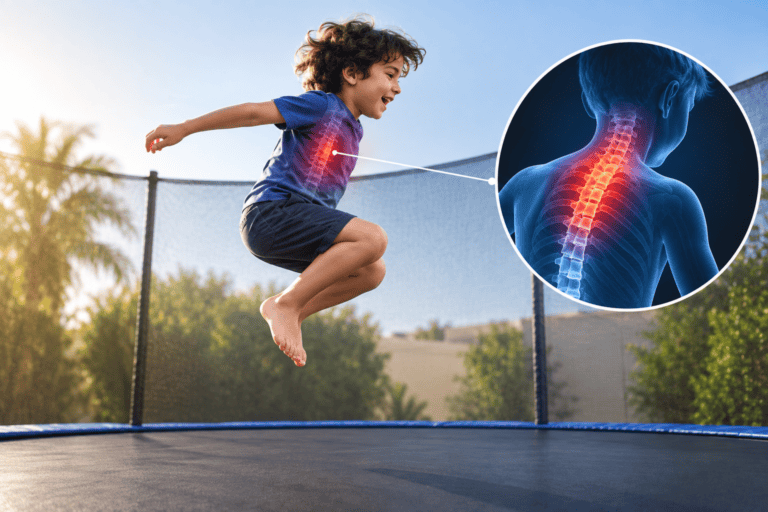
Spinal injury: This is the category of most direct relevance to Dr. Sherief Elsayed’s specialty and carries the most severe potential long-term consequences. Axial loading injuries, where the spine is compressed by a fall landing directly on the head or in a way that transmits significant force along the length of the spine, can produce vertebral fractures and, in the most severe cases, spinal cord injury with the same irreversible consequences discussed in the earlier article on motorbike accident spinal cord injuries. Trampoline-related cervical spine injuries, in particular, are a well-recognised and specifically concerning category of paediatric trauma.
Arm and leg fractures: These are among the most common trampoline-related injuries overall, frequently occurring from awkward landings, particularly at the extremes of the trampoline surface or during attempts to break a fall.
Why these fractures “usually require surgery”: Fractures sustained during high-energy trampoline injuries frequently involve significant displacement or are located at growth plates in children, both of which increase the likelihood that surgical fixation, rather than simple casting, is required to achieve appropriate healing and to protect future growth and function in the affected limb.
Why This Matters Specifically in the UAE
Trampoline parks and home trampolines are widely popular across the UAE, offering an appealing indoor or outdoor recreational option, particularly valuable given the extended periods of the year when outdoor activity is limited by extreme heat. This popularity, combined with the specific risk factors described above, makes trampoline injury a genuinely relevant public health consideration for families in Dubai and across the region. A Spine Doctor in Dubai sees the resulting injuries regularly.
The commercial trampoline park environment presents its own specific considerations. While many parks have supervision staff and safety protocols, the fundamental risk factors identified by Dr. Sherief Elsayed, multiple simultaneous users and the performance of flips and aerial manoeuvres, are often exactly the activities that commercial trampoline parks are designed to encourage and facilitate, given their entertainment-focused business model.
Practical Guidance for Families
For children under six: The strongest and clearest guidance is to avoid trampoline use in this age group given the disproportionate risk relative to any developmental or recreational benefit.
For single-user rules: If a home trampoline is used, enforcing strict single-user-at-a-time rules, regardless of the presence of safety netting, is one of the most effective risk-reduction measures available.
For flips and aerial manoeuvres: Discouraging or actively prohibiting flips and somersaults, particularly without specific coaching and a controlled environment such as a supervised gymnastics or trampolining programme with appropriately padded landing surfaces, significantly reduces the risk of the most severe injury patterns.
For commercial trampoline parks: Families should be aware of and actively enforce the same risk-reduction principles even in a commercial setting, avoiding areas where multiple children of different sizes are jumping simultaneously, and being cautious about sections of the park that encourage or facilitate flips and aerial tricks, particularly for younger or less experienced children.
Supervision: Active, attentive adult supervision, rather than passive presence, is important throughout any trampoline use, allowing for immediate intervention if unsafe behaviour, such as multiple simultaneous users or attempted flips, begins to occur.
What to Do If a Trampoline Injury Occurs
Given the specific risk of spinal injury associated with trampoline use, any fall or collision that results in neck or back pain, particularly if accompanied by numbness, tingling, weakness, or any change in sensation in the arms or legs, should be treated as a potential spinal injury and assessed urgently. As with any suspected spinal injury, the child should not be moved unnecessarily, and emergency medical assessment should be sought immediately. A Spinal Cord Surgeon in Dubai manages the most severe presentations of this injury pattern.
For less severe injuries, including suspected fractures, prompt assessment at an emergency department or urgent care facility allows appropriate imaging and treatment planning. A Spine Trauma Surgeon in Dubai should be consulted for any suspected spinal involvement. at an emergency department or urgent care facility allows appropriate imaging and treatment planning, including surgical referral where indicated.
A Spinal Deformity Surgeon in Dubai or paediatric orthopaedic specialist should be consulted for any suspected spinal injury in a child following a trampoline accident, given the specific expertise required in managing paediatric spinal trauma.
Expert Summary
Trampolines present a genuine and well-documented injury risk for children, with the American Academy of Pediatrics specifically identifying this as a significant concern. The risk is highest in children under six, when multiple people use the trampoline simultaneously regardless of safety netting, and when flips or other aerial manoeuvres are attempted. The resulting injuries, spanning head trauma, spinal injury, and fractures frequently requiring surgery, reflect the significant forces that trampoline use can generate. Families in the UAE, where trampoline use is popular both at home and in commercial parks, should apply these specific risk-reduction principles to protect their children.
Table of Contents
Recent Articles

Why Eight People Were Needed for One Spine Surgery in Dubai
Why Eight People Were Needed for One Spine Surgery in Dubai Does every spinal surgery require exactly eight team members? No, as Dr. Sherief Elsayed explains directly, the specific team
Three Spine Surgery Myths a Dubai Surgeon Wants You to Forget
Three Spine Surgery Myths a Dubai Surgeon Wants You to Forget Is it really safe to walk on the same day as spine surgery? Yes, for the majority of modern
Why Osteoporosis Is Called the Silent Disease in the UAE
Why Osteoporosis Is Called the Silent Disease in the UAE If osteoporosis doesn’t cause pain, how would I know if I needed a DEXA scan? Given the entirely silent nature