
Why Living Indoors in Dubai Can Weaken Your Bones Over Time
How much sun exposure is needed to maintain adequate vitamin D?
This varies significantly by skin type, time of year, and time of day, but brief exposure of the arms, hands, and face for around 10 to 15 minutes several times a week, avoiding the most intense midday sun, can contribute meaningfully. Given the difficulty of reliably achieving this in Dubai’s climate, many residents require supplementation regardless.
Is vitamin D deficiency reversible?
Yes. With appropriate supplementation, vitamin D levels typically normalise within weeks to a few months, depending on the severity of the initial deficiency and the dose used. Bone changes associated with osteomalacia generally improve significantly with treatment, though severe or longstanding cases may take longer to fully resolve.
Should everyone in Dubai take a vitamin D supplement?
Given the high prevalence of deficiency across the population, many clinicians recommend at least considering testing and, where indicated, routine supplementation for residents of the UAE. This is a discussion to have with your doctor, who can advise based on your individual risk factors and, ideally, a baseline blood test.
Can you get too much vitamin D from supplements?
Yes, vitamin D toxicity can occur with excessive supplementation, leading to hypercalcaemia (elevated blood calcium) and associated complications. This is why supplementation should be guided by testing and appropriate dosing rather than indiscriminate high-dose use.
Does sunscreen block vitamin D synthesis?
Sunscreen does reduce UVB penetration and therefore reduces vitamin D synthesis, though the degree of reduction in real-world use is debated, as sunscreen is often applied inconsistently or at lower thickness than tested standards. Given the skin cancer risks of prolonged unprotected sun exposure, sunscreen use combined with supplementation is generally the safer overall strategy rather than avoiding sunscreen to maximise vitamin D synthesis.
Is osteomalacia the same as osteoporosis?
No, though they can coexist. Osteoporosis involves normally mineralised bone that has reduced in overall quantity or density. Osteomalacia involves bone matrix that is present but inadequately mineralised, making it soft rather than simply reduced in amount. The distinction matters because the treatment approaches, while overlapping in the importance of vitamin D and calcium, differ in emphasis and additional management.
Dubai has more annual sunshine than almost anywhere else on Earth, yet a significant proportion of its population, including many who moved specifically for the climate, are vitamin D deficient. This is one of the more counterintuitive public health realities in the region, and understanding exactly why it happens, and what the consequences are for bone health, is essential for anyone living in the UAE.
Dr. Sherief Elsayed, Consultant Spine Surgeon in Dubai, explains this paradox directly, using a comparison that makes the underlying mechanism immediately clear.
The Paradox: More Sunshine, Less Vitamin D
Dr. Sherief Elsayed presents a striking comparative statistic: “Brits in Dubai remarkably have a greater risk of being vitamin D deficient than Brits in the UK.”
This finding, drawn from population health research comparing expatriate communities, initially seems to contradict everything most people assume about sunshine and vitamin D. The UK is famously overcast and grey for much of the year. Dubai is famously sunny almost every single day. Yet the population moving from the former to the latter frequently sees their vitamin D status decline rather than improve.
Why This Happens: Incidental Sun Exposure vs Deliberate Avoidance
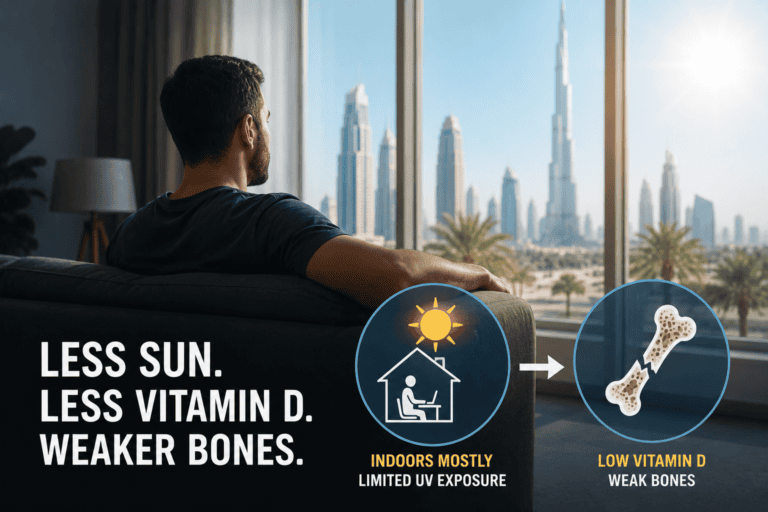
Dr. Sherief Elsayed explains the behavioural mechanism behind this paradox: “In the UK, even if it’s not a really sunny day, you’re still getting UV rays because you’re out and about. Whereas in Dubai, you’re largely indoors because the sun is so harsh.”
This distinction between incidental and deliberate sun exposure is the key to understanding the paradox.
In the UK: Even on an overcast day, ambient UVB radiation, the specific wavelength of ultraviolet light responsible for triggering vitamin D synthesis in the skin, penetrates cloud cover to a meaningful degree. British lifestyle patterns typically involve substantial time spent outdoors: walking to public transport, walking between buildings, outdoor recreation, and general daily activity conducted without excessive concern about sun exposure, because the climate rarely presents the kind of intense heat that would discourage it.
In Dubai: The intensity of the sun, particularly during the long, extremely hot summer months, actively discourages outdoor activity. Air-conditioned indoor environments, from homes to offices to shopping malls to cars, become the default setting for daily life. The very harshness of the climate that provides abundant sunshine also creates powerful behavioural incentives to avoid direct exposure to it.
This produces a genuinely counterintuitive outcome: the population living in the sunnier location often has less actual skin exposure to UVB radiation than the population living in the cloudier one, because behaviour, not solar intensity, is the dominant variable determining vitamin D synthesis in modern urbanised populations.
The Physiology: What Vitamin D Actually Does for Bone
Understanding why vitamin D deficiency matters requires understanding its specific role in calcium metabolism and bone health.
Dr. Sherief Elsayed explains the mechanism: “Low levels of vitamin D means that you absorb less calcium. What does your body do? It takes that calcium from the bones.”
The calcium absorption pathway:
Vitamin D, once activated in the body, acts on the cells lining the small intestine to promote the active transport of dietary calcium from the gut into the bloodstream. Without adequate vitamin D, this active transport mechanism is significantly impaired, meaning that even a diet with adequate calcium content will not be efficiently absorbed. Much of that dietary calcium simply passes through the digestive system unabsorbed.
The compensatory mechanism:
The body maintains blood calcium levels within a very tight range because calcium is essential for numerous critical functions, including nerve signalling, muscle contraction, and blood clotting. When dietary calcium absorption falls due to vitamin D deficiency, the body does not simply allow blood calcium to drop. Instead, the parathyroid glands respond by increasing the release of parathyroid hormone, which acts on bone to release stored calcium into the bloodstream, maintaining normal blood calcium levels at the direct expense of skeletal calcium reserves.
This is the mechanism Dr. Sherief Elsayed is describing when he says the body “takes that calcium from the bones.” It is not a passive failure to build bone. It is an active process of bone resorption, driven by the body’s prioritisation of blood calcium homeostasis over skeletal structural integrity.
What Happens to Bone as a Result
In adults: osteomalacia
Dr. Sherief Elsayed identifies the specific adult condition: “In adults, you get osteomalacia or soft bones.”
Osteomalacia is a condition in which the bone matrix, the collagen framework that gives bone its structure, fails to mineralise adequately with calcium and phosphate. Unlike osteoporosis, where the bone that is present has normal mineralisation but reduced overall quantity, osteomalacia produces bone that is present in adequate quantity but is poorly mineralised, softer, and more prone to bending and deformity under load.
Symptoms of osteomalacia include diffuse bone pain, particularly affecting the lower back, hips, and legs, muscle weakness (as vitamin D also has direct effects on muscle function), and in severe or longstanding cases, an increased risk of fractures, including stress fractures that occur with minimal or no trauma.
In children: rickets
Dr. Sherief Elsayed identifies the childhood equivalent: “In children, rickets, bowing of the bones.”
As covered in detail in the published article Why a Child Walking Like a Duck Could Be a Spine or Bone Problem, rickets is the childhood manifestation of the same underlying vitamin D deficiency and impaired bone mineralisation process. Because children’s bones are actively growing at the growth plates, the consequences of inadequate mineralisation are more visually dramatic, producing bowed legs, waddling gait, and other characteristic skeletal deformities that are less commonly seen in the more subtle, diffuse presentation of adult osteomalacia.
The Long-Term Bone Health Implications
Beyond the immediate conditions of osteomalacia and rickets, chronic vitamin D deficiency has broader implications for long-term skeletal health.
Vitamin D deficiency compounds the natural age-related decline in bone density, meaning that individuals who are chronically deficient enter their later years with a lower bone density baseline than they would have achieved with adequate vitamin D status throughout life. This directly connects to the discussion in the published article Why Women in Their 30s Need to Start Protecting Their Bone Density, where peak bone mineral density and its subsequent maintenance are identified as critical determinants of future fracture risk.
For the spine specifically, chronically inadequate bone mineralisation increases the risk of vertebral compression fractures, contributes to chronic back pain from weakened vertebral structures, and can complicate the outcomes of spinal surgery, as poorly mineralised bone provides less secure fixation for implants including pedicle screws.
Who Is Most at Risk in Dubai?
Several population groups in the UAE are at particular risk of vitamin D deficiency.
Office-based professionals: Those who spend the majority of their waking hours in air-conditioned offices, travelling by car, and living in air-conditioned homes have minimal incidental sun exposure throughout the working week.
Women who wear covering clothing: Traditional dress that covers the majority of the skin, worn for religious or cultural reasons, significantly reduces the skin surface area available for UVB-driven vitamin D synthesis, regardless of how much time is spent outdoors.
Elderly individuals: Skin’s capacity to synthesise vitamin D from UVB exposure declines with age, meaning older adults require more sun exposure to achieve the same vitamin D synthesis as younger individuals, compounding the risk in a population already prone to reduced outdoor activity.
Individuals with darker skin pigmentation: Melanin, which provides protection against UV-related skin damage, also reduces the efficiency of UVB-driven vitamin D synthesis. Individuals with darker skin require significantly longer sun exposure to achieve equivalent vitamin D synthesis compared to those with lighter skin.
Breastfed infants: Breast milk contains minimal vitamin D, making supplementation important for exclusively breastfed infants, particularly in a population where maternal vitamin D deficiency is common.
A Spinal Health Doctor in Dubai assessing a patient with unexplained bone pain, muscle weakness, or recurrent fractures should include vitamin D deficiency in the differential diagnosis, given its high prevalence in the UAE population.
What Can Be Done
Testing: A simple blood test measuring 25-hydroxyvitamin D levels provides an accurate assessment of vitamin D status and should be considered as part of routine health screening for residents of the UAE, given the population-wide risk factors described here.
Supplementation: For individuals found to be deficient, vitamin D supplementation, at a dose and duration appropriate to the severity of deficiency, is a straightforward and highly effective treatment. Maintenance supplementation is often continued long-term given that the underlying behavioural and environmental risk factors, air-conditioned indoor lifestyle and sun avoidance, are unlikely to change.
Sensible sun exposure: Brief, deliberate sun exposure, of the hands, arms, and face, for a short period several times per week, ideally outside the most intense midday hours, can contribute meaningfully to vitamin D synthesis without the skin cancer risk associated with prolonged, unprotected exposure during peak intensity hours.
Dietary sources: Fatty fish, egg yolks, and fortified foods provide dietary vitamin D, though for most people in the UAE, dietary intake alone is insufficient to maintain adequate levels without either sun exposure or supplementation.
Expert Summary
The counterintuitive reality that Dubai residents can be more vitamin D deficient than their counterparts in a far cloudier country reflects behaviour, not solar intensity. The very harshness of the UAE’s climate discourages the incidental outdoor exposure that maintains adequate vitamin D synthesis in less extreme climates, while the air-conditioned indoor lifestyle that the climate necessitates removes the opportunity for that exposure almost entirely. The consequence, reduced calcium absorption and compensatory bone calcium mobilisation, produces osteomalacia in adults and rickets in children, both of which are entirely preventable with appropriate testing and supplementation.
Table of Contents
Recent Articles

Why Eight People Were Needed for One Spine Surgery in Dubai
Why Eight People Were Needed for One Spine Surgery in Dubai Does every spinal surgery require exactly eight team members? No, as Dr. Sherief Elsayed explains directly, the specific team
Three Spine Surgery Myths a Dubai Surgeon Wants You to Forget
Three Spine Surgery Myths a Dubai Surgeon Wants You to Forget Is it really safe to walk on the same day as spine surgery? Yes, for the majority of modern
Why Osteoporosis Is Called the Silent Disease in the UAE
Why Osteoporosis Is Called the Silent Disease in the UAE If osteoporosis doesn’t cause pain, how would I know if I needed a DEXA scan? Given the entirely silent nature