
Why a Custom 3D Scanned Brace Works Better for Scoliosis in Dubai
Is 3D scanning for scoliosis braces widely available in Dubai?
3D scanning for brace manufacture is available at specialist orthotics centres in Dubai and is increasingly becoming the standard approach at leading scoliosis management centres. Patients should ask their scoliosis specialist specifically whether 3D scanning is available and used for brace prescription at their centre.
Does a 3D-scanned brace cost more than a conventional brace?
The manufacturing process for a 3D-scanned custom brace may carry a higher initial cost than a conventionally manufactured brace. However, given that the clinical success of bracing depends critically on wearing hours, and that a better-fitting brace is more likely to achieve adequate wearing hours, the cost-effectiveness of a higher-quality brace should be considered in the context of the cost of the surgical alternative if bracing fails.
How often does the brace need to be replaced as the child grows?
Growing adolescents typically require brace replacement or significant modification every six to twelve months. A Scoliosis Correction Surgeon in Dubai will monitor growth and curve progression at each review to determine when re-scanning is needed. every six to twelve months, depending on growth rate. Regular reviews with the orthotist throughout the bracing period ensure that the fit remains appropriate as the patient grows.
Can a 3D-scanned brace correct the existing curve?
No. As described in the companion article on brace compliance, scoliosis bracing does not correct an existing curve. It prevents progression of the curve during the growth period. The curve present at the time bracing is started remains visible after successful bracing but has not progressed further.
Is a custom brace better than a standard brace for all patients?
Custom bracing is most important for achieving the best possible fit and corrective force distribution in individual patients. For straightforward curve patterns in patients with anatomy close to average, the benefit of custom scanning over high-quality conventional fitting may be smaller. For patients with complex curves, unusual anatomy, or previous failed bracing, custom 3D scanning is particularly valuable.
At what age should brace fitting using 3D scanning ideally begin?
Bracing is most effective when initiated at a Cobb angle of 25 to 45 degrees in a skeletally immature patient. The timing of the brace prescription depends on the clinical assessment of growth remaining, curve magnitude, and rate of progression. The 3D scanning process is suitable for patients across the range of ages at which bracing is clinically appropriate.
Not all scoliosis braces are equal. The difference between a brace that genuinely controls a scoliosis curve and one that merely looks like it does on X-ray but is discarded within weeks because it is unwearable, lies primarily in how well the brace fits the individual patient. A brace designed for an average body shape will fit no actual body perfectly. A brace designed from a precise three-dimensional scan of a specific patient’s torso can be engineered to apply corrective forces exactly where they need to be, and avoid creating pressure exactly where it does not help.
Dr. Sherief Elsayed, Consultant Spine Surgeon in Dubai, describes the specific process of 3D scanning for custom scoliosis brace manufacture and makes the case for why this technology matters for outcomes.
What Traditional Brace Manufacturing Involves
To appreciate what 3D scanning improves, it helps to understand the traditional approach to scoliosis brace manufacture.
Conventional scoliosis braces, including the Boston brace and its variants, are traditionally made from plaster of Paris casts of the patient’s torso or from manual measurements applied to standard shell shapes. A plaster cast is applied to the patient in a corrected position, allowed to set, removed, and sent to an orthotist who uses it as the template for brace fabrication. This process captures the external contour of the torso but relies on the skill of the casting technician and the orthotist to translate that capture accurately into a functional corrective device.
The resulting brace provides a reasonable fit in many cases. But it is also subject to the inaccuracies inherent in a process that involves multiple manual translation steps between the patient’s actual anatomy and the final product.
What 3D Scanning Adds
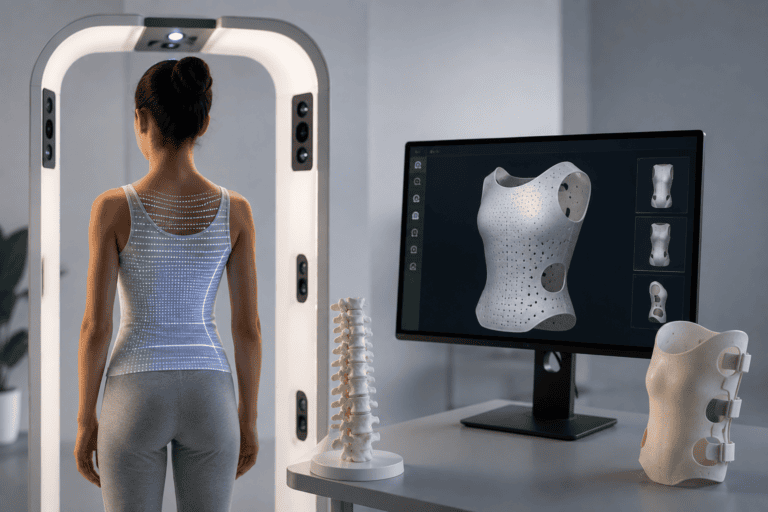
Dr. Sherief Elsayed describes the technology directly: “She’s going to be fitted for a brace. The scanner has basically three-dimensional scanned her torso so the technician can now look at the shape of her torso from all different angles. This brace will be custom-made based on the three-dimensional scan of her body.”
What the scan captures:
A 3D surface scanner, similar in principle to the technology used in industrial manufacturing and increasingly in consumer applications, captures a complete external surface map of the patient’s torso. This is not a single measurement or a cast taken at one point in time. It is a full 360-degree digital model of the patient’s torso as it exists at the moment of scanning, captured in a matter of seconds and stored as a precise three-dimensional dataset.
What this enables:
The orthotist and the brace fabrication system receive not a plaster approximation of the patient’s shape, but a digitally precise model. The corrective geometry of the brace, including where pressure pads are placed, how the trunk is derotated, and where relief zones must be created to allow normal body function and comfortable wear, can be planned and refined in the digital model before any physical material is shaped.
Computer-aided design of the brace allows the specific pressure points and relief zones required for the patient’s individual curve pattern to be engineered into the design rather than estimated during fitting. The resulting brace is then manufactured, typically using computer-controlled milling or vacuum-forming over a 3D-printed positive of the patient’s torso, with a precision that manual fabrication cannot match.
Why Fit Quality Determines Brace Effectiveness
As discussed in the companion article on scoliosis brace compliance, the most important determinant of brace outcome is wearing hours. A brace that is comfortable enough to be worn for close to 23 hours per day will achieve far better curve control than one that is worn for 10 hours because it is too uncomfortable to tolerate longer.
This is where brace fit quality has a direct pathway to clinical outcome.
A poorly fitting brace creates pressure points that cause skin irritation, pain, and tissue breakdown over time. These are not minor inconveniences. They are genuine clinical barriers to compliance. An adolescent who develops painful skin pressure sores from a poorly fitting brace will find reasons to remove it. A brace that restricts normal respiration because it fits incorrectly across the rib cage will be removed at night because it prevents comfortable sleep. A brace that digs into the axilla (armpit) during the school day will be taken off in the bathroom and not put back on until the patient returns home.
Each of these scenarios represents a reduction in wearing hours that directly compromises the clinical effect of the bracing intervention.
What a well-fitting brace enables:
A brace manufactured with precise individual fit can place corrective pressure exactly over the apex of the curve, in the precise amount needed to apply the three-point pressure system that produces curve correction on X-ray, while simultaneously creating adequate relief zones over bony prominences, the iliac crests, the ribs, and the axilla, that allow the brace to be worn comfortably for extended periods. The corrective forces are maximised. The discomfort is minimised. Compliance hours increase. Clinical outcomes improve.
A Scoliosis Specialist in Dubai who prescribes bracing as part of a scoliosis management plan and ensures that the brace is manufactured to the highest quality standard available, including 3D scanning where possible, is providing the foundation for the best achievable non-surgical outcome. The article on brace compliance elsewhere in this series makes clear why every percentage point of improvement in wearing hours has direct clinical consequences.
What the Fitting Process Looks Like
Dr. Sherief Elsayed describes the scene from a real clinical appointment where a patient is being fitted: “This brace will be custom-made based on the three-dimensional scan of her body. The brace will then come back and there are some fine-tuning adjustments, but it’ll be a much better fit than one that wasn’t scanned.”
The process in practice involves:
- The scanning appointment:
The patient stands or sits in a defined position while the scanning device captures the torso surface. Modern scanning systems complete this in under a minute, which is particularly important for younger children or patients with limited ability to maintain a still position.
- Digital design:
The orthotist reviews the 3D model, plans the corrective geometry based on the patient’s X-ray curve data and specific curve pattern, and designs the brace digitally before manufacture.
- Fabrication:
The brace shell is fabricated using the digital design, typically from polypropylene or similar thermoplastic material, cut and shaped by computer-controlled equipment rather than manual fabrication tools.
- Fine-tuning at fitting:
The manufactured brace is applied to the patient, and the orthotist makes any necessary adjustments based on the actual fit, which Dr. Sherief Elsayed acknowledges: “there are some fine-tuning adjustments.” No scan and no manufacturing process eliminates the need for clinical assessment of the finished brace on the individual patient. But the adjustments required after a 3D-scanned custom brace are typically minor, compared to the more significant modifications often needed for braces that were not started from a precise individual template.
UAE-Specific Considerations
Access to 3D scanning for scoliosis brace manufacture is available at specialist orthotics and brace centres in Dubai and across the UAE. A Spinal Deformity Surgeon in Dubai (Spinal Deformities, Adult & Paediatric Care) can direct families toward centres offering this higher standard of brace manufacture. at specialist orthotics and brace centres in Dubai and across the UAE. However, not all bracing services offer this technology, and some patients may be prescribed braces made using conventional methods simply because a 3D scanning service is not available at the prescribing centre.
For a condition where the difference between adequate and inadequate brace compliance can be the difference between avoiding surgery and requiring it, this investment matters. A Consultant Spine Surgeon in Dubai overseeing scoliosis management will emphasise this quality standard when prescribing bracing. can be the difference between avoiding surgery and requiring it, ensuring that the brace has the best possible chance of being worn successfully is a worthwhile priority. Families of adolescents who have been prescribed scoliosis bracing should ask specifically whether the brace will be manufactured from a 3D scan of their child’s torso.
Expert Summary
A scoliosis brace manufactured from a precise 3D scan of the patient’s individual torso fits better than one made from conventional manual methods. Better fit means greater comfort. Greater comfort means more wearing hours. More wearing hours mean better curve control and reduced surgical risk. The technology is available, the pathway from scan to better outcome is direct and well-understood, and the investment in this higher standard of brace manufacture is appropriate for a condition where the alternative is surgery. Dr. Sherief Elsayed’s description of the 3D scanning process from a real patient fitting appointment illustrates how this technology is applied in everyday clinical practice in Dubai.
Table of Contents
Recent Articles
Why Eight People Were Needed for One Spine Surgery in Dubai
Why Eight People Were Needed for One Spine Surgery in Dubai Does every spinal surgery require exactly eight team members? No, as Dr. Sherief Elsayed explains directly, the specific team
Three Spine Surgery Myths a Dubai Surgeon Wants You to Forget
Three Spine Surgery Myths a Dubai Surgeon Wants You to Forget Is it really safe to walk on the same day as spine surgery? Yes, for the majority of modern
Why Osteoporosis Is Called the Silent Disease in the UAE
Why Osteoporosis Is Called the Silent Disease in the UAE If osteoporosis doesn’t cause pain, how would I know if I needed a DEXA scan? Given the entirely silent nature