
Why Spinal Cord Injuries From Motorbike Accidents Are Irreversible
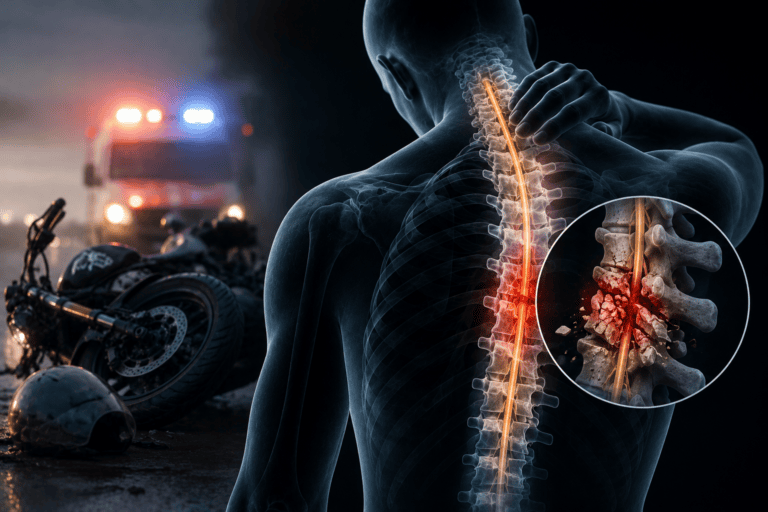
Can any recovery occur after a complete spinal cord injury?
True complete spinal cord injury, with no preserved motor or sensory function below the injury level, has a very poor prognosis for meaningful neurological recovery. A small proportion of patients classified as complete at initial assessment are reclassified as incomplete on later assessment as oedema reduces and function returns, and these patients have a better prognosis. However, for genuinely complete injuries confirmed beyond the acute phase, significant functional recovery is not expected with current treatments.
How important is time-to-surgery for spinal cord injuries?
For incomplete injuries, prompt surgical decompression, within hours of the injury in many cases, is associated with better neurological outcomes. For complete injuries, the urgency of surgery is less related to neurological recovery and more related to spinal stability, infection prevention, and allowing early rehabilitation. Speed matters most when some function is preserved and decompressing ongoing mechanical pressure on the cord may allow that function to be maintained or improve.
Is helmet use the most important factor in preventing spinal cord injury on a motorcycle?
Helmet use is the single most evidence-supported intervention for reducing head injury severity in motorcycle crashes. For cervical spinal cord injury, the relationship is more complex: some helmet designs may affect the transmission of forces to the cervical spine differently, but no helmet can prevent cord injury in sufficiently high-energy impacts. Speed reduction and protective body armour for the torso and limbs are as important as helmet use in reducing overall injury severity.
What does a spinal cord injury at different levels mean for function?
The level of injury determines which muscles and sensory areas are affected. Cervical injuries at C4 and above may require ventilatory support. Injuries at C5 to C8 produce tetraplegia (all four limbs affected) but with progressively more preserved arm and hand function. Thoracic and lumbar injuries produce paraplegia affecting the legs with preservation of hand and arm function. The specific level and completeness of the injury together determine functional prognosis.
Are spinal cord injuries covered by insurance in the UAE?
Medical insurance coverage for spinal cord injury treatment and rehabilitation varies between providers and policies. The acute surgical phase is typically covered by comprehensive health insurance. Long-term rehabilitation and ongoing care requirements should be confirmed with the insurance provider, as these can represent significant ongoing costs.
Is there a cure for spinal cord injury on the horizon?
Several research directions are actively pursued, including stem cell transplantation, growth factor therapy, targeting the inhibitory environment of the injured cord, and electrical stimulation approaches. While none has yet produced a clinical cure, the science is genuinely advancing, and what is possible for people living with cord injuries is meaningfully different today from what it was a decade ago.
Of all the sobering conversations that a spine surgeon has, the one about irreversibility is the hardest. A patient arrives in the emergency department, perhaps still confused, perhaps beginning to understand that something has permanently changed. The spinal cord, unlike almost every other structure in the body, does not regenerate in any clinically meaningful way once it has been significantly damaged. Understanding why this is, what the current limits of medicine actually are, and what realistic hope looks like, matters both for patients and for every person who rides a motorbike or drives at speed.
Dr. Sherief Elsayed, Consultant Spine Surgeon in Dubai, addresses this directly from an emergency context involving motorbike accidents, one of the most common sources of catastrophic spinal cord injury in the UAE.
The Clinical Reality at the Scene
Dr. Sherief Elsayed describes the immediate surgical picture: “When I see a patient with a spinal cord injury from a motorbike accident or any other traumatic accident, my role is to try and realign the spine and to protect the spinal cord from any further injury. I can’t undo the injury that’s already been done. I can only make sure that whatever function is left over, I protect it.”
This statement, delivered simply and without cushioning, defines the actual scope of spinal cord injury surgery. It is not restorative. It is protective. The spine is realigned, the cord is decompressed from any ongoing mechanical compression, and stability is restored to prevent further damage. But the neurons within the cord that were destroyed at the moment of injury are gone. They will not grow back. They will not reconnect.
This is fundamentally different from how most of the body heals. A broken bone reunites. A lacerated tendon remodels. A severed peripheral nerve can, over months, regrow to reach its target muscle. The spinal cord, as part of the central nervous system, lacks the regenerative capacity that peripheral tissues possess.
Why the Spinal Cord Cannot Regenerate
The difference between peripheral nerve regeneration and spinal cord regeneration is biological and specific.
Peripheral nerve regeneration: A peripheral nerve, such as the sciatic nerve or a nerve in the hand, can regenerate after injury because it is surrounded by Schwann cells that provide a physical and chemical scaffold for regrowth. When a peripheral nerve is damaged, Schwann cells dedifferentiate, clear the debris of the damaged axons, and create tubes through which new axonal growth can occur. The process is slow (roughly 1 millimetre per day) but meaningful recovery is possible over months.
Spinal cord regeneration: The spinal cord exists in an inhibitory environment. After injury, oligodendrocytes (the myelin-producing cells of the central nervous system) and astrocytes respond to damage in ways that are collectively hostile to axonal regrowth. Myelin debris from damaged axons produces growth-inhibitory proteins. Astrocytes form a glial scar that is a physical and chemical barrier to regenerating axons. The factors that enable peripheral nerve regeneration are absent or suppressed in the central nervous system.
This is an active area of research, with considerable effort directed at modifying the inhibitory environment, providing growth factors, creating scaffolds, and using stem cells to provide alternative regenerative pathways. But as of now, none of these approaches has translated into a clinical treatment that meaningfully restores function in human patients with complete spinal cord injury.
What “Protecting What Is Left” Actually Means
Despite the limits of what surgery can achieve, Dr. Sherief Elsayed’s role in protecting remaining function is genuinely important, and the difference between adequate and inadequate management in the acute phase is clinically significant.
Realigning the spine:
In a traumatic spinal injury, the vertebrae may be fractured, dislocated, or both, creating mechanical compression on the spinal cord or an unstable segment that continues to compress the cord with every movement. Surgical realignment removes this ongoing mechanical threat, potentially preventing additional cord damage beyond what the initial injury caused.
Stabilising the segment:
Without surgical fixation, an unstable fracture will continue to move with every breath and movement. A Spinal Cord Surgeon in Dubai stabilises this instability as the first priority in acute traumatic spinal cord injury management. with every breath and movement. This ongoing instability is a source of repeated mechanical insult to the already-injured cord. Stabilisation with screws, rods, and plates creates a rigid mechanical environment in which the cord can recover whatever limited recovery is possible without ongoing provocation.
Protecting blood supply:
As covered in the article on spinal cord protection during surgery, maintaining adequate blood pressure, specifically mean arterial pressure, is essential in the acute phase of spinal cord injury to prevent secondary ischaemic injury. The management of blood pressure in the intensive care unit following a spinal cord injury directly affects neurological outcome, and this medical management is as important as the surgical intervention itself.
Preserving incomplete injuries:
The most important distinction in spinal cord injury management is between complete and incomplete injuries. A complete injury, in which no motor or sensory function is preserved below the level of injury, has a poor prognosis for functional recovery regardless of surgical intervention. An incomplete injury, in which some function is preserved, carries a much better prognosis, and the amount of recovery depends heavily on how quickly and effectively the cord is decompressed and protected from secondary injury.
A patient who is incomplete at admission and converts to complete by the time of surgery may represent inadequate management of secondary injury in the interval between accident and treatment. This is why time-to-surgery matters in incomplete spinal cord injuries in a way that it does not in complete ones.
The UAE Context: Motorbike Accidents and Why They Cause Such Severe Injuries
Dr. Sherief Elsayed’s specific mention of motorbike accidents reflects a genuine epidemiological reality in the UAE. Road traffic accidents are a leading cause of traumatic spinal cord injury, and motorcyclists are disproportionately represented in the most severe injury categories.
Several biomechanical factors explain this severity.
Lack of structural protection: A car’s body structure absorbs and distributes crash energy over a large surface area. The occupant is encircled by this structure and connected to it via a seatbelt and airbag system. A motorcycle rider has none of this. Their body is the primary energy-absorbing structure in a collision.
Ejection and secondary impact: Motorcycle crashes frequently involve ejection from the vehicle, leading to high-energy impacts with the ground, barriers, or other vehicles at speeds that the human body was not designed to sustain. The forces transmitted to the cervical and thoracic spine during these impacts routinely exceed the structural limits of the vertebral column.
High operating speeds: The UAE’s road network includes both urban and inter-emirate highway sections where motorcycles travel at high speeds. The kinetic energy in a collision increases as the square of velocity, meaning that a collision at 100 km/h does not simply have twice the energy of a collision at 50 km/h but four times the energy. At these velocities, even modern protective equipment cannot prevent significant force transmission to the spine.
Helmet protection and its limits: A proper helmet protects the brain and skull very effectively but does not protect the cervical spine, which is subjected to the same decelerative and rotational forces as the head in a crash. Cervical spine fractures with cord injury remain common even in properly helmeted riders in high-energy impacts. A Spine Trauma Surgeon in Dubai who manages these cases understands that the same injury forces that cause catastrophic neurological damage can look deceptively minor on external examination.
What Rehabilitation Can and Cannot Achieve
While neurological recovery from a complete spinal cord injury is not currently achievable, rehabilitation plays an enormously important role in maximising functional outcome, quality of life, and independence.
What rehabilitation achieves:
Preventing secondary complications, including pressure sores, contractures, urinary tract infections, and respiratory complications, each of which can be life-threatening in a cord-injured patient. Maximising the functional use of whatever motor function remains through intensive physiotherapy and occupational therapy. Retraining compensatory strategies so that patients can perform activities of daily living using alternative muscle groups or adaptive equipment. Managing spasticity, pain, and autonomic dysfunction with appropriate medical and physical interventions. Preparing patients and families for long-term community living with the appropriate support structures.
What rehabilitation cannot achieve:
It cannot restore lost neurological function in a complete cord injury. It cannot reconnect damaged axonal pathways. It cannot make a paraplegic patient walk again if the cord damage is complete at the relevant level.
The emerging landscape:
Brain-computer interfaces, epidural electrical stimulation, and exoskeletal devices are improving the functional possibilities for people with spinal cord injuries in meaningful ways. A person with a complete thoracic cord injury can, with certain electrical stimulation protocols, activate stepping movements that would not otherwise be possible. A brain-computer interface can allow direct computer control for patients with cervical cord injuries. These technologies do not reverse the cord injury, but they are extending what a person with cord damage can functionally do, and the landscape is genuinely advancing. The article Dr. Sherief Elsayed on Why AI Is a Useful Guide but Not a Replacement for Your Doctor touches on how technology is increasingly integrated into medical care.
Expert Summary
Spinal cord injuries from motorbike accidents are irreversible because the central nervous system cannot regenerate damaged neurons. Surgery protects what remains, stabilises the spine, and prevents secondary injury, but it cannot undo what the initial impact caused. This is the honest clinical reality that every rider should understand, and it is the context in which protective equipment, road safety, and sensible riding speeds are not merely legal requirements but genuine determinants of whether a crash results in a bruise or a permanent neurological deficit. If you have questions about spinal cord injury management in the UAE, consulting a Spinal Reconstruction Surgeon in Dubai provides the most direct access to specialist expertise in this area.
Table of Contents
Recent Articles

Why Eight People Were Needed for One Spine Surgery in Dubai
Why Eight People Were Needed for One Spine Surgery in Dubai Does every spinal surgery require exactly eight team members? No, as Dr. Sherief Elsayed explains directly, the specific team
Three Spine Surgery Myths a Dubai Surgeon Wants You to Forget
Three Spine Surgery Myths a Dubai Surgeon Wants You to Forget Is it really safe to walk on the same day as spine surgery? Yes, for the majority of modern
Why Osteoporosis Is Called the Silent Disease in the UAE
Why Osteoporosis Is Called the Silent Disease in the UAE If osteoporosis doesn’t cause pain, how would I know if I needed a DEXA scan? Given the entirely silent nature