
Why Titanium Is Used in Spinal Implants, A UAE Surgeon Explains
Is titanium safe to have permanently in the body?
Yes. Titanium has an outstanding biocompatibility record across decades of use in spinal and orthopaedic surgery. Its natural oxide layer makes it chemically stable in the biological environment, and it does not release significant levels of metal ions. Most titanium spinal implants remain in place permanently without causing problems.
Can I have an MRI scan with titanium implants in my spine?
Yes. Titanium is non-ferromagnetic, meaning it does not interact with the magnetic field of an MRI scanner in a way that would cause movement or significant heating. Modern titanium spinal implants are MRI-compatible, though they may produce some local image artifact on the MRI, which experienced radiologists account for in their interpretation.
What is stress shielding and why is it a problem?
Stress shielding occurs when a stiff implant carries most of the mechanical load that would otherwise pass through the adjacent bone. Bone that is not adequately loaded loses density over time. In spinal surgery, stress shielding around a cage can lead to bone loss, implant loosening, and reduced long-term stability of the fusion.
How long does it take for bone to grow into a 3D-printed titanium cage?
Bone ingrowth into the porous structure of a 3D-printed cage begins within weeks of surgery and continues over months. Solid radiographic evidence of fusion, visible on CT imaging, is typically present at three to six months, with continued maturation over the following year.
What is the difference between a titanium cage and a titanium plate in spine surgery?
A cage is an interbody spacer placed within the disc space to restore disc height, provide a scaffold for fusion, and decompress the neural structures. A plate is a flat metal component fixed to the front or back of the vertebrae with screws, providing additional stability to the construct while fusion occurs. Both may be used together in the same procedure.
Can 3D-printed titanium cages be customised for individual patients?
Yes, this is one of the significant advances of additive manufacturing. For complex cases, particularly tumour reconstruction or severe deformity correction, patient-specific implants can be designed from the individual’s CT scan and manufactured to precisely match their anatomy, providing a fit and stability that standard off-the-shelf implants cannot achieve.
When a patient undergoes spinal surgery requiring an implant, the material that implant is made from is not chosen arbitrarily. It is the result of decades of materials science research, clinical testing, and engineering refinement. Titanium has become the dominant material in modern spinal implant design, and the reason, rooted in a specific mechanical property, is both scientifically precise and clinically critical.
Dr. Sherief Elsayed, Consultant Spine Surgeon in Dubai, explains this directly from the operating theatre while preparing to insert a 3D-printed titanium mesh cage after removing two cervical discs compressing the spinal cord.
The Case: Two Discs Compressing the Spinal Cord
Dr. Sherief Elsayed walks through the imaging findings in real time: “This is the MRI scan of today’s case. We’re looking at the patient from the side. There’s the bottom of his brain, that’s the spinal cord. Disc, vertebra, disc, vertebra. On this type of MRI, fluid is white, so we can see all the normal white fluid around the cord. You can see that this disc and this disc is compressing his spinal cord, and he has weakness because of that.”
The clinical picture is clear. Two cervical discs have herniated sufficiently to compress the spinal cord itself, not merely a nerve root. The result is myelopathy, producing limb weakness from cord-level dysfunction. The surgical plan follows directly from the imaging: “So what we’re going to do is we’re gonna remove both those discs, make the spinal cord nice and free, and now I’m gonna insert a 3D-printed titanium mesh cage.”
What Is Young’s Modulus and Why Does It Matter for Spinal Implants?
Dr. Sherief Elsayed names the specific engineering property that makes titanium the material of choice: “The reason we use titanium is it has a Young’s modulus similar to bone. Those engineers amongst you will understand what that means.”
Young’s modulus is a measure of a material’s stiffness, specifically its resistance to deformation when a force is applied along its length. It describes how much a material will compress or stretch under a given load. A high Young’s modulus means a very stiff material that deforms very little under load. A low Young’s modulus means a more flexible material.
Why this matters for spinal implants:
The vertebral bone that surrounds and supports any spinal cage has its own Young’s modulus. If the implant placed within or against that bone is dramatically stiffer than the bone itself, a serious problem develops. Under the cyclic compressive loads that the spine generates with every step, every breath, and every movement, the much stiffer implant carries almost all the load while the bone beside it carries very little. Bone, like muscle, responds to the load it receives. Remove the load stimulus and bone density in that region falls through a process called stress shielding. Over time, this bone loss weakens the construct, risks implant loosening, and can lead to implant failure or subsidence (the implant sinking into the softened bone).
Titanium’s Young’s modulus, at approximately 100 to 110 GPa, is meaningfully lower than that of steel (approximately 200 GPa) and much closer to cortical bone (15 to 25 GPa for bone, though the specific value varies with density and location). This means titanium shares load more appropriately with adjacent bone rather than completely shielding it, reducing stress shielding and supporting better long-term integration and stability.
What Is a 3D-Printed Titanium Mesh Cage?
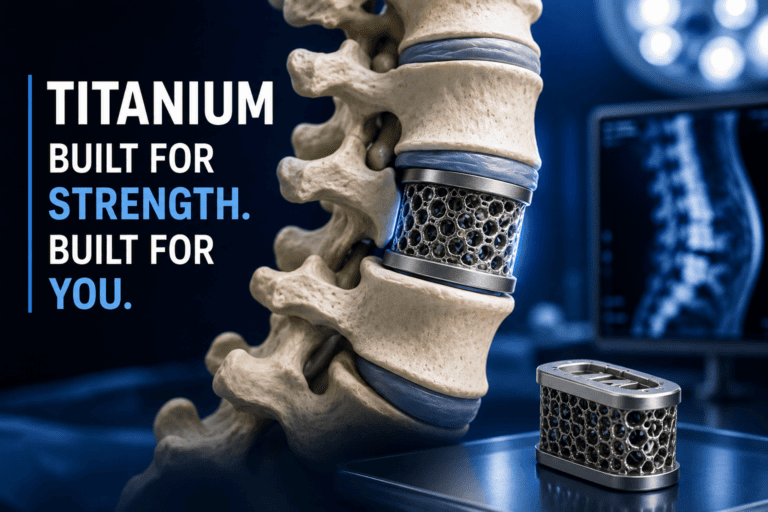
The specific implant used in this case, a 3D-printed titanium mesh cage, represents a significant advance on earlier generation solid titanium and polyetheretherketone (PEEK) implants.
How it is made:
3D printing, or additive manufacturing, builds the cage layer by layer from titanium powder using a laser or electron beam. This allows the creation of complex internal architectures, including porous lattice structures, that would be impossible to manufacture using conventional machining.
Why the porous design matters:
The lattice structure of a 3D-printed cage is not merely aesthetic. It creates a scaffold with a high surface area and interconnected pore channels that allow bone to grow directly into the implant over time. This biological integration, called osseointegration, creates a direct structural bond between the implant and the surrounding bone that a smooth-surfaced solid implant cannot achieve. The porous titanium cage essentially becomes incorporated into the patient’s own bone architecture over the months following surgery, creating a fusion that is far more stable and durable than surface-level contact alone.
The porosity also addresses stiffness:
By introducing a controlled degree of porosity, the effective Young’s modulus of the porous cage is reduced further than that of solid titanium, bringing it even closer to the range of bone. This is an active engineering solution to the stress shielding problem, refined through computational modelling and clinical testing.
A Cervical Spine Doctor in Dubai performing a multilevel cervical corpectomy or discectomy will select the specific cage design, size, and porosity based on the patient’s anatomy, the number of levels being addressed, and the degree of bone quality present at the operative levels.
Why Titanium Wins Over Alternative Materials
Several materials have been used historically in spinal implants, each with advantages and limitations.
Stainless steel: Strong and inexpensive but poorly tolerated in MRI environments due to significant artifact formation and its much higher Young’s modulus creating stress shielding concerns. Largely superseded by titanium for interbody applications.
PEEK (Polyetheretherketone): A high-performance polymer with a Young’s modulus closer to bone than even titanium. MRI-compatible and radiolucent (does not appear on X-ray, making it easier to assess fusion around the implant). However, PEEK surfaces do not osseointegrate well, with smooth PEEK surfaces potentially fibrous-encapsulating rather than fusing with adjacent bone. Hybrid implants combining PEEK bodies with titanium surfaces attempt to address this.
3D-printed titanium: Combines the established biocompatibility, corrosion resistance, and strength of titanium with the surface characteristics that promote osseointegration. Current evidence supports superior fusion rates compared to solid PEEK. The porosity can be tuned for specific applications.
Biocompatibility: Why the Body Tolerates Titanium
Beyond its mechanical properties, titanium’s clinical success depends on its extraordinary biocompatibility. A Spinal Fusion Doctor in Duba selecting implant material for a fusion procedure weighs this biocompatibility alongside the mechanical properties discussed above. The body’s immune system recognises titanium as inert and does not mount a significant inflammatory response to its presence. This is due primarily to a naturally occurring oxide layer that forms on titanium’s surface on contact with air or biological fluids, which is chemically stable and does not participate in the biological reactions that trigger inflammation.
Over decades of clinical use, titanium has demonstrated an excellent safety record. A Spine Fusion Surgeon in Duba can explain the specific implant options available for a given procedure and their relative track records. in orthopaedic and spinal surgery, with no systemic toxicity from ion release at the low levels observed with well-integrated implants. This is in contrast to some older metallic alloys that released higher concentrations of potentially problematic ions over time.
UAE-Specific Context
Major spinal surgical centres across Dubai and the wider UAE routinely use 3D-printed titanium cage technology for cervical and lumbar interbody fusion procedures. The availability of advanced imaging for pre-operative planning, surgical navigation systems for precise implant placement, and post-operative CT and MRI for fusion assessment means that patients in the UAE can access the same technology available at leading spinal centres globally. For patients considering a procedure involving spinal implants, consulting a Consultant Spine Surgeon in Dubai who can explain the specific implant choice and its rationale provides the clearest picture of what a procedure will involve and why.
Expert Summary
Titanium is the material of choice for modern spinal implants because its Young’s modulus is closer to that of bone than any other metallic implant material, reducing stress shielding and supporting long-term bone health adjacent to the implant. The evolution to 3D-printed porous titanium cages further refines this by creating a scaffold that directly supports bone ingrowth, achieving biological integration rather than merely mechanical contact. In a case where two cervical discs were compressing the spinal cord, this precise, engineered material is the bridge between decompressing the cord and achieving a stable, lasting structural reconstruction of the spinal column.
Table of Contents
Recent Articles
Which Surgeon Should You See for Your Spine Problem in Dubai?
Which Surgeon Should You See for Your Spine Problem in Dubai? Is a neurosurgeon always more qualified than an orthopaedic surgeon for spine conditions? No. Both pathways, when combined with

Can Calcium Supplements Cause Kidney Stones?
Can Calcium Supplements Cause Kidney Stones? If I have osteoporosis, should I take calcium supplements? This should be discussed specifically with your doctor, who will assess your individual dietary calcium

What Precision Medicine Means for Pain Management in Dubai
What Precision Medicine Means for Pain Management in Dubai How accurate is pharmacogenomic testing? Pharmacogenomic testing for well-established genetic variants, including CYP2D6 metaboliser status, is highly accurate and based on