
Back Pain That Wakes a Child at Night, What It Could Mean
Is osteoid osteoma cancerous?
No. Osteoid osteoma is a benign bone tumour. It does not spread to other parts of the body and is not life-threatening. However, it can cause significant pain and, in the spine, can contribute to scoliosis if left untreated, which is why diagnosis and treatment are still important.
At what age does osteoid osteoma typically occur?
It most commonly affects children, adolescents, and young adults, typically between the ages of 5 and 25, with a peak incidence in the second decade of life. It is more common in males than females.
Can osteoid osteoma resolve without treatment?
Yes, osteoid osteomas have a natural history of eventual spontaneous resolution over a period of several years. However, because this can mean years of significant pain and NSAID dependence, and because spinal lesions can contribute to scoliosis, active treatment is usually recommended rather than waiting for natural resolution.
Is radiofrequency ablation safe for spinal osteoid osteoma?
Radiofrequency ablation is generally safe and highly effective for osteoid osteoma in accessible locations. For lesions very close to the spinal cord or major nerves, the proximity may make this technique less suitable, and surgical excision under direct visualisation may be preferred for safety.
Should all night-waking back pain in children be investigated with an MRI?
Persistent night pain (more than a few weeks), particularly when accompanied by other red flags such as fever, weight loss, neurological symptoms, or functional limitation, warrants prompt medical assessment and appropriate imaging. A paediatrician or specialist should guide the specific investigation pathway based on the full clinical picture.
Why is aspirin not normally recommended for children?
Aspirin use in children, particularly during viral illnesses such as chickenpox or influenza, is associated with Reye’s syndrome, a rare but serious and potentially fatal condition affecting the liver and brain. For this reason, aspirin is generally avoided in children under 16 except under specific medical guidance, and paracetamol or ibuprofen are preferred for most paediatric pain and fever management.
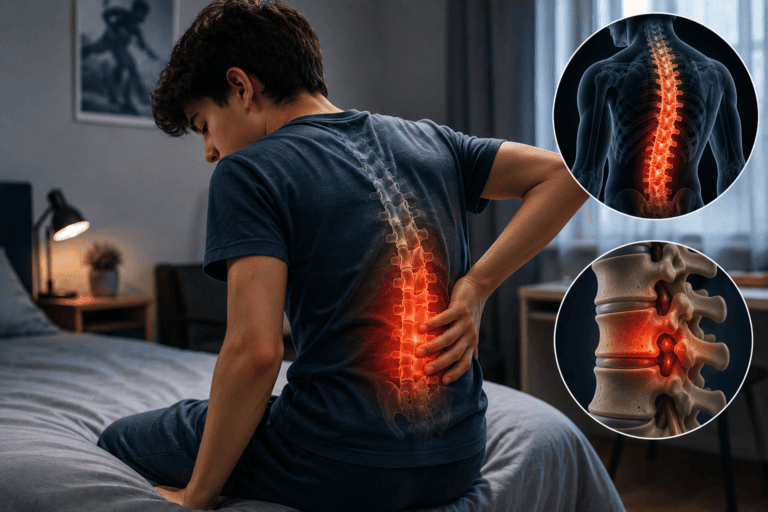
Back pain in a child is never something to dismiss casually, but the single detail that most reliably separates benign musculoskeletal pain from something serious is timing. A child who has back pain during the day, with activity, that settles with rest, is a very different clinical picture from a child who is woken from sleep by pain. The second pattern is a red flag that experienced clinicians take seriously, and the diagnostic process that follows demonstrates exactly why.
Dr. Sherief Elsayed, Consultant Spine Surgeon in Dubai, walks through a real clinical consultation that illustrates how a careful, structured approach to a worrying symptom in a child leads, step by step, to a specific and somewhat surprising diagnosis.
The Case: A 10-Year-Old With Night Pain
The case is presented as a direct clinical discussion: “I have a 10 year old boy with back pain. How long has it been a problem? It’s been there for a month. He keeps waking up at night with this pain. Certainly needs some urgent imaging.”
The very first response to night-waking back pain in a child is recognition that this requires investigation. The question that follows, about which investigation to choose, is equally instructive: “Would we do a CT? Would you jump straight to a CT scan in a 10 year old? Maybe an MRI?”
The preference for MRI over CT in a child is deliberate and important. CT scanning uses ionising radiation, and children are considerably more radiosensitive than adults, with a longer remaining lifespan during which radiation-induced malignancy could theoretically develop. MRI provides excellent soft tissue and bone marrow detail without any radiation exposure, making it the preferred first-line investigation for suspected serious spinal pathology in children whenever the clinical situation allows.
Why Night Pain Is a Red Flag
The clinical reasoning behind treating night pain seriously is explicit in the case discussion: “What comes to mind when I tell you that he wakes up at night with his pain? Infection, tumour, something worrying.”
This response reflects a well-established principle in musculoskeletal medicine. Mechanical back pain, the kind caused by muscle strain, poor posture, or minor ligamentous injury, is typically activity-related. It worsens with movement and loading, and it improves with rest. Pain that wakes a patient from sleep, particularly pain that is not related to position or movement, suggests a different mechanism: an inflammatory, infective, or neoplastic process that is active regardless of mechanical load.
In children specifically, the differential diagnosis for night-waking back pain includes a relatively short but important list of conditions that must be actively excluded:
- Spinal infection (discitis, vertebral osteomyelitis)
- Bone tumours, both benign and malignant
- Leukaemia and other haematological malignancies, which can present with bone pain
- Spondylolysis or spondylolisthesis, particularly in active children and adolescents
- In rare cases, spinal cord tumours
The seriousness of this differential is exactly why the case proceeds methodically through investigation rather than reassurance.
What the Imaging Showed
“He’s had an X-ray which doesn’t show very much. He’s had an MRI scan which shows a little bit of oedema in the T8 vertebra.”
A normal or near-normal X-ray does not exclude serious pathology in early disease. Many bone lesions, particularly small or early ones, are not visible on plain radiography until they have progressed significantly, because X-ray primarily detects changes in bone density and structure that take time to develop.
The MRI finding, localised oedema (fluid signal change reflecting inflammation) within the T8 vertebral body, is a more sensitive finding. MRI bone marrow oedema indicates an active process within the bone, but it is non-specific on its own. Infection, tumour, and several other conditions can all produce this appearance. The oedema tells the clinician where to look but not definitively what is happening.
Excluding Infection: The Travel History
“Any history of foreign travel? No foreign travel. I’m thinking some kind of weird infection could be possible.”
Travel history is a standard component of the assessment of suspected spinal infection. A Spine Infection Specialist in Dubai will routinely take this history when assessing a child with persistent back pain., because certain infective causes of vertebral osteomyelitis and discitis, including tuberculosis (Pott’s disease) and certain fungal infections, are geographically distributed and far more likely in patients with relevant travel or residence history. A negative travel history reduces, though does not entirely eliminate, the probability of these specific infective causes, while still leaving more common bacterial causes of discitis on the differential.
The Clue That Changed Everything: A Mother’s Unconventional Treatment
The detail that ultimately directs the diagnosis is unusual and easy to underestimate: “His mum, against all medical advice, gave him baby aspirin, got rid of the pain.”
This single piece of history is diagnostically powerful. The response: “Now you’re leading down my specialty. Maybe osteoid osteoma? Bang on.”
What Is Osteoid Osteoma?
Osteoid osteoma is a benign bone tumour, most commonly affecting children and young adults, with a strong predilection for the posterior elements of the spine and the long bones of the limbs. It is small, typically less than 1.5 centimetres, and consists of a nidus (core) of highly vascular, osteoid-producing tissue surrounded by a zone of reactive sclerotic bone.
The classic clinical features of osteoid osteoma:
- Pain that is characteristically worse at night
- Pain that responds dramatically and specifically to non-steroidal anti-inflammatory drugs (NSAIDs), including aspirin
- The pain relief from NSAIDs is so characteristic that it is considered a near-diagnostic clinical feature
- Localised tenderness over the lesion
- In spinal cases, painful scoliosis can develop as the child unconsciously postures away from the painful side
Why NSAIDs work so specifically for osteoid osteoma:
The nidus of an osteoid osteoma produces extremely high levels of prostaglandins, the inflammatory mediators that NSAIDs specifically inhibit through the cyclooxygenase (COX) enzyme pathway. This is why the response to aspirin or ibuprofen in osteoid osteoma is often described by patients and parents as dramatic and complete, far more effective than would be expected for typical musculoskeletal pain. The mother’s observation that baby aspirin “got rid of the pain” entirely is exactly the kind of response that should prompt specific consideration of this diagnosis.
How Is Osteoid Osteoma Confirmed and Treated?
Diagnosis:
CT scanning is the investigation of choice for confirming osteoid osteoma, as it shows the characteristic small lytic nidus with surrounding sclerosis with far greater clarity than MRI, which is excellent for detecting the surrounding bone marrow oedema but less precise for visualising the small nidus itself. In this case, the MRI finding of T8 oedema would prompt a targeted CT to identify and characterise the nidus.
Treatment options:
- Continued NSAID therapy can manage symptoms in some cases, as osteoid osteomas have a natural tendency toward spontaneous resolution over several years, though this requires prolonged medication use
- Radiofrequency ablation, a minimally invasive image-guided procedure that destroys the nidus with heat, has become the standard treatment for accessible lesions. A Spinal Cord Surgeon in Dubai would be consulted for lesions in higher-risk locations close to neural structures, offering excellent success rates with minimal invasiveness.
- Surgical excision is reserved for lesions in locations unsuitable for radiofrequency ablation, particularly those very close to the spinal cord or major neurovascular structures, where the precision of open surgical removal under direct vision is preferred for safety
A Spinal Deformity Surgeon in Dubai assessing a child with painful, NSAID-responsive back pain and scoliosis will specifically consider osteoid osteoma as part of the differential, particularly when the scoliosis appears to have developed acutely alongside the pain rather than gradually over time as in typical idiopathic scoliosis.
Why This Case Is a Model for Paediatric Back Pain Assessment
The value of this case extends beyond the specific diagnosis. It demonstrates the correct sequence of clinical reasoning for any child presenting with persistent back pain, particularly pain with red flag features.
The structured approach:
- Recognise red flag features (night pain, persistence beyond several weeks, any neurological symptoms) as requiring investigation rather than reassurance
- Choose imaging modalities appropriately for a paediatric patient, favouring MRI over CT where possible to avoid radiation exposure
- Take a thorough history including specific risk factors (travel, family history, constitutional symptoms)
- Pay close attention to seemingly incidental details, such as response to over-the-counter medication, which can carry significant diagnostic weight
- Use targeted further imaging (CT in this case) once the differential has been narrowed by the clinical picture
This systematic process, rather than reliance on any single test, is what allows a rare but specific diagnosis like osteoid osteoma to be reached confidently.
UAE-Specific Considerations
Parents in the UAE managing a child with persistent back pain should be aware that over-the-counter use of aspirin in children carries its own specific risk that must be discussed with a doctor: Reye’s syndrome, a rare but serious condition associated with aspirin use in children, particularly during viral illness. Any parent considering medication for a child’s pain, even seemingly minor over-the-counter treatment, should discuss this with a paediatrician first, both for the safety of the child and because, as this case shows, the response to such medication can itself be diagnostically important information to share with a specialist. A Spine Surgeon in UAE assessing a child with back pain will always ask about any medications tried and how the child responded.
Parents in the UAE may also find our article on why trampolines are dangerous for children useful.
Expert Summary
Back pain that wakes a child at night should never be assumed to be ordinary growing pains or muscular strain. It requires structured investigation, beginning with appropriate imaging and a thorough history. In this case, the combination of night pain, persistence, and a dramatic response to a simple NSAID pointed directly to osteoid osteoma, a benign but specifically treatable bone tumour. The lesson for any parent or clinician is that the smallest details, including how a child responds to medication, can carry significant diagnostic weight when interpreted in the right clinical context.
Table of Contents
Recent Articles
Why Eight People Were Needed for One Spine Surgery in Dubai
Why Eight People Were Needed for One Spine Surgery in Dubai Does every spinal surgery require exactly eight team members? No, as Dr. Sherief Elsayed explains directly, the specific team
Three Spine Surgery Myths a Dubai Surgeon Wants You to Forget
Three Spine Surgery Myths a Dubai Surgeon Wants You to Forget Is it really safe to walk on the same day as spine surgery? Yes, for the majority of modern
Why Osteoporosis Is Called the Silent Disease in the UAE
Why Osteoporosis Is Called the Silent Disease in the UAE If osteoporosis doesn’t cause pain, how would I know if I needed a DEXA scan? Given the entirely silent nature