
Not All Sciatica Comes From a Slipped Disc: A Dubai Spine Surgeon Explains Why

Can spondylolisthesis be present without causing any symptoms?
Yes. Many cases are discovered incidentally on imaging obtained for another reason. The presence of a slip does not inevitably lead to symptoms, and management is guided by the clinical picture rather than the imaging finding alone.
Is spondylolisthesis hereditary?
There is a genetic component, particularly for isthmic spondylolisthesis. First-degree relatives of affected patients have a higher prevalence. However, environmental factors including sports activity and occupation play an important role in whether the genetic predisposition leads to clinical disease.
Will a back brace help spondylolisthesis?
A lumbar support brace can provide short-term pain relief by reducing movement at the unstable segment. It is most useful in the acute phase or in younger patients with isthmic spondylolisthesis while the bone heals. It is not a long-term solution and does not address the underlying instability.
Can spondylolisthesis get worse over time?
Yes. The degree of slip can progress, particularly during periods of rapid growth in younger patients and during periods of disc degeneration in older patients. Regular follow-up imaging allows the progression to be monitored and treatment escalated if the slip advances significantly. For patients with high-grade slips or traumatic instability, a Spine Trauma Surgeon in Dubai (Dr Sherief Elsayed – Leading Spine Surgeon in Dubai) provides specialist assessment of complex structural cases.
How is spondylolisthesis different from spondylolysis?
Spondylolysis is a stress fracture through the pars interarticularis, the bone bridge that connects the facet joints. It is the precursor lesion that can lead to spondylolisthesis if the vertebra slips forward. Spondylolysis can exist without any slip occurring; spondylolisthesis by definition involves actual vertebral displacement.
Can spondylolisthesis be treated with a single injection?
A nerve root injection can provide significant temporary relief from the sciatica caused by foraminal compression in spondylolisthesis. It does not treat the underlying instability and is best used as part of a conservative management programme that includes physiotherapy, or as a bridge to surgery in patients who are not yet ready to proceed with an operation.
When patients experience shooting pain down the leg, the immediate assumption is almost always a slipped disc. It is the diagnosis that has entered popular consciousness as the explanation for sciatica, and it is correct, but only in some cases. A significant number of patients with classic sciatic symptoms have a completely different structural cause that requires a different treatment approach.
Dr. Sherief Elsayed, Consultant Spine Surgeon in Dubai, uses MRI imaging to show patients exactly how spondylolisthesis, a forward slip of one vertebra over another, produces nerve compression and sciatica that is just as painful as any disc herniation, but requires a different surgical solution.
What Is Spondylolisthesis?
Spondylolisthesis is a condition where one vertebra slips forward relative to the vertebra beneath it. The word comes from the Greek “spondylos” meaning vertebra and “olisthesis” meaning to slide.
Dr. Sherief Elsayed describes it directly: “What you see over here is a spondylolisthesis, which means that one vertebra slips forward over another.”
This forward displacement changes the geometry of the spine at that level. The spinal canal, already a precisely calibrated channel, is distorted. The foramen through which the nerve roots exit the spine, already a confined space, can become compressed. The result is nerve irritation or compression that produces symptoms clinically indistinguishable from those caused by a disc herniation.
Types of spondylolisthesis:
Isthmic spondylolisthesis: Caused by a stress fracture through the pars interarticularis, the narrow bone bridge connecting the facet joints front and back. Common in young athletes who perform repetitive spinal extension, such as gymnasts, fast bowlers in cricket, and weightlifters. The fracture (spondylolysis) allows the vertebra to slip forward.
Degenerative spondylolisthesis: The most common type in adults over 50. Develops as the disc degenerates and the facet joints wear, losing the structural integrity that normally prevents forward slip. Most common at L4/5. Associated with lumbar stenosis.
Dysplastic spondylolisthesis: Caused by congenital underdevelopment of the sacrum or facet joints.
Traumatic spondylolisthesis: Following direct injury to the posterior spinal elements.
Pathological spondylolisthesis: From disease weakening the bone, such as tumour or infection.
How Does Spondylolisthesis Cause Sciatica?
The mechanism is directly visible on MRI. Dr. Sherief Elsayed walks through the imaging: “Most of you will know that a disc prolapse that comes out and presses on a nerve causes sciatica, but another common cause of sciatica is this. We’re right in the middle of the spine here, but if I come to one side, I can see that this nerve up here is escaping nicely through the big hole. So is this nerve escaping nicely. But look at this now, compressed right down, and that’s why the patient has this nasty leg pain.”
The mechanism involves the foramen, the exit hole through which each nerve root leaves the spinal canal. In a normal spine, this hole is large enough to accommodate the nerve root with space to spare. When a vertebra slips forward, the foramen at that level is compressed. The nerve root has less space, and as the slip progresses, the space available can become critically narrow. The compressed nerve produces the characteristic burning, shooting, or electric pain that travels into the leg in the pattern of that specific nerve root.
Why foraminal stenosis from spondylolisthesis is different from central canal stenosis:
Central stenosis (canal narrowing) from spondylolisthesis affects the cauda equina and typically produces bilateral neurogenic claudication, symptoms in both legs that build with walking. Foraminal stenosis from spondylolisthesis compresses a single nerve root on one or both sides, producing unilateral or asymmetric sciatica in the distribution of that root.
Many patients with spondylolisthesis have elements of both, central canal compression producing claudication and foraminal compression producing sciatica, because the forward slip distorts both the central canal and the lateral recess simultaneously.
How Spondylolisthesis Is Graded
The Meyerding classification grades the severity of the slip as a percentage of the vertebral body width:
- Grade I: Up to 25% forward slip
- Grade II: 26 to 50% forward slip
- Grade III: 51 to 75% forward slip
- Grade IV: 76 to 100% forward slip
- Grade V (Spondyloptosis): Complete slip, the vertebra has fallen off the one below entirely
The grade of slip does not always correlate directly with symptom severity. Some patients with Grade II slips have significant pain and neurological symptoms; others tolerate the same degree of slip with minimal symptoms. The clinical presentation, not the grade alone, determines the urgency and nature of treatment.
What Are the Symptoms?
Spondylolisthesis can be asymptomatic and discovered incidentally on imaging obtained for another reason. When symptomatic, the presentation varies with the mechanism.
Common presentations include:
- Low back pain, typically worsened by extension, standing, and activity, often eased by sitting
- Leg pain in a nerve root distribution (sciatica), most commonly L5 or S1 root involvement
- Leg heaviness and neurogenic claudication if central canal compromise is present
- In younger patients with isthmic spondylolisthesis, back pain is often the dominant feature without significant neurological symptoms initially
- In older patients with degenerative spondylolisthesis, claudication and bilateral leg symptoms are more common, often combined with the back pain
Physical examination findings:
- Visible or palpable step deformity in the lumbar spine in significant slips
- Limited lumbar extension
- Tight hamstrings, particularly in younger patients with isthmic spondylolisthesis, a classical finding
- Neurological findings in the distribution of the compressed root if foraminal stenosis is present
How Is Spondylolisthesis Treated?
Dr. Sherief Elsayed summarises the treatment approach: “Treatments involve physiotherapy, injections around the nerve, or surgery to open up that hole with screws and rods.”
This three-tier approach reflects the standard management ladder.
Conservative Management
For patients with back pain and mild or no neurological symptoms, conservative management is the appropriate first step.
Conservative options:
- Physiotherapy focusing on core strengthening, lumbar flexion exercises, and posterior pelvic tilting to reduce the shear force at the slip level
- Activity modification, avoiding extension-loaded activities and high-impact sports that load the unstable segment
- Anti-inflammatory medication for pain management
- A structured trial of at least three to six months before surgical assessment is considered, in the absence of progressive neurological deficit
Injection Therapy
Selective nerve root injections can provide targeted relief for the foraminal compression producing sciatica. These are both therapeutic (reducing nerve inflammation) and diagnostic (confirming which level is causing the symptoms). A Spine Doctor in Dubai (Spinal Conditions – Diagnosis & Treatment in Dubai) will use injection therapy as part of the stepped care pathway.
Surgical Treatment
Surgery for spondylolisthesis addresses two separate but related problems: decompression of the compressed nerve, and stabilisation of the unstable segment. Both are usually required together.
Unusual spinal presentations – including conditions that mimic more common diagnoses – are an area where clinical experience is particularly important. How Dr. Sherief Elsayed Diagnoses Rare Spine Conditions in Children Quickly illustrates how systematic clinical reasoning leads to fast and accurate diagnosis even for uncommon conditions.
Dr. Sherief Elsayed describes this as “surgery to open up that hole with screws and rods.” In practice, this is a spinal fusion with decompression, the most common surgical approach for symptomatic spondylolisthesis.
What the surgery involves:
- Decompression: removing the bone and ligament compressing the canal and foramina, opening up the “hole” through which the nerve root exits
- Reduction (where appropriate): partially or fully reducing the forward slip to restore normal alignment
- Fusion: placing bone graft material (and often a structural cage in the disc space) to allow the two vertebrae to grow together as one solid unit
- Instrumentation: pedicle screws and connecting rods placed in the vertebrae hold the spine in the corrected position while fusion occurs
This is typically performed through a posterior approach in the lumbar spine, with some cases benefiting from a combined anterior and posterior approach (circumferential fusion) for greater stability and disc height restoration.
Outcomes of surgery for spondylolisthesis:
For appropriately selected patients with confirmed neurological compression and failed conservative management, outcomes are generally good. Leg pain (sciatica and claudication) improves most reliably. Back pain outcomes are less predictable but tend to improve with good fusion and restoration of spinal alignment. The Spondylolisthesis Treatment in Dubai (Spondylolisthesis Treatment in Dubai) page covers the full surgical and non-surgical pathway in detail.
Who Is at Risk of Spondylolisthesis in the UAE?
Young athletes: Isthmic spondylolisthesis is particularly common in sports involving repeated lumbar extension and rotation. Cricket fast bowlers, gymnasts, weightlifters, and football players are among the highest-risk groups. Back pain in an athletic teenager warrants X-ray and MRI to exclude this diagnosis.
Women over 50: Degenerative spondylolisthesis is significantly more common in women than men and most commonly develops in the perimenopausal period. The hormonal changes of menopause contribute to disc degeneration and ligamentous laxity, both of which accelerate the forward slip.
Patients with previous lumbar surgery: Adjacent segment degeneration following lumbar fusion can cause spondylolisthesis at the level above the fusion, as the fused segment transfers mechanical stress to its neighbour.
Patients with generalised hypermobility: Laxity of the spinal ligaments, whether from connective tissue disorder or generalised joint hypermobility, predisposes to instability that can manifest as spondylolisthesis.
Red Flags That Require Urgent Review
Most spondylolisthesis can be managed in a routine outpatient setting. However, the following features require urgent assessment:
- Rapidly progressive lower limb weakness
- Loss of bladder or bowel control
- Bilateral leg symptoms with saddle area numbness
- Severe and uncontrolled pain following trauma
These may indicate cauda equina compromise from significant slip or acute instability. If you are unsure whether your symptoms require urgent review, the article When Is Back Pain an Emergency? When Is Back Pain an Emergency?) provides clear guidance.
Expert Summary
Sciatica is a symptom with multiple potential causes, and spondylolisthesis is one of the most important non-disc causes to identify. The forward slip of one vertebra over another compresses the nerve root at the foraminal exit point, producing leg pain that is clinically indistinguishable from disc-related sciatica, but that requires a different and more complex surgical solution.
Dr. Sherief Elsayed’s approach is to identify the structural cause of the nerve compression, whether it is a disc, a slip, or both acting together, and to apply the appropriate treatment at each stage. Conservative management is appropriate for many patients; surgical decompression and fusion is available and highly effective when conservative measures have been exhausted or when neurological compromise demands earlier intervention. For patients in the UAE experiencing sciatica, a thorough clinical assessment with a Consultant Spine Surgeon in Dubai (About Dr Sherief Elsayed – Consultant Spine Surgeon) is the essential first step in identifying the correct cause and the correct treatment.
Table of Contents
Recent Articles
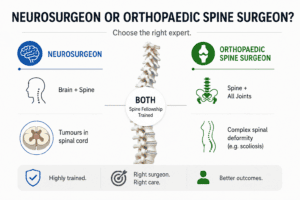
Which Surgeon Should You See for Your Spine Problem in Dubai?
Which Surgeon Should You See for Your Spine Problem in Dubai? Is a neurosurgeon always more qualified than an orthopaedic surgeon for spine conditions? No. Both pathways, when combined with
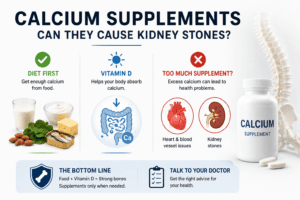
Can Calcium Supplements Cause Kidney Stones?
Can Calcium Supplements Cause Kidney Stones? If I have osteoporosis, should I take calcium supplements? This should be discussed specifically with your doctor, who will assess your individual dietary calcium

What Precision Medicine Means for Pain Management in Dubai
What Precision Medicine Means for Pain Management in Dubai How accurate is pharmacogenomic testing? Pharmacogenomic testing for well-established genetic variants, including CYP2D6 metaboliser status, is highly accurate and based on