
Cervical Myelopathy and Spondylolisthesis, A UAE Spine Surgeon Reflects

What are the risks of posterior cervical decompression surgery?
The main risks include neurological injury including worsening of myelopathy, infection, dural tear (cerebrospinal fluid leak), and in fusion cases, hardware failure or non-union. In elderly patients, anaesthetic risk and post-operative recovery are additional considerations. The risk-benefit balance is assessed individually for each patient.
How long does recovery take after cervical myelopathy surgery?
Most patients are mobile within a day or two of surgery. Return to normal activities takes four to eight weeks. Neurological recovery from myelopathy symptoms is variable: some patients improve significantly over months, others plateau at a level improved from their pre-operative state. Patients with severe myelopathy before surgery are less likely to achieve full recovery.
Is cervical myelopathy always treated with surgery?
Surgery is recommended when myelopathy is confirmed and progressive, or when there is significant functional impairment. Mild or stable myelopathy may be monitored, but the natural history tends toward deterioration, making surveillance rather than indefinite conservative management the usual approach for confirmed myelopathy.
Can HIV-positive patients safely undergo spinal surgery?
Yes. HIV-positive patients with well-controlled viral loads on antiretroviral therapy have surgical risk profiles broadly comparable to HIV-negative patients. Specific pre-operative assessment including viral load and CD4 count is standard, and the surgical team follows standard infection prevention precautions. HIV status alone is not a contraindication to spinal surgery.
What is the difference between cervical myelopathy and cervical radiculopathy?
Cervical myelopathy is compression of the spinal cord in the neck, producing upper motor neurone signs in the limbs, gait problems, and bladder dysfunction. Cervical radiculopathy is compression of a single nerve root leaving the neck, producing pain, weakness, and numbness in one arm. Both can coexist in the same patient (myeloradiculopathy).
How is spondylolisthesis at L3/4 different from the more common L4/5 level?
The clinical presentation is similar, but the specific nerve roots affected differ. L3/4 spondylolisthesis compresses the L3 and L4 nerve roots, producing anterior thigh and knee symptoms and a reduced knee jerk. L4/5 spondylolisthesis compresses L4 and L5 roots, producing medial leg, shin, and foot symptoms. The surgical approach is similar at both levels.
There are moments in a surgical career that define what the work actually demands. Not the routine cases where everything proceeds as expected, but the ones where the complexity, the stakes, and the uncertainty arrive simultaneously, on a day when you are new to the environment and have not yet established your footing.
Dr. Sherief Elsayed, Consultant Spine Surgeon in Dubai, describes his first day as a newly appointed consultant surgeon with a directness that says a great deal about the nature of surgical confidence, the weight of clinical responsibility, and what it means to be genuinely prepared for the unexpected.
The First Day
“On my very first day as a consultant spinal surgeon, brand new hospital, I had two cases, both big cases. One was an 82-year-old lady who had cervical myelopathy. So I had to open up her spinal cord from the back and remove the bone. And the next patient had spondylolisthesis at L3/4. So I had to put screws and rods in and it caved. Complex operation. And he was HIV positive. And so it was actually a really scary day. Thankfully, it progressed well. And several years later, here I am able to cope with most things.”
This account, offered without embellishment, contains several layers worth examining. The clinical details are precise. The emotional honesty is striking. And the conclusion, “several years later, here I am able to cope with most things,” reflects a hard-won confidence that is entirely different from the bravado of inexperience.
What Is Cervical Myelopathy?
Cervical myelopathy is compression of the spinal cord in the neck. It is the most common cause of acquired spinal cord dysfunction in adults over 55, and it is one of the most consequentially misdiagnosed and undertreated conditions in spine medicine.
The compression most commonly arises from a combination of factors:
- Disc herniation pressing on the cord from the front
- Osteophyte (bone spur) formation at the disc-vertebra interfaces
- Thickening of the ligamentum flavum from behind
- In some patients, a congenitally narrow cervical canal that leaves little reserve space and amplifies the effect of degenerative changes
Because the process is gradual, patients and their clinicians often attribute early myelopathy symptoms to ageing, arthritis, or peripheral nerve conditions. The diagnosis is frequently delayed.
Symptoms of cervical myelopathy:
- Progressive difficulty with fine motor tasks: buttoning shirts, handwriting, using cutlery
- Changes in gait: a wide-based, unsteady, or shuffling walk
- Weakness or clumsiness in the hands or legs
- Numbness in the hands, often described as feeling like wearing gloves
- Bladder urgency or incontinence in more advanced cases
- Lhermitte’s sign: an electric shock sensation running down the spine into the limbs on neck flexion
- Hyperreflexia: exaggerated deep tendon reflexes, particularly in the legs
- A positive Babinski sign
The danger of cervical myelopathy is that by the time symptoms are clearly recognisable, a significant degree of spinal cord damage may already have occurred. In the natural history of untreated myelopathy, most patients deteriorate over time, some plateau, and a minority improve spontaneously. The unpredictability of the natural history, combined with the irreversibility of cord injury, makes early surgical decompression the standard of care when myelopathy is confirmed.
The Surgery: Posterior Cervical Decompression
Dr. Sherief Elsayed describes the procedure for the 82-year-old: “I had to open up her spinal cord from the back and remove the bone.”
This describes a posterior cervical decompression, most commonly a laminectomy or laminoplasty.
Laminectomy: The laminae (the bony roof of the spinal canal at each vertebral level) are removed, expanding the available space for the spinal cord and relieving the compression from behind. When multiple levels are involved, a posterior cervical fusion is typically added to prevent instability created by removing the posterior bony elements.
Laminoplasty: An alternative technique in which the laminae are not removed but are instead opened like a hinged door, creating more space for the cord while preserving the posterior bony elements. This approach reduces the risk of post-laminectomy instability and is often preferred in patients without significant pre-existing deformity.
Operating on an 82-year-old patient with cervical myelopathy is technically demanding. For patients diagnosed with this condition, the Cervical Myelopathy Doctor in Dubai page covers the full treatment spectrum from conservative monitoring to surgical decompression. not only because of the cord proximity but because the elderly spine is often osteoporotic, with fragile bone that requires careful handling. The neurological stakes are high: inadequate decompression leaves the myelopathy uncorrected, while excessive manipulation of an already compromised cord can worsen function. The balance between achieving adequate decompression and maintaining cord stability throughout the procedure requires both technical precision and sound surgical judgement.
A Cervical Spine Doctor in Dubai managing cervical myelopathy will apply the same principles of careful decompression and cord protection whether the patient is young or elderly, though the specific surgical approach is tailored to the individual’s anatomy, bone quality, and degree of deformity.
What Is Spondylolisthesis?
The second case involved a patient with spondylolisthesis at L3/4. As detailed in the published article Not All Sciatica Comes From a Slipped Disc, spondylolisthesis refers to the forward slip of one vertebra over the one below.
At L3/4, this produces a combination of problems:
- Central canal stenosis from the forward shift of the spinal column, causing neurogenic claudication
- Foraminal stenosis at the affected level, compressing the exiting nerve roots and causing leg pain
- Segmental instability that worsens the mechanical component of the pain
The surgical solution is decompression with fusion: removing the compressive bone and ligament, decompressing the nerves, and stabilising the unstable segment with pedicle screws and rods. This is what Dr. Sherief Elsayed describes performing on his second case.
The phrase “it caved” refers to a challenging aspect of this surgery: the degree of slip and instability can make maintaining the corrected position while placing instrumentation technically demanding, particularly if the bone quality is reduced. The surgeon must achieve stable fixation in bone that may not be ideal while avoiding inadvertent injury to the neural structures that are the primary reason for the procedure.
The HIV-Positive Patient: A Note on Risk and Professionalism
Dr. Sherief Elsayed mentions that the second patient was HIV positive, and that this contributed to the day feeling “really scary.”
HIV-positive patients who are managed on antiretroviral therapy and have an undetectable or well-controlled viral load carry a very low risk of surgical site complications related to their HIV status and a negligible risk of transmission to the surgical team when standard precautions are followed. In the modern antiretroviral era, the prognosis and surgical risk profile of well-controlled HIV positive patients is broadly comparable to HIV-negative patients for elective procedures.
The acknowledgement of fear in this context is not clinical concern about increased risk. It is the honest recognition that on a first day in a new institution, with two large cases, in an unfamiliar environment, every additional variable adds to the psychological weight of the situation. A surgeon who denies ever feeling fear is a surgeon whose self-awareness should be questioned. A surgeon who acknowledges it, manages it, and delivers excellent care despite it is one worth trusting.
Imposter Syndrome and Surgical Confidence
Dr. Sherief Elsayed has spoken in other contexts about imposter syndrome in surgery – the experience of doubting one’s own competence despite objective evidence of capability. The first-day case described here is a classic context for that experience. New environment, complex cases, high stakes, and no track record at that institution to draw on.
The outcome, in this case, was good. “Thankfully, it progressed well.” But the progress was not a result of luck. It was the result of a training process that prepared a surgeon to handle exactly these situations, combined with the judgment to know when to proceed and how to proceed safely.
The sentence that follows is worth noting: “And several years later, here I am able to cope with most things.” Not all things. Most things. This is the measured confidence of someone who has learned the difference between genuine competence and omnipotence, and who understands that the former is achievable and the latter is not.
What This Means for Patients
Patients often wonder what their surgeon is feeling when they perform a complex procedure. They want their surgeon to be completely calm, completely confident, and entirely free of the uncertainty that the patient themselves feels. The reality is more nuanced.
A surgeon who never feels the weight of responsibility may not be taking that responsibility seriously enough. A surgeon who feels it but does not allow it to impair their technical execution is the one whose hands you want.
Dr. Sherief Elsayed’s account of his first day is a reminder that competence is not the absence of difficulty. It is the capacity to manage difficulty, to deliver safe and effective care even when the clinical environment is challenging, and to build, over time, the experience that allows complexity to be approached with the equanimity that patients rightfully expect. To discuss your specific spinal condition with a Consultant Spine Surgeon in Dubai (About Dr Sherief Elsayed – Consultant Spine Surgeon) who brings both technical expertise and clinical honesty to every consultation, a direct appointment is the starting point.
Table of Contents
Recent Articles
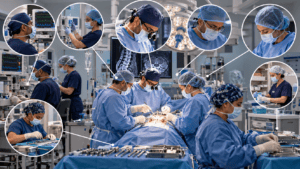
Why Eight People Were Needed for One Spine Surgery in Dubai
Why Eight People Were Needed for One Spine Surgery in Dubai Does every spinal surgery require exactly eight team members? No, as Dr. Sherief Elsayed explains directly, the specific team
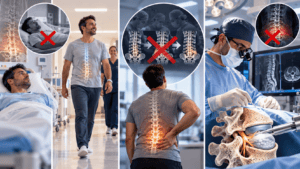
Three Spine Surgery Myths a Dubai Surgeon Wants You to Forget
Three Spine Surgery Myths a Dubai Surgeon Wants You to Forget Is it really safe to walk on the same day as spine surgery? Yes, for the majority of modern
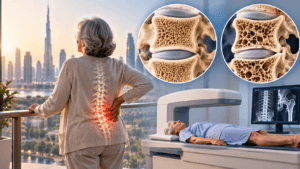
Why Osteoporosis Is Called the Silent Disease in the UAE
Why Osteoporosis Is Called the Silent Disease in the UAE If osteoporosis doesn’t cause pain, how would I know if I needed a DEXA scan? Given the entirely silent nature