
How UAE Spine Surgeons Keep Your Spinal Cord Safe During Surgery
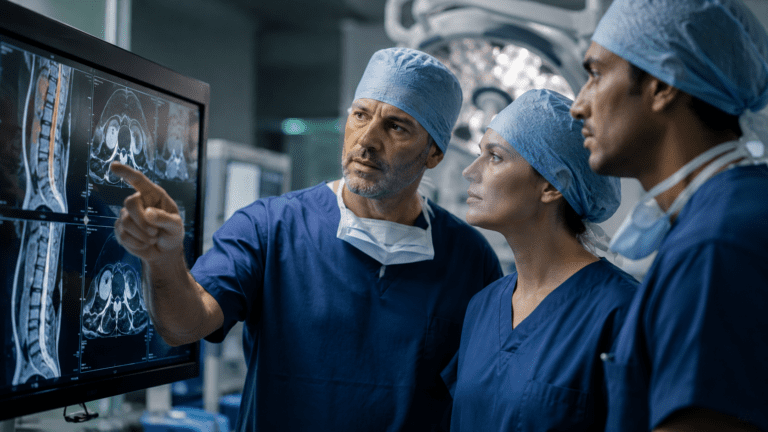
What happens if the spinal cord is accidentally injured during surgery?
The surgical team responds immediately: blood pressure is raised, any compressive instruments are removed, and steroids may be given. The neuromonitoring team alerts the surgeon to any signal change that precedes clinical deficit, allowing earlier intervention. Despite all protective measures, neurological injury is a recognised risk of spinal cord surgery and is discussed during the consent process.
How does blood pressure affect the spinal cord during surgery?
The spinal cord requires a minimum perfusion pressure to receive adequate blood flow. If blood pressure drops below a critical threshold, cord blood flow falls, oxygen delivery decreases, and ischaemic injury can develop. This is why the anaesthetic team maintains blood pressure above a specified target throughout high-risk procedures.
Is neuromonitoring used in all spinal surgeries?
Not all. Neuromonitoring is standard for procedures with significant spinal cord risk, particularly cervical and thoracic surgery, deformity correction, and revision procedures. For routine lumbar disc surgery and decompression at levels where only nerve roots are at risk, neuromonitoring is used selectively based on the specific risk profile of the case.
What are steroids used for in spinal cord surgery?
Steroids, particularly methylprednisolone, are used to stabilise cell membranes of neural tissue and reduce the inflammatory response that follows mechanical or ischaemic cord insult. They are most established in acute traumatic spinal cord injury and are used selectively in elective surgery based on the risk profile of the specific procedure.
How long does it take to know if the spinal cord has been protected successfully during surgery?
Neurological function is assessed as soon as the patient emerges from anaesthesia. Neuromonitoring provides continuous real-time assessment during the procedure. In the immediate post-operative period, a structured neurological examination confirms whether motor, sensory, and bladder/bowel function are intact. Any new deficit compared to the pre-operative baseline is investigated immediately.
Can the spinal cord recover if it is injured during surgery?
This depends on the severity and type of injury. Neuropraxia, a temporary loss of function from stretching or brief compression without structural damage, typically recovers fully over days to weeks. More significant injury with structural damage recovers less predictably and may be permanent in severe cases. Prompt recognition and management of intraoperative cord events maximises recovery potential.
Spinal surgery, by definition, operates in close proximity to the most critical neural structures in the body. The spinal cord controls movement in the limbs, sensation throughout the body, and the function of the bladder and bowel. Damaging it, even partially, can produce consequences that no amount of surgical skill can fully reverse. This is why protecting the spinal cord during surgery is not merely a technical concern but a fundamental principle that shapes every decision made before, during, and after the procedure.
Dr. Sherief Elsayed, Consultant Spine Surgeon in Dubai, explains the specific protective strategies applied during spinal cord surgery with the directness of someone for whom these considerations are a daily clinical reality.
Why Spinal Cord Protection Requires Active Management
The spinal cord, unlike most tissues, has a narrow tolerance for physiological disruption. It requires a consistent and adequate blood supply to maintain function, and it is vulnerable to both mechanical injury from direct trauma and ischaemic injury from reduced perfusion.
Dr. Sherief Elsayed explains the stakes: “Protecting the spinal cord during surgery is really important because as you all know, the spinal cord controls our bodies, arms and legs, our bladder and bowel function.”
This statement, simple as it is, frames why the protective strategies described below are not optional refinements but essential elements of the surgical plan for any procedure involving the spinal cord.
Strategy One: Maintaining Blood Pressure Throughout the Procedure
Blood supply to the spinal cord depends on adequate perfusion pressure. A Cervical Spine Surgeon in Dubai performing cord-proximity procedures will specify a target blood pressure with the anaesthetic team before surgery begins. If blood pressure drops significantly during surgery, spinal cord blood flow may fall below the threshold needed to maintain function, producing ischaemic injury even without any direct mechanical contact with the cord.
Dr. Sherief Elsayed describes this as a primary protective measure: “We maintain a good blood pressure to ensure that the spinal cord has a good blood supply throughout the procedure. We try and avoid dips in blood pressure.”
The anaesthetic team plays a central role here. Monitoring blood pressure continuously, typically through an arterial line that provides beat-to-beat readings rather than intermittent cuff measurements, allows the anaesthetist to detect and correct any hypotensive episode immediately. In complex spinal cord surgery, a target mean arterial pressure (MAP) is specified before surgery begins, typically above 85 to 90 mmHg, to ensure adequate cord perfusion throughout.
This is particularly important during spinal cord procedures. Patients can learn more about the anaesthetic management side of this from the General Anaesthesia vs Sedation article published on this blog.
- Position changes, particularly moving from supine to prone, where blood pressure can transiently drop
- Periods of significant blood loss
- The most technically demanding phases of the decompression, when retraction and manipulation near the cord are at their peak
For patients who arrive at surgery with pre-existing cardiovascular conditions, particularly hypertension where the cord may have adapted to higher perfusion pressures, the target MAP may be set even higher to account for this.
Strategy Two: Steroids for Cell Membrane Stabilisation
Methylprednisolone and other corticosteroids have a specific role in protecting the spinal cord from injury during high-risk procedures. Dr. Sherief Elsayed explains the mechanism: “Sometimes we use steroids, which help to stabilise the cell membranes of the spinal cord and prevent injury.”
Steroids act at the cellular level, reducing the inflammatory cascade that propagates neural damage following mechanical or ischaemic insult. By stabilising cell membranes and reducing oedema (swelling) within the cord tissue, they help to limit the extent of injury when the cord is at risk.
The use of steroids in spinal cord surgery is protocol-dependent and not applied universally. Their use is most established in the context of acute traumatic spinal cord injury, where methylprednisolone given within hours of injury has shown benefit in specific patient populations in clinical trials, though this indication remains subject to ongoing clinical debate. In elective spinal cord surgery, their use is tailored to the specific risk profile of the procedure and the patient.
Strategy Three: Surgical Technique and Avoiding Direct Cord Contact
Perhaps the most fundamental protective strategy is the one that requires no pharmacology or monitoring equipment: surgical precision.
Dr. Sherief Elsayed identifies this directly: “Surgical technique, making sure that we don’t ding the spinal cord accidentally is also crucially important.”
The word “accidentally” is important here. Spinal cord injury in elective surgery is not typically the result of a deliberate action but of an inadvertent contact, excessive retraction, a moment of imprecise dissection, or a haemostatic measure applied too close to the cord surface.
Technical elements that protect the spinal cord:
- Maintaining a clear and bloodless surgical field so that anatomical structures are always visible before instruments approach them
- Using microsurgical technique with magnification to work with precision in the confined space of the spinal canal
- Minimising retraction on the cord and nerve roots, since sustained retraction reduces local blood flow in addition to the direct mechanical risk
- Using ultrasonic or motorised cutting instruments rather than manual chisels in the bony decompression to avoid transmitted force to the cord
- Confirming adequate decompression before closing, so that the cord is not left with residual compression that was not addressed
The relationship between the surgeon’s hands and the cord is, in a fundamental sense, what all the monitoring and pharmacological strategies are supporting. Neuromonitoring catches the unexpected. Technique prevents it.
Strategy Four: Intraoperative Neuromonitoring
While Dr. Sherief Elsayed does not mention neuromonitoring explicitly in this transcript, it is an integral part of spinal cord protection in modern surgical practice and warrants inclusion as a connected strategy.
Intraoperative neuromonitoring continuously tracks the functional integrity of the spinal cord and nerve roots. At specialist centres where a UAE Spinal Cord Specialist operates, this monitoring is standard for all high-risk cord procedures. of the spinal cord and nerve roots throughout the procedure. Two main modalities are used:
Somatosensory evoked potentials (SSEPs): An electrical stimulus is applied to a peripheral nerve and the response is recorded at the brain, reflecting the integrity of the ascending sensory pathways through the cord. A significant decrease in amplitude or increase in latency alerts the surgical team that the sensory pathways are under stress.
Motor evoked potentials (MEPs): A magnetic or electrical stimulus is applied to the brain and the resulting muscle responses in the limbs are recorded, reflecting the integrity of the descending motor pathways. MEPs are particularly sensitive to motor tract injury.
When either modality shows a significant change during surgery, the team responds immediately: blood pressure is raised if it has dropped, any recently placed retractors or instruments are repositioned, and the surgical approach is reassessed. In this way, neuromonitoring converts a potentially irreversible event into a recoverable near-miss.
A Spinal Cord Surgeon in Dubai performing procedures at risk to the cord will use neuromonitoring as standard, not as an optional addition.
When These Strategies Are Most Critical
Not all spinal surgery carries equal spinal cord risk. The strategies above are most actively applied in:
Cervical spine surgery: The cervical spinal cord is narrower in its canal than the thoracic or lumbar cord, leaving less reserve space around it. Operations for cervical myelopathy, cervical disc herniation with cord compression, and cervical tumours all carry significant cord proximity risk.
Thoracic spine surgery: The thoracic cord has the most tenuous blood supply of any cord segment, relying largely on the anterior spinal artery with fewer collateral contributions than at other levels. Operations in the thoracic spine, particularly for tumours or deformity correction, require the most stringent blood pressure management.
Deformity correction: Scoliosis and kyphosis correction procedures move the spine and cord from a deformed position toward a corrected one. The cord may be tethered or adapted to the deformed configuration, making sudden corrective movements a potential cord injury risk. Neuromonitoring is essential throughout these procedures.
Revision surgery: Scar tissue from previous spinal operations obliterates the normal anatomical planes, making the cord and nerve roots harder to identify and protect. The risk of inadvertent cord contact is higher in revision cases than in primary procedures.
The article General Anaesthesia vs Sedation, What Every Patient in Dubai Should Know Before Surgery covers the anaesthetic management that supports these protective strategies in more detail.
Pre-Operative Optimisation: Protecting the Cord Before Surgery Begins
Spinal cord protection starts before the patient enters the operating theatre. Several pre-operative factors directly influence cord vulnerability during surgery.
Anaemia: Low haemoglobin reduces the oxygen-carrying capacity of the blood that perfuses the cord. Patients with significant anaemia before major spinal cord surgery are optimised with iron supplementation or, where time allows, with erythropoietin-stimulating agents to build red cell mass before the procedure.
Medications: Certain medications that lower blood pressure (antihypertensives) or affect coagulation (antiplatelet agents, anticoagulants) require specific management in the peri-operative period to avoid intraoperative hypotension or haemorrhage that would compromise cord perfusion.
Pre-operative imaging: Detailed review of the preoperative MRI and CT identifies the specific anatomy of the cord compression, any areas of cord signal change (suggesting pre-existing vulnerability), and the surgical anatomy that needs to be navigated.
Expert Summary
Protecting the spinal cord during surgery is a multi-layered commitment that begins with pre-operative planning and ends only when the patient has been safely recovered from anaesthesia. Blood pressure management, steroid administration, and surgical precision work in combination, each addressing a different vulnerability.
Dr. Sherief Elsayed’s direct acknowledgment that surgical technique, the avoidance of accidental cord contact, is “crucially important” reflects the humility of an experienced surgeon who knows that all the monitoring and pharmacology in the world cannot substitute for the careful, deliberate movements that keep the cord safe moment by moment in the operating field.
Table of Contents
Recent Articles
Why Eight People Were Needed for One Spine Surgery in Dubai
Why Eight People Were Needed for One Spine Surgery in Dubai Does every spinal surgery require exactly eight team members? No, as Dr. Sherief Elsayed explains directly, the specific team
Three Spine Surgery Myths a Dubai Surgeon Wants You to Forget
Three Spine Surgery Myths a Dubai Surgeon Wants You to Forget Is it really safe to walk on the same day as spine surgery? Yes, for the majority of modern

Why Osteoporosis Is Called the Silent Disease in the UAE
Why Osteoporosis Is Called the Silent Disease in the UAE If osteoporosis doesn’t cause pain, how would I know if I needed a DEXA scan? Given the entirely silent nature