
How Long Can a Compressed Nerve Wait Before Surgery? A Dubai Spine Surgeon Answers

My sciatica has been present for three months. Is it too late for surgery to help?
Three months of sciatica without neurological deficit is within the window where conservative management is still appropriate and where natural resorption may still occur. If conservative measures have been properly tried and have not provided adequate relief, surgical assessment is reasonable. The presence and degree of any neurological deficit is the key factor in determining how useful surgery is likely to be at this stage.
I have foot drop. How urgent is this?
Foot drop represents a significant motor deficit (weakness of ankle dorsiflexion, typically from L4 or L5 nerve root compression) and should be assessed urgently. The duration of the foot drop matters: recent onset foot drop, particularly if rapidly progressive, benefits most from early decompression. Longstanding stable foot drop is a different situation, though surgical assessment remains appropriate.
Can a nerve recover fully after surgery?
Recovery depends on the severity and duration of compression before decompression. Nerves compressed for a short period by a disc herniation often recover well, with strength and sensation returning over weeks to months. Nerves compressed significantly for a long time before decompression recover less completely and more slowly. This is the primary reason why acting quickly when neurological deficit is present or progressive is so important.
Is it safe to exercise with nerve compression?
In most cases, appropriate exercise is safe and beneficial. Exercises that provoke or worsen neurological symptoms should be avoided. Your physiotherapist can guide the appropriate programme for your specific nerve level and symptom pattern.
How will I know if my conservative treatment is working?
Pain levels can fluctuate with conservative management. The key markers of improvement are: neurological symptoms (weakness, numbness) that are stable or improving, not worsening; increasing walking tolerance and functional capacity; and reducing reliance on pain medication over time. If neurological symptoms are worsening despite conservative management, this indicates progression and warrants surgical review.
What is the success rate of surgery for nerve compression?
For carefully selected patients with confirmed nerve compression on imaging that correlates with their clinical symptoms, the success rate for relief of leg or arm pain (radicular symptoms) is high. Back or neck pain outcomes are less predictable. Results are best in patients who have not had prolonged significant neurological deficit before surgery.
One of the most common questions patients with spinal nerve compression ask is how long they have. How long can they wait before trying surgery? Is it safe to attempt physiotherapy and injections first, or does delay make things worse? The answer depends entirely on the clinical picture, and there is one finding that changes the calculus completely.
Dr. Sherief Elsayed, Consultant Spine Surgeon in Dubai, gives a clear and clinically precise answer that cuts through the confusion many patients feel when navigating this decision.
The Central Principle: Progression Changes Everything
The most important distinction in the management of nerve compression is not the severity of pain. It is whether neurological function is deteriorating.
Dr. Sherief Elsayed states this directly: “Spine surgery becomes urgent if you have progressive neurological deficit. That means that if you have some weakness and it’s getting worse, then your surgery is urgent. If you don’t have weakness, by and large, it’s not super urgent. Depends on what it is, of course. But any sign or suggestion that things are progressing, urgent surgery, tell your surgeon right away.”
This is the clinical rule that governs urgency in spinal nerve compression. Pain alone, however severe, is not the primary surgical trigger. Progressive neurological loss is.
Why Progression Matters: The Biology of Nerve Recovery
The reason progression changes urgency is rooted in the biology of nerve tissue. Unlike most tissues in the body, nerve fibres have a limited capacity for recovery once they have been significantly damaged by sustained compression.
Dr. Sherief Elsayed explains the surgical reality honestly: “The reason for that is that the longer a nerve is compressed, the less likely it is to recover. As a surgeon, I can take the pressure off the nerve, but I can’t tell it to behave itself. So that’s why it’s really important to promptly decompress the nerve.”
This statement captures something important. Surgery decompresses the nerve. It removes the structural cause of the problem. But it cannot reverse neurological damage that has already occurred. A nerve that has been significantly compressed for a prolonged period may not recover full function even after technically perfect surgical decompression.
The implication is direct: when neurological function is declining, operating quickly maximises the chance of recovery. Operating after significant, prolonged neurological deficit has set in may stabilise the situation but is less likely to restore what has already been lost.
What Does Progressive Neurological Deficit Look Like?
Patients often ask how they would know if they have a progressive neurological deficit. The signs are identifiable with self-observation, though clinical assessment is always required to confirm them.
Motor signs – worsening weakness:
- A foot that increasingly drags or catches when walking
- Difficulty rising from a chair or climbing stairs that is getting worse over days or weeks
- Dropping objects from a hand that you were previously able to hold
- Weakness when gripping, pinching, or performing fine motor tasks that is progressively declining
Sensory signs – worsening numbness:
- An area of numbness that is expanding over time
- Loss of sensation that is spreading from the foot into the calf, or from the hand into the forearm
Bladder or bowel changes:
- Any new difficulty initiating urination, incomplete bladder emptying, or urinary incontinence
- Any change in bowel function that is new and unexplained
Any of these features developing or worsening over hours to days demands prompt contact with your spine surgeon. The window for optimising recovery narrows with each passing day.
When Conservative Management Is Appropriate
The flip side of the urgency principle is equally important. Without progressive neurological deficit, the majority of patients with disc herniation and nerve compression can and should attempt conservative management first.
The natural history of disc herniation is favourable. As covered in the article Why Your Legs Feel Heavy and Painful When You Walk, many patients with nerve compression from disc herniations experience significant improvement over six to twelve weeks as the body’s immune response reduces the size of the herniation and nerve inflammation settles.
Conservative management typically includes:
- Structured physiotherapy with nerve mobilisation and targeted strengthening
- Anti-inflammatory and nerve pain medication
- Epidural steroid injection for acute radiculopathy, which can reduce nerve root inflammation and provide meaningful pain relief that supports rehabilitation
- Activity modification to reduce provocation without complete rest
A structured conservative programme should be given an adequate trial, typically six to twelve weeks, before surgical assessment is sought in patients without neurological deficit. This is not passive waiting. It is an active, supervised process that addresses the inflammatory and mechanical components of the problem while the disc’s natural resorption takes place.
Special Situations: When Urgency Applies Even Without Clear Weakness
There are situations where surgical urgency applies even when frank weakness is not yet present.
Cauda equina syndrome: Any patient with lower back pain who develops new changes in bladder or bowel function, numbness in the groin or inner thighs (saddle anaesthesia), or bilateral leg symptoms requires emergency assessment. This is a surgical emergency regardless of pain level or the presence of weakness, because the window for recovery from cauda equina compression is measured in hours.
Severe uncontrolled pain: Occasionally, pain from nerve compression is so severe and unresponsive to all conservative measures that early surgical decompression becomes appropriate even in the absence of neurological deficit. This is a minority situation but is a legitimate indication when the clinical picture warrants it.
Rapid progression with very recent onset: When neurological signs have developed rapidly over hours, the urgency is higher than when the same degree of deficit has been present and stable for weeks. Rapid onset suggests an acute mechanical compression that may respond well to decompression if addressed quickly.
The Consent Conversation: What to Discuss With Your Surgeon
When you and your surgeon are deciding on timing for spinal surgery, the conversation should address several specific questions.
What to ask:
- Is there any neurological deficit present now, and if so, is it stable or progressive?
- Based on my imaging and examination, how urgent is the intervention?
- What is the likely natural history if I attempt conservative management for the next six to twelve weeks?
- What specific signs would indicate that things are deteriorating and that I should contact you urgently?
- What is the risk to neurological recovery if there is a delay of two to four weeks to allow a short trial of conservative care?
A surgeon who is willing to answer these questions clearly and honestly is one whose recommendation can be trusted. The guidance from When Is Spine Surgery Wrong? A Dubai Surgeon Explains covers the decision-making framework in full and complements the timing question directly.
UAE-Specific Context
In Dubai’s private healthcare environment, patients sometimes feel pressure, from themselves or from others, to resolve their problem quickly. The cultural and professional environment in the UAE places high value on productivity and rapid return to function. This can create a tendency toward earlier operative intervention than the clinical evidence supports.
Understanding that conservative management for the appropriate period is not delay but rather the correct clinical approach. A pine Nerve Specialist in Dubai can confirm whether your situation warrants urgent surgery or a structured conservative programme., and that the urgency threshold is defined by neurological progression rather than pain severity, helps patients make better decisions and avoid unnecessary surgery.
Equally, patients in the UAE who do develop progressive weakness should not delay seeking assessment because of work commitments, insurance pre-authorisation processes, or reluctance to acknowledge the urgency of the situation. When a nerve is progressively failing, time is directly translating into recovery potential. A Consultant Spine Surgeon in Dubai who understands this principle will communicate it clearly and act accordingly.
Expert Summary
The answer to “how long can a compressed nerve wait?” is: as long as there is no progressive neurological deficit, and no longer than that once progression begins.
Conservative management is appropriate and effective for the majority of patients without neurological deficit. A Sciatica Assessment Doctor in Dubai can structure this pathway correctly, ensuring the right treatment is applied at each stage. It should be given a proper trial. But when weakness is developing, when sensory loss is spreading, or when bladder or bowel function is changing, the clinical calculus changes immediately. Decompressing the nerve promptly is the only intervention that preserves the potential for recovery, because no amount of rehabilitation can restore function in a nerve that has been irreversibly damaged by prolonged compression.
Table of Contents
Recent Articles
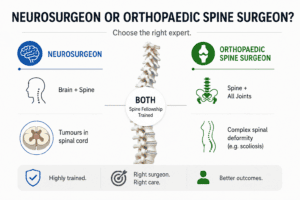
Which Surgeon Should You See for Your Spine Problem in Dubai?
Which Surgeon Should You See for Your Spine Problem in Dubai? Is a neurosurgeon always more qualified than an orthopaedic surgeon for spine conditions?No. Both pathways, when combined with dedicated

Can Calcium Supplements Cause Kidney Stones?
Can Calcium Supplements Cause Kidney Stones? If I have osteoporosis, should I take calcium supplements? This should be discussed specifically with your doctor, who will assess your individual dietary calcium

What Precision Medicine Means for Pain Management in Dubai
What Precision Medicine Means for Pain Management in Dubai How accurate is pharmacogenomic testing? Pharmacogenomic testing for well-established genetic variants, including CYP2D6 metaboliser status, is highly accurate and based on