
Why Your Thigh Pain Might Be a Spine Problem - UAE Spine Surgeon
Can thigh pain be the only symptom of a spine problem with no back pain at all?
Yes, this occurs more commonly than many people realise. Some patients with lumbar disc herniations or stenosis experience leg symptoms including thigh pain without significant back pain. This happens because the disc material or narrowing primarily affects the nerve root rather than causing local inflammation in back structures. The nerve root compression produces symptoms in the thigh where the nerve travels, but you may never develop significant back pain. This can make diagnosis challenging because neither patients nor some healthcare providers consider spinal causes when back pain is absent.
How quickly should I expect improvement if my thigh pain comes from a spine problem?
This varies significantly depending on the specific cause and treatment approach. Disc herniations often improve gradually over 6 to 12 weeks as your body naturally reabsorbs herniated material. Injections may provide relief within days to weeks. Spinal stenosis, being a structural narrowing problem, may not improve significantly with conservative treatment, though symptoms can be managed. If you undergo surgery for appropriate indications, leg symptoms typically improve quickly, often within days, though complete recovery takes weeks to months. Your doctor can give you more specific timelines based on your particular diagnosis.
Should I avoid exercise if I have thigh pain from my spine?
Not necessarily. While you should avoid movements that significantly worsen your symptoms, gentle movement and appropriate exercise generally support recovery rather than hindering it. Complete rest is rarely beneficial for spine problems. The key is working with a physiotherapist or spine specialist to identify safe exercises and gradually progress activity as tolerated. Some exercises may actually help reduce nerve compression and accelerate recovery. However, high-impact activities, heavy lifting, or movements that reproduce symptoms should be avoided until you have improved.
Can stress or psychological factors cause thigh pain that seems to come from the spine?
Psychological factors influence pain perception and can amplify symptoms from real structural problems, but they rarely cause symptoms completely independent of physical pathology. Stress, anxiety, and depression all lower pain thresholds and make existing problems feel worse. However, if comprehensive evaluation reveals genuine structural pathology like disc herniation or stenosis compressing a nerve, this physical problem requires appropriate physical treatment. Addressing psychological contributors alongside physical treatment often improves outcomes, but psychological interventions alone cannot resolve problems caused by structural nerve compression.
Is surgery always necessary if imaging shows a disc pressing on a nerve?
No, definitely not. Many disc herniations visible on MRI scans improve with conservative treatment because your body naturally reabsorbs herniated material over time. Surgery becomes necessary only if you develop red flag symptoms like severe weakness or bladder problems requiring urgent intervention, or if your symptoms remain significantly disabling despite 6 to 12 weeks of appropriate conservative treatment. Even with clear nerve compression visible on scans, if your symptoms are manageable and improving, surgery is not indicated. The presence of a herniation on imaging does not automatically mean you need surgery.
Can my thigh pain from a spine problem become permanent?
Most patients with spine-related thigh pain improve significantly, either naturally or with treatment. However, some people develop chronic symptoms. Factors associated with better outcomes include younger age, acute onset rather than gradual development, early appropriate treatment, maintaining activity levels, and absence of psychological complications like catastrophic thinking about the condition. Even if some discomfort persists long-term, most patients achieve satisfactory function. Severe, permanent disability is uncommon with appropriate management. Early specialist assessment and treatment optimises your chances of complete recovery.
When you experience pain in your thigh, the natural assumption is that the problem lies somewhere in your thigh itself. Perhaps a muscle strain from exercise, a bruise from an impact, or a joint issue at the hip or knee. Yet many patients who visit my spine clinic in Dubai are surprised to discover that their persistent thigh pain actually originates from their lower back or neck, despite never experiencing significant back or neck discomfort.
This disconnect between where you feel pain and where the problem actually exists is one of the fascinating aspects of spine medicine. Understanding this connection helps explain why treating your thigh muscles or joints directly sometimes provides no relief, and why proper diagnosis by a spine specialist can finally resolve symptoms that have puzzled you and other healthcare providers for months.
As a consultant spine surgeon practising across the UAE, I regularly see patients who have spent considerable time and resources treating their thigh pain locally, only to find lasting relief once we address the underlying spinal cause. This article explores how spine problems cause thigh pain, which specific conditions to consider, how to distinguish spinal-origin thigh pain from local causes, and when specialist assessment becomes necessary.
How Can Your Spine Cause Pain in Your Thigh?
The connection between your spine and thigh pain lies in the anatomy of your nervous system. Nerves that exit your spine do not simply stop at your back. They travel through your pelvis and into your legs, carrying both sensory information from your skin and muscles back to your brain, and motor commands from your brain to your leg muscles.
Your lumbar spine, the lower back region, contains five vertebrae labelled L1 through L5. At each level, nerve roots branch off from the spinal cord and exit through small openings on both sides. These nerve roots eventually join together to form the major nerves supplying your entire lower limb.
Specifically, the L2, L3, and L4 nerve roots combine to form the femoral nerve, which provides sensation to the front and inner thigh and controls the quadriceps muscles that straighten your knee. The upper lumbar nerve roots also contribute to the lateral femoral cutaneous nerve, which supplies sensation to the outer thigh.
When something compresses, irritates, or inflames these nerve roots in your spine, you can feel pain anywhere along the nerve’s distribution path. The pain might manifest primarily in your thigh despite the actual problem being centimetres away in your lower back. This phenomenon, called radicular pain or radiculopathy when accompanied by other neurological symptoms, explains why back problems cause leg symptoms.
Your cervical spine, or neck, can also contribute to thigh pain through more complex mechanisms. Although cervical nerves primarily supply the arms, severe spinal cord compression in the neck can affect walking patterns and leg function, occasionally producing thigh discomfort, though this is less common than lumbar causes.
Think of it like an electrical circuit. If you damage a wire near the power source, the problem manifests wherever that wire provides power. Similarly, nerve compression near the spine produces symptoms distant from the compression site.
What Spine Conditions Cause Thigh Pain?
Several spinal pathologies can produce thigh pain as a primary or accompanying symptom.
Lumbar disc herniation:
When the soft inner material of an intervertebral disc pushes through a tear in the tough outer layer, it can compress nearby nerve roots. If this herniation occurs at the L2-L3, L3-L4, or L4-L5 levels and compresses the corresponding nerve roots, you may experience pain radiating into your thigh.
L2 or L3 nerve root compression typically causes pain in the front of your thigh, sometimes extending down to your knee. L4 nerve root compression produces pain that may radiate down the front and inner thigh, and patients often describe weakness when straightening the knee or difficulty climbing stairs.
Unlike sciatica treatment in Dubai (Sciatica Treatment in Dubai – Fast Symptom Relief), which affects the back of the thigh and lower leg, upper lumbar disc herniations affect the front and side of the thigh. This distinction helps identify which spinal level is involved.
Spinal stenosis:
As we age, the spinal canal and the foramina through which nerves exit can narrow due to degenerative changes including disc height loss, facet joint arthritis, and ligament thickening. When this narrowing becomes significant enough to compress nerves, the condition is called spinal stenosis.
Spinal stenosis treatment in Dubai (Spinal Stenosis Treatment in Dubai) becomes necessary when narrowing produces symptoms. Patients with lumbar stenosis often describe thigh pain or heaviness that develops with walking and improves with rest or forward bending. This pattern, called neurogenic claudication, occurs because walking extends the spine slightly, further narrowing an already tight canal, while forward bending or sitting opens the canal and relieves pressure.
The thigh symptoms from stenosis are often bilateral, affecting both legs, though one side may be worse than the other. Many patients describe their thighs feeling heavy, weak, or painful after walking a certain distance, forcing them to stop and rest.
Meralgia paraesthetica:
This specific condition involves compression of the lateral femoral cutaneous nerve, a purely sensory nerve supplying the outer thigh. While compression can occur along the nerve’s course, often where it passes under the inguinal ligament in the groin, spinal pathology at the upper lumbar levels can also affect this nerve before it even exits the pelvis.
Patients with meralgia paraesthetica typically describe burning pain, tingling, or numbness on the outer thigh. Symptoms often worsen with standing or walking and improve when sitting. Unlike radiculopathy from disc herniation, there is no motor weakness because this is a sensory-only nerve.
The condition can be triggered or worsened by factors including tight clothing, prolonged standing, weight gain, pregnancy, or diabetes, but underlying spinal stenosis or disc problems at L2-L3 can predispose to this syndrome.
Lumbar radiculopathy:
This term describes a constellation of symptoms including pain, numbness, tingling, or weakness occurring when a nerve root is compressed or inflamed. The L2, L3, and L4 radiculopathies all present with various patterns of thigh involvement.
L2 radiculopathy causes pain and numbness in the upper, inner thigh. L3 radiculopathy affects the mid-thigh region, both front and inner aspects. L4 radiculopathy produces symptoms in the front of the thigh extending to the inner shin and occasionally the inner ankle.
Each radiculopathy has associated motor findings. L2 and L3 radiculopathies may cause hip flexor weakness, making it difficult to lift your thigh toward your chest. L4 radiculopathy typically produces quadriceps weakness, manifesting as difficulty straightening your knee, weakness going downstairs, or instability when standing from a seated position.
Facet joint arthritis:
The facet joints are small joints at the back of your spine that guide spinal movement. Like any joint, they can develop arthritis with age or following injury. Arthritic facet joints become inflamed and painful, and importantly, they have nerve supplies that can refer pain to distant sites.
Lumbar facet joint pain commonly refers into the buttock, hip, and thigh. The pattern is typically a deep, aching discomfort rather than the sharp, shooting pain of nerve root compression. Facet pain worsens with spinal extension, movements like arching backward, and often increases with prolonged standing or walking.
Referred pain from degenerative disc disease:
Even without frank disc herniation, degenerated discs can be painful. The pain mechanism involves inflammation of sensitised nerve endings within the disc itself and surrounding tissues. This pain frequently refers into the buttocks, hips, and thighs through complex neurological pathways not fully understood.
Cervical degenerative disc disease treatment in Dubai (Cervical Degenerative Disc Disease Treatment in Dubai) addresses similar processes in the neck, while lumbar degenerative disc disease requires different management strategies tailored to the lower back.
Spondylolisthesis:
This condition involves one vertebra slipping forward relative to the vertebra below. The slippage can narrow the spinal canal and foramina, compressing nerves. Spondylolisthesis treatment in Dubai (Spondylolisthesis Treatment in Dubai) depends on the severity of slippage and resulting nerve compression.
Patients with spondylolisthesis may experience thigh pain either from direct nerve compression or from referred pain patterns. The pain often worsens with activities that extend the spine, like walking downhill or standing for prolonged periods.
How Is Spine-Origin Thigh Pain Different from Local Thigh Problems?
Distinguishing between thigh pain originating from your spine versus local causes like muscle strains, hip arthritis, or vascular problems requires careful clinical assessment. However, certain features suggest a spinal origin.
Pain distribution patterns:
Spinal-origin pain typically follows specific anatomical pathways called dermatomes. L2 radiculopathy affects the upper inner thigh in a relatively narrow band. L3 affects the mid-thigh, L4 the front thigh and inner shin. These patterns are fairly consistent across patients.
Local muscle strains produce pain in the affected muscle belly and worsen with use of that specific muscle. Hip arthritis causes groin pain that worsens with hip movements like putting on shoes or getting out of cars. Vascular problems cause pain with walking that improves immediately upon stopping, unlike neurogenic claudication which requires several minutes of rest.
Associated symptoms:
Spine-origin pain often accompanies other neurological symptoms including numbness, tingling, or burning sensations in specific distributions. You might notice that light touch feels different on the affected thigh compared to the other side, or that the area feels slightly numb even when not painful.
Motor symptoms provide strong clues. Weakness when straightening your knee, difficulty climbing stairs, or a sensation that your leg might give way all suggest nerve involvement from spinal pathology rather than local thigh problems.
Positional factors:
Pain from spinal stenosis characteristically improves with forward bending. Patients often report that leaning on a shopping cart while walking allows them to walk farther than usual, or that they can cycle long distances despite struggling to walk for ten minutes. This occurs because forward bending increases the spinal canal diameter and reduces nerve compression.
Conversely, spinal extension, movements like arching your back, often worsens stenosis symptoms and facet-mediated pain. If your thigh pain consistently improves with forward bending and worsens with backward bending, a spinal origin is likely.
Response to treatment:
If you have tried local treatments including rest, ice, physiotherapy focused on thigh muscles, or anti-inflammatory medications without improvement, this suggests the problem may not be local. Conversely, if spinal-directed treatments like specific back exercises, epidural injections, or manipulation provide unexpected improvement in thigh symptoms, this confirms spinal origin.
Examination findings:
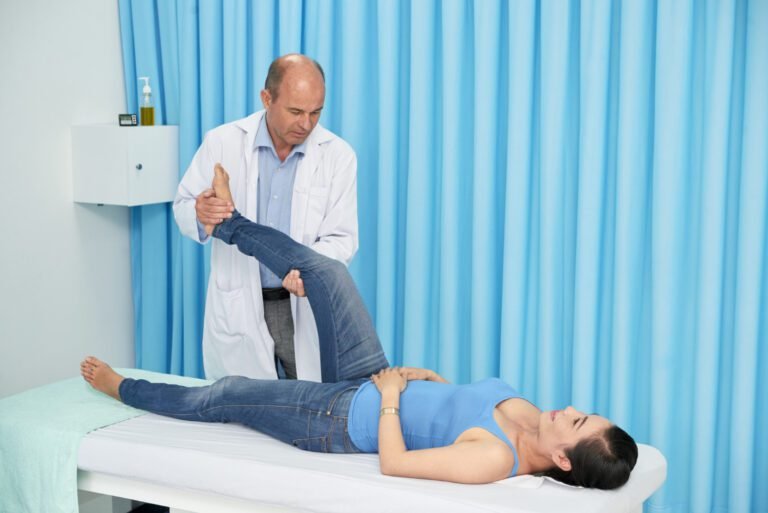
A thorough physical examination can usually differentiate spinal from non-spinal causes. Spine specialists perform specific tests including straight leg raising, femoral nerve stretch tests, reflexes, sensation mapping, and muscle strength testing that reveal patterns consistent with nerve root involvement.
Hip examination, gait analysis, and vascular assessment help exclude non-spinal causes. The combination of history, symptom pattern, and examination findings typically provides clear diagnostic direction.
What Does Dr. Sherief Elsayed Look for When Assessing Thigh Pain?
When patients present to my clinic with thigh pain, I follow a systematic approach that considers both spinal and non-spinal causes.
Comprehensive history:
I begin by understanding your symptoms in detail. Where exactly do you feel pain? Is it constant or intermittent? What makes it better or worse? Have you noticed any numbness, tingling, or weakness? Does the pain wake you at night? Have you had any recent injuries or new activities?
Questions about bladder and bowel function, unexplained weight loss, fever, or night sweats help identify red flags suggesting serious pathology like infection or tumour that requires urgent investigation.
I also explore your daily activities, occupation, and hobbies. Certain activities predispose to specific problems. For example, drivers and desk workers commonly develop lumbar disc problems, while heavy labourers face different risk profiles.
Physical examination:
Examination begins with observation. How do you walk? Is there a limp or altered gait pattern? Do you struggle to rise from a chair or remove your shoes? These observations provide clues before formal testing begins.
I examine your spine, assessing range of motion and identifying positions that reproduce your symptoms. I then perform neurological testing including muscle strength assessment in multiple groups, reflex testing, and sensation mapping to identify which, if any, nerve roots are affected.
Specific provocative tests help localise pathology. The straight leg raise test assesses sciatic nerve tension. The femoral nerve stretch test, performed by extending the hip with the patient lying face down, reproduces L2, L3, or L4 radiculopathy symptoms if those nerves are compressed.
Hip examination, including range of motion testing and specific manoeuvres, helps exclude hip arthritis as the pain source. Palpation of peripheral pulses and assessment for vascular insufficiency identifies circulatory problems.
The examination findings must correlate with your symptom description. If examination reveals L3 radiculopathy signs, but your pain does not follow an L3 distribution, I remain suspicious and investigate further rather than accepting a convenient but incorrect diagnosis.
Imaging interpretation:
Many patients arrive having already obtained MRI scans, often of their hip or thigh looking for local pathology. I review these but understand their limitations. A normal hip MRI does not exclude spine problems, and conversely, seeing age-related changes in the hip does not prove those changes cause your symptoms.
If spinal pathology is suspected but not yet imaged, I order appropriate studies. Plain X-rays show bony alignment and can identify fractures, spondylolisthesis, or severe disc space collapse. MRI scans provide detailed images of discs, nerves, and soft tissues, helping identify herniations, stenosis, or other pathology.
Critically, I interpret imaging in clinical context. MRI studies of asymptomatic people commonly show disc bulges, facet arthritis, and mild stenosis. The question is not whether abnormalities exist but whether they explain your specific symptoms. I correlate imaging findings with examination and symptom patterns to determine the true pain generator.
Treatment philosophy:
My approach prioritises accurate diagnosis before treatment. Treating symptoms without understanding their cause leads to frustration and wasted resources.
Once diagnosis is established, treatment follows a logical progression:
Conservative management first: For most spinal causes of thigh pain, conservative treatment forms the initial approach. This includes appropriate pain medications, activity modification, and physiotherapy focused on the correct area. For example, if your thigh pain stems from L3 nerve root compression, physiotherapy should address lumbar spine mechanics, not thigh muscles.
Core strengthening, postural correction, and specific exercises that reduce nerve compression often provide significant relief over weeks to months. Many patients improve with this approach alone.
Targeted interventions when needed: If conservative measures provide insufficient relief, I consider more targeted interventions. For radiculopathy, image-guided nerve root blocks (Nerve Root Block – Diagnostic & Therapeutic Injection) can provide both diagnostic confirmation and therapeutic benefit. If the injection temporarily eliminates your thigh pain, it confirms that this specific nerve root is the source.
For facet-mediated pain, lumbar facet joint injections (Lumbar Facet Joint Injections – Targeted Treatment) serve a similar purpose. For meralgia paraesthetica, local nerve blocks where the nerve passes through the groin can be both diagnostic and therapeutic.
Surgical options when appropriate: Surgery becomes necessary when conservative treatment fails and symptoms significantly impact quality of life, or when there are red flag features like progressive weakness suggesting urgent need for nerve decompression.
Operative treatments (Operative Treatments – Advanced Spine Surgery) for lumbar pathology might include microdiscectomy to remove herniated disc material compressing a nerve, laminectomy to decompress stenosis, or fusion procedures for unstable spondylolisthesis.
The decision to pursue surgery is always shared. I explain what surgery can and cannot achieve, realistic recovery timelines, and potential risks. Not all pain resolves completely with surgery, and setting appropriate expectations is crucial for patient satisfaction.
When Should You Suspect Your Thigh Pain Is Actually a Spine Problem?
Several features suggest your thigh pain warrants evaluation by a spine specialist rather than continued treatment focused on the thigh itself.
Pain patterns that suggest spinal origin:
- Pain in a strip or band distribution rather than diffuse thigh pain
- Pain accompanied by numbness, tingling, or burning in specific areas
- Pain that radiates from back or buttock into thigh
- Pain that changes significantly with spinal position, improving with forward bending or worsening with backward bending
- Bilateral thigh symptoms that develop with walking and improve with rest
Associated features warranting concern:
- Weakness in your leg, difficulty climbing stairs, or feeling that your leg might give way
- Changes in sensation, areas of numbness or altered feeling
- Pain that wakes you from sleep, particularly if it improves with getting up and moving
- Symptoms that have progressively worsened over weeks to months
- Lack of improvement despite appropriate local treatment
Red flag symptoms requiring urgent assessment:
While most thigh pain from spine problems does not represent an emergency, certain symptoms indicate potentially serious pathology:
- Severe or rapidly progressive leg weakness
- Numbness in the groin, inner thighs, or genital area
- New bladder or bowel control problems
- Pain accompanied by fever, chills, or unexplained weight loss
- Severe pain following significant trauma
- Symptoms in both legs simultaneously, particularly if progressive
These red flags may indicate conditions requiring urgent intervention including cauda equina syndrome (Cauda Equina Syndrome – Urgent Spinal Care), spinal infection, or tumour.
Can Physical Therapy Help If My Thigh Pain Comes from My Spine?
Absolutely. In fact, physiotherapy represents a cornerstone of conservative treatment for most spinal causes of thigh pain. However, the therapy must address the correct problem.
If your thigh pain originates from L3 nerve root compression, exercises focused on strengthening your quadriceps or stretching your thigh muscles will not address the underlying issue. The physiotherapy programme needs to target lumbar spine mechanics, posture, and core stability.
Effective spine-focused physiotherapy includes:
Education and activity modification: Understanding which positions and movements aggravate your symptoms allows you to modify activities accordingly. Your physiotherapist can teach you neutral spine positions, proper lifting techniques, and strategies to reduce nerve compression during daily activities.
Specific exercises: Certain exercises help reduce nerve compression. For example, flexion-based exercises that round the lower back slightly can increase spinal canal diameter and reduce stenosis symptoms. Extension exercises might help disc problems where the herniation is located anteriorly rather than posteriorly.
Core strengthening: Strong abdominal and back muscles support your spine and reduce load on discs and facet joints. Progressive core strengthening forms a foundation for long-term spinal health.
Manual therapy: Skilled manual techniques including mobilisation and manipulation can sometimes provide symptom relief, though their effects are typically temporary without accompanying exercise and strengthening programmes.
Functional training: As symptoms improve, therapy progresses to functional exercises that prepare you to return to work, sports, and daily activities without symptom recurrence.
The key is working with a physiotherapist who understands spinal pathology and can tailor treatment to your specific diagnosis. Generic exercise programmes rarely address the nuanced mechanics of different spinal conditions.
Are There Non-Spine Causes of Thigh Pain That Mimic Spine Problems?
Yes, several conditions can produce thigh pain patterns that overlap with spinal causes, making accurate diagnosis essential.
Hip arthritis:
Osteoarthritis of the hip typically causes groin pain but frequently refers pain into the front thigh and occasionally down to the knee. Unlike spinal-origin pain, hip arthritis pain worsens specifically with hip movements including walking, climbing stairs, putting on shoes, or getting in and out of cars.
Examination reveals reduced hip range of motion and pain with hip rotation. X-rays show characteristic joint space narrowing and bone changes. Treatment focuses on the hip joint itself, potentially including injections or hip replacement rather than spine-directed therapy.
Vascular claudication:
Peripheral arterial disease reduces blood flow to leg muscles. When you walk, muscles require increased blood flow, and if arteries cannot deliver adequate blood, you develop cramping pain called claudication. This typically affects the calves but can involve thighs in severe disease.
Unlike neurogenic claudication from spinal stenosis, vascular claudication improves immediately upon stopping walking, symptoms do not vary with spinal position, and peripheral pulses are diminished or absent. Vascular studies confirm the diagnosis.
Greater trochanteric pain syndrome:
Previously called trochanteric bursitis, this condition involves pain on the outer hip and thigh related to inflammation of tendons attaching to the greater trochanter, the bony prominence you can feel on the outside of your hip.
Pain is localised to the outer hip and thigh, worsens with lying on the affected side, and does not follow nerve distribution patterns. Local tenderness over the greater trochanter is present. Treatment includes rest, physiotherapy, and sometimes local steroid injections.
Muscle strains:
Quadriceps or hamstring strains produce pain during muscle use and tenderness over the affected muscle. There is typically a history of sudden onset during athletic activity. Pain improves with rest and worsens with specific movements that stress the injured muscle.
Femoral nerve entrapment:
The femoral nerve can be compressed as it passes under the inguinal ligament in the groin, producing symptoms similar to L2-L4 radiculopathy. However, the compression site is in the groin rather than the spine. Examination often reveals local tenderness in the groin, and symptoms may respond to local nerve blocks.
Referred pain from internal organs:
Occasionally, problems with internal organs including kidneys, intestines, or reproductive organs can refer pain to the thigh. This is uncommon but emphasises the importance of thorough evaluation when thigh pain does not fit typical patterns.
Distinguishing between these various causes requires clinical expertise and sometimes multiple investigations. This is why persistent, unexplained thigh pain warrants comprehensive evaluation rather than assumption that the cause is necessarily local.
What Lifestyle Factors Affect Spine Health and Thigh Pain?
Several modifiable factors influence spine health and your likelihood of developing problems that produce thigh pain.
Body weight: Excess weight increases mechanical load on lumbar discs and facet joints, accelerating degeneration and increasing herniation risk. Weight loss in overweight individuals often provides significant symptom relief and may prevent progression of degenerative changes.
Physical fitness: Regular exercise that includes core strengthening, flexibility work, and cardiovascular fitness supports spinal health. Strong core muscles reduce disc and facet joint loading. Cardiovascular fitness improves blood flow to spinal structures, supporting healing and maintaining healthy tissue.
Smoking: Cigarette smoking impairs blood flow to intervertebral discs, accelerating degeneration. Smokers have higher rates of back pain, disc herniations, and poor surgical outcomes. Smoking cessation benefits spine health along with every other organ system.
Occupation and ergonomics: Jobs requiring prolonged sitting, heavy lifting, or repetitive bending increase spine stress. Optimising workplace ergonomics, taking regular breaks from sustained postures, and using proper lifting techniques reduce injury risk.
Posture habits: Chronic poor posture, particularly flexed sitting postures common during computer work or phone use, increases disc pressure and can contribute to herniation over time. Postural awareness and regular position changes help.
Sleep quality: Poor sleep quality and insufficient sleep worsen pain perception and reduce your body’s ability to heal damaged tissues. Addressing sleep problems forms an important part of comprehensive spine care.
Stress and psychological factors: Chronic stress, anxiety, and depression all influence pain perception and recovery from spine problems. Addressing psychological contributors improves outcomes for many patients with chronic spine pain.
While you cannot control factors like age and genetics that influence spine health, optimising modifiable factors provides significant benefits.
Conclusion
Thigh pain that seems to arise from nowhere, does not respond to local treatment, or accompanies unusual symptoms like numbness or weakness should prompt consideration of a spinal origin. The connection between your spine and legs through the nervous system means that problems at your back can produce symptoms in distant locations.
Understanding this relationship helps explain why you might experience persistent thigh discomfort despite normal hip X-rays or failed trials of thigh-focused physiotherapy. The problem may lie not where you feel it, but several centimetres away in your lumbar spine.
Accurate diagnosis is essential. Treatment focused on the wrong area provides little benefit and delays appropriate care. If your thigh pain has features suggesting spinal origin, assessment by a spine specialist can identify the true cause and guide effective treatment.
Most spinal causes of thigh pain respond well to conservative management including appropriate medications, targeted physiotherapy, and sometimes image-guided injections. Surgery becomes necessary only for specific indications when conservative treatment has failed or when there are red flag features requiring urgent intervention.
Whether your thigh pain began recently or has troubled you for months, proper evaluation can provide answers and direct you toward effective treatment. Do not accept unexplained, persistent pain as normal or untreatable. Effective options are available once the correct diagnosis is established.
Table of Contents
Recent Articles
How Dr. Sherief Elsayed Spots Spinal Tumours Before Paralysis Sets In
How Dr. Sherief Elsayed Spots Spinal Tumours Before Paralysis Sets In If I have no symptoms, why would a tumour on my spine need urgent treatment? The absence of symptoms
Why a Custom 3D Scanned Brace Works Better for Scoliosis in Dubai
Why a Custom 3D Scanned Brace Works Better for Scoliosis in Dubai Is 3D scanning for scoliosis braces widely available in Dubai? 3D scanning for brace manufacture is available at
What Happens When a Spine Cage Is Placed in the Wrong Position?
What Happens When a Spine Cage Is Placed in the Wrong Position? How is cage malpositioning diagnosed? Post-operative imaging is essential. Plain X-rays can identify obvious cage malpositioning. CT scanning