
Can You Diagnose a Slipped Disc Without MRI? Dr. Sherief Elsayed Explains
How accurate is clinical diagnosis compared to MRI for detecting a slipped disc?
Studies show that experienced spine surgeons can accurately diagnose a slipped disc through clinical examination with approximately 85-90% accuracy when symptoms are classic. The straight leg raise test, combined with neurological examination, is particularly reliable for lumbar disc herniations. However, MRI provides additional information about the size, location, and severity of herniation, as well as other spine conditions that might be present. Dr. Sherief Elsayed uses clinical diagnosis to guide initial treatment and orders MRI when it will change management decisions or when red flags are present.
If I don't have an MRI, how will the doctor know if I need surgery?
The decision for surgery is based primarily on your symptoms and examination findings, not just MRI appearance. Dr. Sherief Elsayed considers surgery when there are red flags like progressive weakness or cauda equina syndrome, or when severe symptoms persist despite 6-12 weeks of appropriate conservative treatment. If surgery becomes a consideration, an MRI would be ordered at that point to plan the procedure. However, most patients with slipped discs recover without surgery, so many never need an MRI at all.
Can a slipped disc heal on its own without knowing exactly what the MRI shows?
Yes, absolutely. Your body has a natural ability to heal herniated discs. Over time, the herniated material can shrink as it’s reabsorbed by the body, and inflammation around the nerve settles down. This healing occurs whether or not you have an MRI. The most important factors for healing are: reducing activities that worsen symptoms, maintaining gentle movement to promote circulation, strengthening exercises as tolerated, and addressing underlying factors like poor posture or weak core muscles. Dr. Sherief Elsayed’s conservative treatment approach supports this natural healing process.
What if my symptoms don't match what the clinical examination suggests?
This is when MRI becomes particularly valuable. While clinical examination is highly accurate for typical cases, some situations involve multiple issues, unusual anatomy, or overlapping conditions. If your symptoms seem out of proportion to examination findings, if treatment based on clinical diagnosis isn’t helping, or if something doesn’t fit the usual pattern, Dr. Sherief Elsayed would order an MRI to get a complete picture. His experience includes handling complex spine cases where the diagnosis isn’t straightforward, and he knows when additional imaging is necessary.
Are there any risks to starting treatment based on clinical diagnosis without an MRI?
When performed by an experienced spine surgeon who carefully screens for red flags, starting conservative treatment based on clinical diagnosis is safe and follows evidence-based guidelines. The key is proper monitoring. If symptoms worsen despite treatment, or if red flags develop, Dr. Sherief Elsayed would immediately reassess and order appropriate imaging. Conservative treatments like physiotherapy, anti-inflammatory medications, and activity modification carry minimal risks and often provide relief while avoiding the costs and potential anxiety of unnecessary imaging.
How long should I wait before getting an MRI if conservative treatment isn't working?
Most spine specialists, including Dr. Sherief Elsayed, recommend giving conservative treatment 6 to 12 weeks before ordering an MRI for persistent symptoms without red flags. This timeline is based on research showing that many disc herniations improve within this period. However, if you develop red flags at any time (loss of bladder/bowel control, progressive weakness, severe pain), an MRI should be done immediately. If your pain is severe and significantly affecting your quality of life, Dr. Sherief Elsayed might recommend an MRI earlier to consider options like epidural steroid injections or surgery, ensuring treatment is personalized to your specific situation.
When you experience sharp leg pain or persistent lower back discomfort, you might wonder: do I have a slipped disc? And more importantly, do you always need an MRI scan to find out?
Dr. Sherief Elsayed, a senior UK-trained spinal surgeon practicing in Dubai, UAE, brings over 25 years of medical experience to answer this common question. His approach focuses on understanding the root cause of your symptoms rather than rushing to imaging tests. As he often tells his patients: “Pain is a symptom, not a diagnosis.”
In this article, you’ll learn how spine specialists can often identify a slipped disc through clinical examination alone, when an MRI becomes necessary, and what this means for patients seeking spine care in the UAE.
What Exactly Is a Slipped Disc and Why Does It Matter?
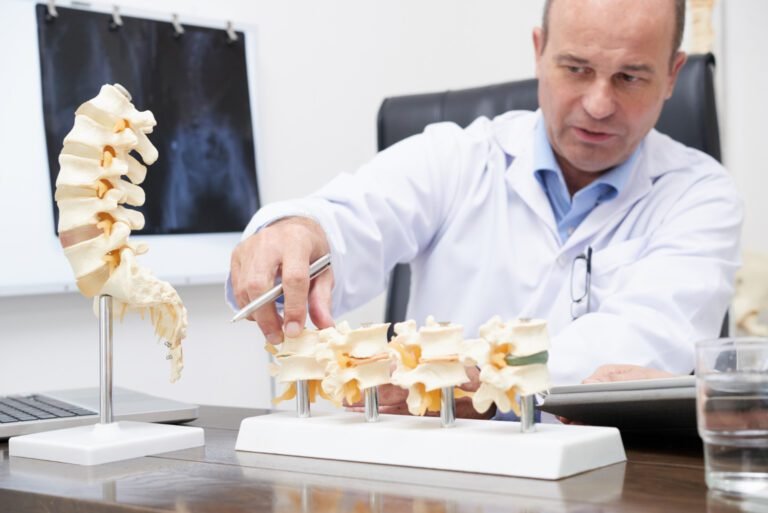
A slipped disc, medically known as a herniated disc or prolapsed disc, occurs when the soft inner material of a spinal disc pushes through its tough outer layer. Think of it like a jam donut being squeezed until the filling bursts out from one side.
Your spine contains 23 discs that act as cushions between your vertebrae (back bones). When a disc herniates, it can press on nearby nerves, causing pain that radiates down your leg (sciatica), numbness, tingling, or weakness. However, not every slipped disc causes symptoms, and not every back pain comes from a slipped disc.
For patients in Dubai and across the UAE, understanding this distinction matters because it affects your treatment path. Dr. Sherief Elsayed emphasizes that proper diagnosis comes from understanding your complete clinical picture, not just looking at an MRI image.
How Can Doctors Tell If You Have a Slipped Disc Without an MRI?
Dr. Sherief Elsayed uses a comprehensive clinical assessment that often reveals a slipped disc before any imaging is performed. This approach follows the same evidence-based protocols used in leading UK spine centers.
The Clinical History: Your Story Matters
The diagnostic process begins with understanding your symptoms in detail:
Pattern of Pain: Slipped discs typically cause pain that travels down one leg, following a specific nerve path. If your pain started in your lower back and then moved into your buttock, thigh, calf, or foot, this suggests nerve involvement.
How It Started: Did the pain begin after lifting something heavy? After bending or twisting? Or did it develop gradually over weeks? A slipped disc often has a clear triggering event, though not always.
What Makes It Worse or Better: Pain from a slipped disc usually worsens when sitting, bending forward, coughing, or sneezing. These activities increase pressure inside the disc. Many patients find relief when standing or lying down.
Time of Day: Many people with slipped discs experience worse pain in the morning. This happens because discs absorb fluid overnight, making them larger and more likely to press on nerves.
For example, a 38-year-old Dubai-based office worker might describe pain that started after moving furniture, initially felt in the lower back, but then traveled down the back of the right leg to the foot over the next few days. This classic pattern strongly suggests a herniated disc, even before any physical examination.
What Physical Tests Can Reveal a Slipped Disc?
Dr. Sherief Elsayed performs specific physical examination tests that can indicate nerve compression from a herniated disc with remarkable accuracy.
The Straight Leg Raise Test
This is one of the most reliable tests for diagnosing a lumbar (lower back) slipped disc. You lie on your back while the doctor slowly lifts your leg, keeping it straight. If this reproduces your leg pain (not just back pain) before reaching 60 degrees, particularly if the pain shoots down below your knee, this strongly suggests a herniated disc pressing on the sciatic nerve.
The test works because lifting your leg stretches the sciatic nerve. If a disc is pressing on this nerve, the stretch increases the pressure and reproduces your symptoms.
Neurological Examination
Dr. Sherief Elsayed carefully examines three key aspects of nerve function:
Muscle Strength: He tests specific muscle groups in your legs. For instance, can you stand on your toes? Can you stand on your heels? Can you lift your big toe against resistance? Weakness in specific muscles indicates which nerve root might be compressed.
Reflexes: Using a reflex hammer, he checks the knee jerk and ankle jerk reflexes. A reduced or absent reflex on one side suggests nerve compression at a specific spinal level.
Sensation: He tests feeling in different areas of your legs and feet. Each area of skin is supplied by a specific nerve root. Numbness or altered sensation in a particular pattern helps identify which disc might be herniated.
For example, numbness on the top of your foot and weakness when lifting your foot upward typically indicates a herniation at the L4-L5 disc level. Numbness on the outer side of your foot with difficulty standing on your toes suggests an L5-S1 disc herniation.
Posture and Movement Assessment
Dr. Sherief Elsayed also observes how you move and stand. Patients with acute disc herniations often:
- Lean to one side to relieve nerve pressure
- Have difficulty bending forward
- Walk with an altered gait
- Show muscle spasm in the lower back
These observations add important pieces to the diagnostic puzzle.
When Is Clinical Diagnosis Enough and When Do You Need an MRI?
Here’s where Dr. Sherief Elsayed’s philosophy of personalized spine care becomes particularly important. As he explains: “We treat the person, not the scan.”
When Clinical Diagnosis May Be Sufficient
If your symptoms and physical examination clearly indicate a slipped disc, and you don’t have any warning signs (red flags), you may not need an immediate MRI. Instead, Dr. Sherief Elsayed typically recommends starting with conservative treatment:
- Physiotherapy focused on reducing nerve irritation
- Anti-inflammatory medications
- Activity modification (avoiding positions that worsen pain)
- Specific exercises to promote disc healing
- Postural correction and ergonomic advice
Many slipped discs improve within 6 to 12 weeks with conservative care. Research shows that most patients with herniated discs recover without surgery, as the body gradually absorbs the herniated disc material.
For UAE residents working in offices across Dubai, Abu Dhabi, or Sharjah, this means you might avoid unnecessary scanning costs while still receiving effective treatment based on clinical diagnosis.
When You Definitely Need an MRI
Dr. Sherief Elsayed always orders an MRI when certain red flags are present, as these could indicate serious complications:
Red Flag: Loss of Bladder or Bowel Control
This could indicate cauda equina syndrome, a medical emergency where the nerves at the base of your spine are severely compressed. This requires immediate MRI and potentially urgent surgery within 24 to 48 hours to prevent permanent damage.
Red Flag: Numbness in Inner Thighs or Groin Area (Saddle Anesthesia)
This is another warning sign of cauda equina syndrome. If you cannot feel yourself when using the bathroom, or you have numbness where you would sit on a saddle, seek immediate medical attention.
Red Flag: Progressive Weakness
If your leg weakness is getting worse despite rest, or if you develop foot drop (cannot lift your foot properly when walking), this indicates ongoing nerve damage that may require surgical intervention.
Red Flag: Severe Pain After Trauma
If your back pain started after a fall, car accident, or other significant injury, an MRI helps rule out fractures, unstable injuries, or other structural damage.
When an MRI Helps Plan Treatment
Even without red flags, Dr. Sherief Elsayed recommends an MRI in certain situations:
- Symptoms persist beyond 6 weeks despite appropriate conservative treatment
- Pain is severe and significantly affecting your quality of life
- You’re considering epidural steroid injections (the MRI helps guide the injection)
- Surgery might be necessary (the MRI provides the surgical roadmap)
- There’s uncertainty about the diagnosis after clinical examination
The MRI doesn’t just confirm a slipped disc, it also shows:
- The exact location and size of the herniation
- Which nerve root is compressed
- Whether there are other spine problems (like spinal stenosis or arthritis)
- The condition of other discs
- Any unexpected findings that might explain your symptoms
Why Does Dr. Sherief Elsayed Focus on Clinical Diagnosis First?
Dr. Sherief Elsayed’s approach reflects current best practices in spine care worldwide. Here’s why clinical diagnosis comes first:
MRI Findings Don’t Always Match Symptoms
Research shows that many people without any back pain have herniated discs visible on MRI. One famous study found that about 30% of 20-year-olds with no symptoms had disc bulges on MRI, and this percentage increases with age.
As Dr. Sherief Elsayed explains: “Every spine is different. Every treatment should be, too.” An MRI might show multiple disc abnormalities, but only a thorough clinical examination can determine which one, if any, is actually causing your current symptoms.
Clinical Assessment Guides Treatment
The severity of your symptoms, the degree of nerve involvement, and how much the condition affects your daily life matter more than the size of a disc herniation on MRI. A small herniation pressing on a nerve in just the right spot can cause severe symptoms, while a large herniation might cause minimal problems.
Dr. Sherief Elsayed’s comprehensive assessment includes:
- Your medical history and lifestyle factors
- Your work environment (especially relevant for UAE office workers)
- Your activity level and fitness
- Previous spine problems
- Your goals and expectations for treatment
This holistic view helps create a personalized treatment plan that addresses root causes, not just symptoms.
Avoiding Unnecessary Worry
MRI reports can be frightening when you read terms like “herniation,” “degeneration,” or “disc desiccation.” However, many of these findings are normal age-related changes that don’t require treatment.
Dr. Sherief Elsayed believes in clear communication and shared decision-making. He helps patients understand which MRI findings are relevant to their symptoms and which are simply incidental findings that many people have without problems.
What Happens During a Comprehensive Spine Assessment With Dr. Sherief Elsayed?
Understanding what to expect can help UAE patients prepare for their consultation.
Step 1: Detailed History Taking
Dr. Sherief Elsayed spends time understanding:
- Your exact symptoms: where, when, how severe
- Your lifestyle: occupation, exercise habits, hobbies
- Your workspace ergonomics (critical for Dubai’s large office-working population)
- Previous treatments you’ve tried
- Your overall health and any other medical conditions
Step 2: Physical Examination
As described earlier, this includes:
- Observation of posture and movement
- Specific tests for nerve compression
- Neurological examination (strength, reflexes, sensation)
- Assessment of spine flexibility and painful movements
- Examination of related areas (hips, pelvis) that might contribute to symptoms
Step 3: Discussion and Shared Decision-Making
Based on the clinical findings, Dr. Sherief Elsayed discusses:
- His clinical impression of what’s causing your pain
- Whether imaging is necessary now or can wait
- The recommended treatment approach
- What to expect in terms of recovery timeline
- Warning signs to watch for
This is where his patient-first philosophy shines. As he often says: “Surgery is not the first step. It is the right step only when necessary.”
The Treatment Pathway: Conservative to Advanced
Dr. Sherief Elsayed follows a stepped approach:
Step 1: Conservative Care (first 6-12 weeks for most patients)
- Physiotherapy with exercises to reduce nerve pressure
- Anti-inflammatory medications
- Activity modification and ergonomic improvements
- Education about the condition and self-management
- Possibly epidural steroid injections if symptoms are severe
Step 2: Minimally Invasive Options (if conservative care doesn’t provide adequate relief)
- Microdiscectomy: removing the herniated portion through a small incision
- Endoscopic discectomy: even less invasive, using a tiny camera and instruments
Step 3: Advanced Surgical Options (rarely needed for simple disc herniations)
- Disc replacement for select cases
- Fusion surgery if there’s instability
- Revision surgery if previous surgery didn’t resolve the problem
The vast majority of patients with slipped discs never need surgery. Studies show that about 90% of people improve with conservative treatment alone.
What About Special Imaging Tests Besides MRI?
While discussing imaging, it’s worth mentioning other tests that might be considered:
X-rays
X-rays don’t show slipped discs because discs are soft tissue. However, X-rays can show:
- Alignment of your spine
- Height of disc spaces (narrowing might indicate disc degeneration)
- Bony abnormalities or fractures
- Arthritis of the spine joints
Dr. Sherief Elsayed sometimes orders X-rays as an initial test, especially after trauma or when evaluating spine alignment.
CT Scans
CT scans provide detailed images of bone but are less useful for discs and nerves. They’re sometimes used:
- When MRI cannot be performed (if you have certain metal implants)
- To evaluate bony anatomy before surgery
- After trauma to check for fractures
Nerve Conduction Studies and EMG
These electrical tests measure nerve function. Dr. Sherief Elsayed might recommend them when:
- There’s uncertainty about which nerve root is affected
- Symptoms might come from nerve problems elsewhere (like carpal tunnel or peripheral neuropathy)
- He needs to assess the severity and timeline of nerve damage
Real Patient Scenarios: When Clinical Diagnosis Was Enough
Scenario 1: The Office Worker
Ahmed, a 42-year-old IT professional working in Dubai Marina, developed lower back pain that traveled down his left leg after playing football on the weekend. He could barely walk by Monday morning.
Dr. Sherief Elsayed’s examination showed a positive straight leg raise test, reduced ankle reflex on the left, and mild weakness when standing on his left toes. The clinical diagnosis: L5-S1 disc herniation with S1 nerve root compression.
Treatment started immediately with physiotherapy, anti-inflammatory medication, and activity modification. No MRI was ordered initially. After three weeks, Ahmed’s leg pain reduced by 70%. At six weeks, he returned to work comfortably. At three months, he was back to playing football, and the MRI that was never ordered saved him unnecessary expense and worry.
Scenario 2: The Warehouse Manager
Fatima, a 35-year-old warehouse manager in Jebel Ali, experienced severe lower back pain after lifting boxes incorrectly. The pain shot down her right leg, and she noticed numbness on the top of her foot.
Clinical examination revealed weakness when lifting her right foot upward and numbness in the L5 distribution. The diagnosis was clear: L4-L5 disc herniation.
However, after two weeks of conservative treatment, Fatima’s leg weakness was getting worse. This progressive weakness was a red flag. Dr. Sherief Elsayed immediately ordered an MRI, which confirmed a large disc herniation with significant nerve compression. She underwent a successful microdiscectomy, and her strength returned within weeks.
This case shows why clinical assessment remains essential even when MRI is eventually needed. The changing clinical picture (progressive weakness) prompted the imaging, not the initial symptoms.
What Should UAE Patients Do If They Suspect a Slipped Disc?
If you’re experiencing symptoms that might indicate a slipped disc:
Seek Proper Assessment
Don’t self-diagnose based on internet searches or assume you need an MRI. A proper clinical examination by an experienced spine specialist like Dr. Sherief Elsayed provides valuable diagnostic information and guides appropriate treatment.
Watch for Red Flags
Seek urgent medical attention if you experience:
- Loss of bladder or bowel control
- Numbness in inner thighs or groin area
- Progressive weakness in your legs
- Severe pain after trauma
- Symptoms in both legs simultaneously
Start with Conservative Care
Unless red flags are present, most slipped discs respond well to conservative treatment. This approach:
- Avoids unnecessary medical costs
- Prevents surgical risks
- Promotes natural healing
- Often provides lasting relief
Be Patient But Persistent
Disc herniations take time to heal, usually 6 to 12 weeks. However, if your symptoms aren’t improving or are worsening despite appropriate treatment, follow up with your spine specialist to reassess.
Focus on Root Causes
Work with your healthcare provider to identify what contributed to your disc herniation:
- Poor lifting technique
- Prolonged sitting with bad posture
- Weak core muscles
- Sedentary lifestyle
- Workplace ergonomics
Addressing these factors helps prevent recurrence, which is important because having one disc herniation increases your risk of another.
Dr. Sherief Elsayed’s Expert Perspective on Diagnosis and Treatment
Drawing on his extensive training at Cardiff University, his fellowship in complex spine surgery at the Centre for Spinal Studies & Surgery in Nottingham, and his years as Lead Clinician for Spinal Surgery at Brighton & Sussex University Hospitals in the UK, Dr. Sherief Elsayed brings world-class expertise to patients in the UAE.
His key messages about diagnosing slipped discs without MRI include:
“Pain is a symptom, not a diagnosis. A thorough clinical examination reveals the underlying cause and guides appropriate treatment, whether that’s conservative care, minimally invasive procedures, or advanced surgery.”
“Most patients with a slipped disc don’t need immediate MRI or surgery. The body has remarkable healing capacity when given proper support through physiotherapy, medication, and lifestyle modification.”
“Every spine is different. Every treatment should be, too. Cookie-cutter approaches don’t serve patients well. I spend time understanding your unique situation, your lifestyle, and your goals before recommending a treatment path.”
“We treat the person, not the scan. MRI findings must be interpreted in the context of your symptoms and examination findings. Not every abnormality on MRI needs treatment.”
This philosophy has helped countless patients in Dubai and across the UAE avoid unnecessary procedures while still receiving expert care that addresses their spine problems effectively.
Conclusion
Can you diagnose a slipped disc without an MRI? The answer is often yes. An experienced spine surgeon like Dr. Sherief Elsayed can identify a herniated disc through comprehensive clinical assessment, including detailed history-taking and specific physical examination tests.
However, this doesn’t mean MRI is never needed. When red flags are present, when conservative treatment fails, when surgery is being considered, or when there’s diagnostic uncertainty, MRI provides valuable information that guides treatment decisions.
The key is starting with proper clinical assessment by a qualified spine specialist who understands when imaging is necessary and when it can be safely avoided. This approach saves patients time, money, and unnecessary worry while ensuring that serious conditions are identified promptly.
If you’re experiencing back pain with leg symptoms, numbness, or weakness, the most important step is to get a proper assessment. Understanding the cause of your pain is the first step toward effective treatment and recovery.
Table of Contents
Recent Articles
Which Surgeon Should You See for Your Spine Problem in Dubai?
Which Surgeon Should You See for Your Spine Problem in Dubai? Is a neurosurgeon always more qualified than an orthopaedic surgeon for spine conditions?No. Both pathways, when combined with dedicated

Can Calcium Supplements Cause Kidney Stones?
Can Calcium Supplements Cause Kidney Stones? If I have osteoporosis, should I take calcium supplements? This should be discussed specifically with your doctor, who will assess your individual dietary calcium

What Precision Medicine Means for Pain Management in Dubai
What Precision Medicine Means for Pain Management in Dubai How accurate is pharmacogenomic testing? Pharmacogenomic testing for well-established genetic variants, including CYP2D6 metaboliser status, is highly accurate and based on